- contact@insightserviceai.com
AI agents
Agents that prepare the complaint, and people who decide it
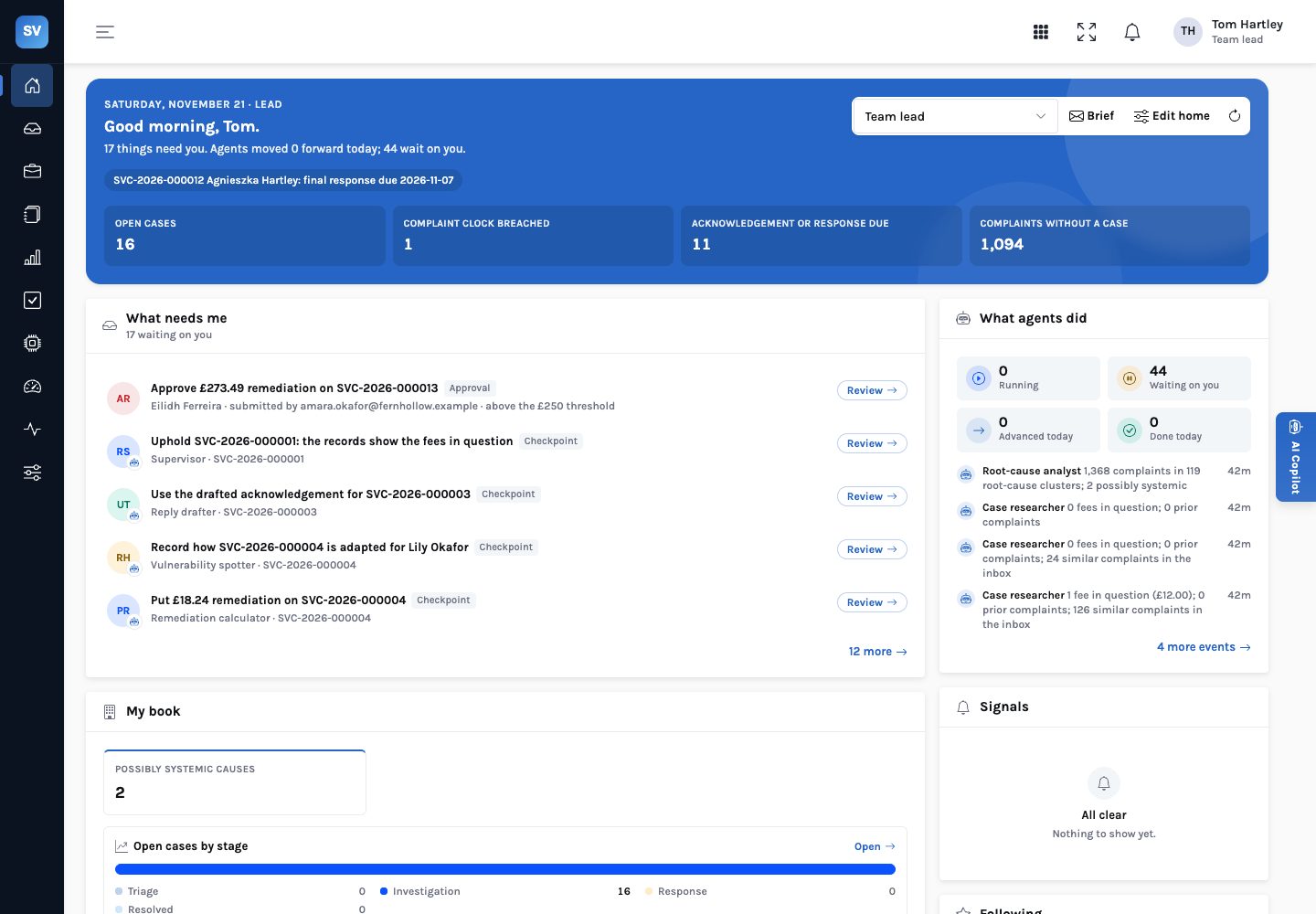
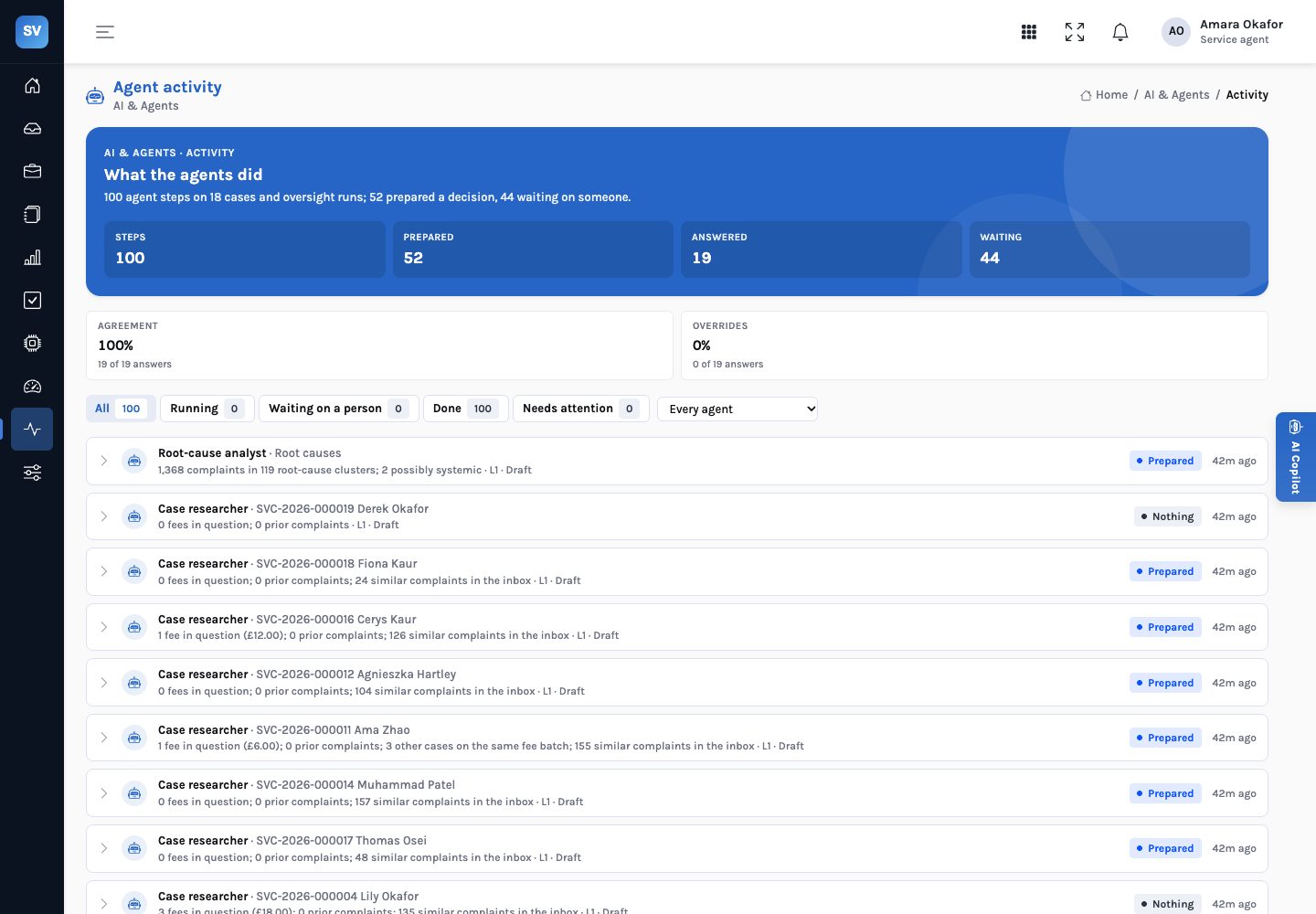
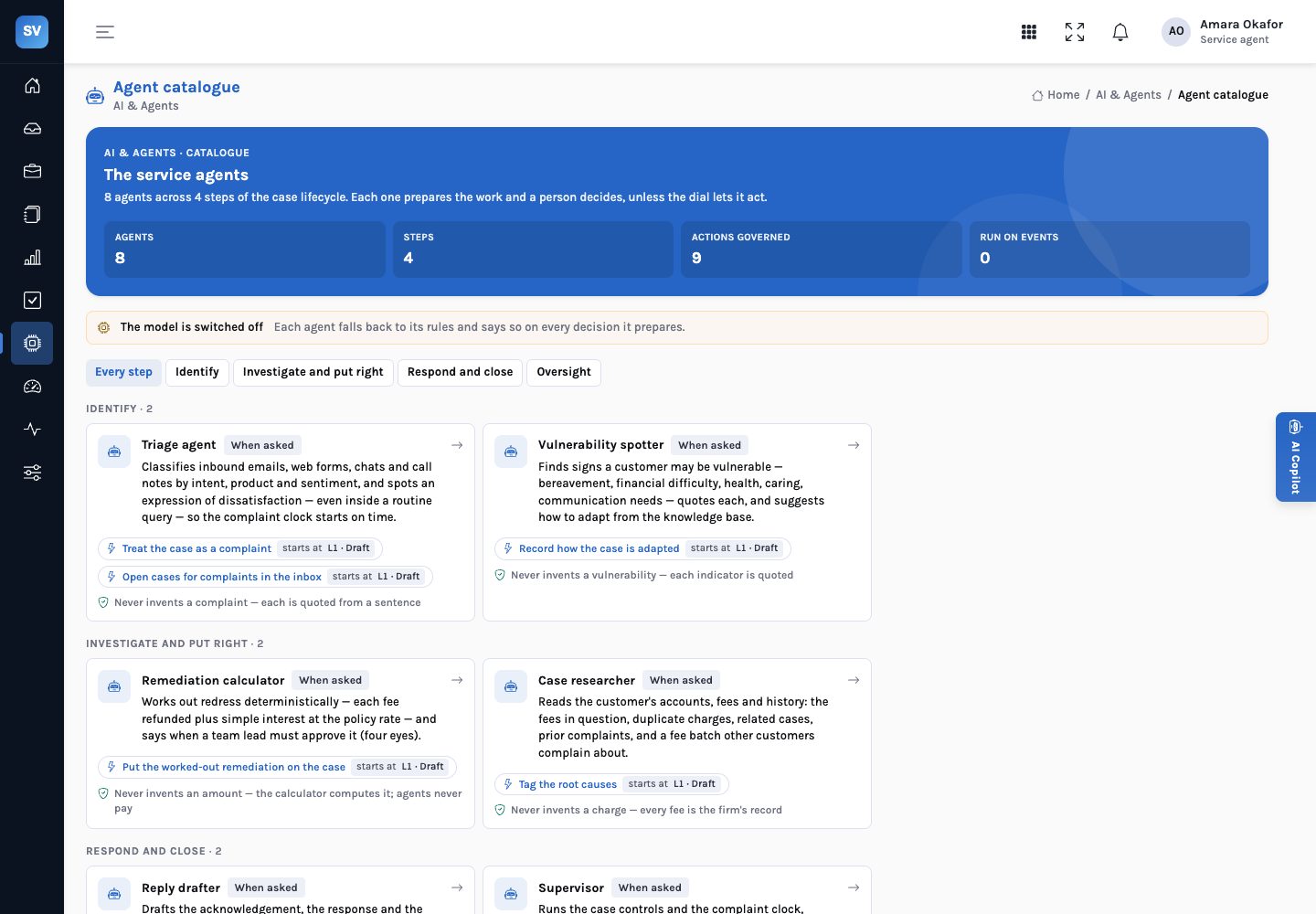
Eight agents for triage, vulnerability, research, remediation, replies, supervision, root causes and QA. They never send, pay, classify, close or approve.
The eight agents
One step each, and a line none of them crosses
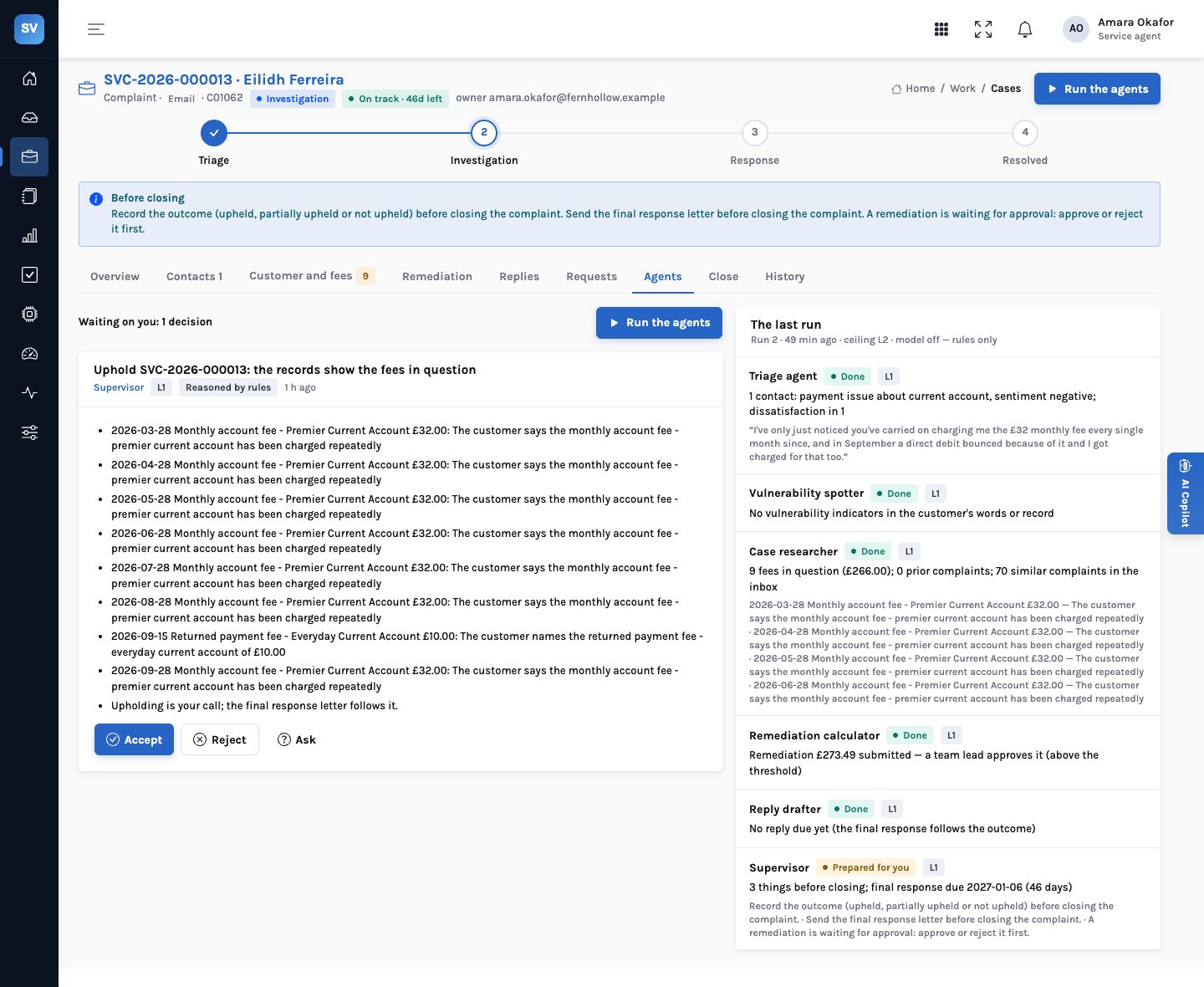
Six agents work on a case, in order, when someone presses “Run the agents”. Three work across the book: the triage agent over the inbox, the root-cause analyst and the QA reviewer.
| Agent | Where | What it prepares | What it never does |
|---|---|---|---|
| Triage agent | Case and inbox | Intent, product, sentiment and the quoted dissatisfaction; treating a hidden complaint as a complaint; cases for inbox complaints, most urgent first | Decide whether a case is a complaint |
| Vulnerability spotter | Case | Each indicator quoted; how to adapt the case, from the knowledge base | Invent an indicator |
| Case researcher | Case | The fees in question, related cases, prior complaints, a shared fee run; the root-cause tags | Invent a charge: every fee is the firm’s record |
| Remediation calculator | Case | The refund plus interest the calculator worked out, and whether a lead must approve it | Approve or pay redress |
| Reply drafter | Case | The acknowledgement, response or final response letter, with citations, held | Send to a customer |
| Supervisor | Case | Where the case stands against the controls and the clock; an outcome where the records support one | Record the outcome or close the case |
| Root-cause analyst | Oversight | Clusters by cause and product, and taking ownership of the systemic ones | Invent a cause: every cluster counts real complaints |
| QA reviewer | Oversight | A sample of closed cases checked against the checklist; a pass for the clean ones | Record a QA result |
Autonomy
Autonomy is earned, and capped
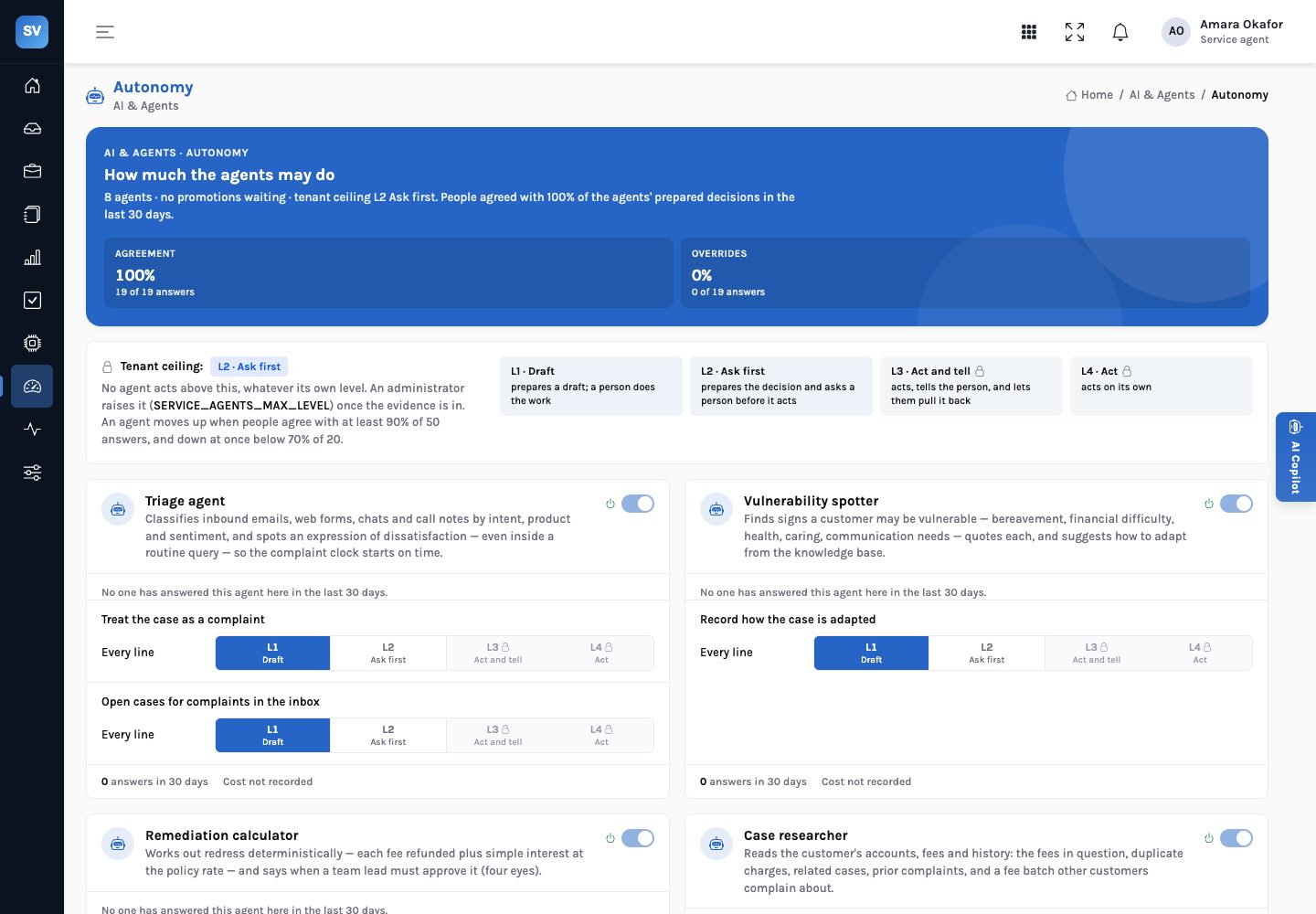
Each agent’s actions start at L1 and are hard-capped at L2. An administrator can enable or disable an agent and set its level within the cap. The platform recommends a promotion only when people agreed with at least 90% of at least 50 answers in 30 days, and a demotion when agreement falls below 70%.
| Level | Name | What the agent may do |
|---|---|---|
| L1 | Draft | Prepares a draft; a person does the work. Every InsightService agent starts here |
| L2 | Ask first | Prepares the decision and asks a person before it acts. The ceiling for every InsightService action |
| L3 | Act and tell | Acts, tells the person, and lets them pull it back. Not available to InsightService agents |
| L4 | Act | Acts on its own. Not available to InsightService agents |
Grounding
The engines compute. The model explains.
Classification, deadlines, fee matching, interest and the controls are deterministic code. Where a language model is used, it explains and drafts over numbered facts, and an answer that carries a name or number not in those facts is thrown away.
Deterministic
Arithmetic is code
Deadlines, duplicate fees, refunds and interest are calculated, not generated, so the same data gives the same answer.
Grounded
Facts are numbered
Each agent reasons over numbered facts from the case and cites them; anything else is discarded.
Fallback
Model off is a supported mode
With SERVICE_AGENTS_LLM=0 every agent runs on its rules and says “reasoned by rules” on each step.
Prepared decisions
Accept, reject or ask
What an agent prepares lands on the case and on the handler’s home. Accepting carries it out as the person who accepted; rejecting records that a person disagreed; asking sends a question back. Each answer counts toward the agent’s agreement rate.
Copilot
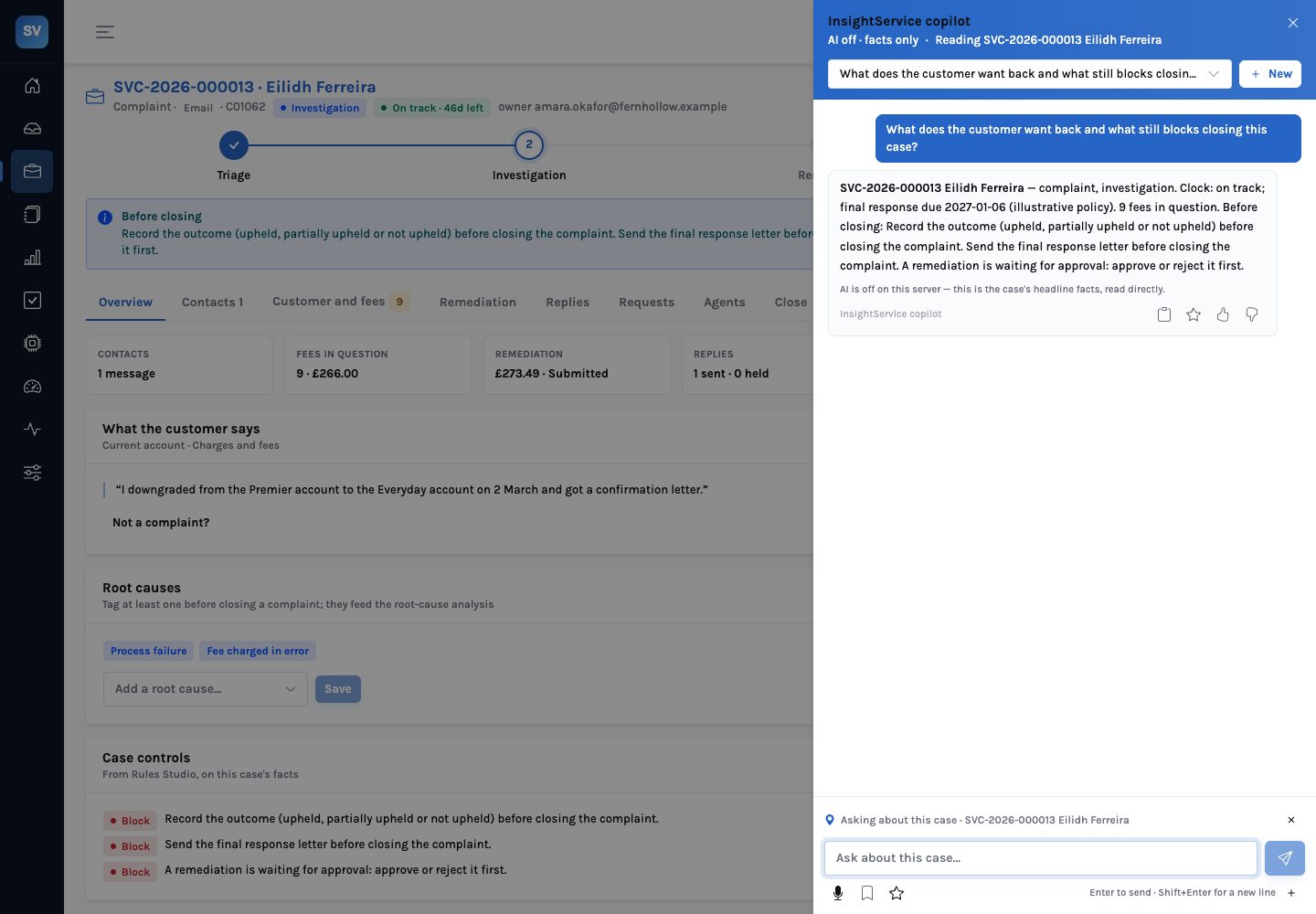
A read-only colleague on every case
The copilot answers questions about the open case from read-only tools and never changes anything.