- contact@insightserviceai.com
InsightService · customer service and complaint handling, prepared by agents
Every complaint found and prepared. Every decision yours.
InsightService reads every email, web form, chat and call note, and quotes the sentence that makes it a complaint, even when it is hidden inside a routine request. It starts the clock, finds the fees in question in the customer’s records, works out the refund and interest to the penny, drafts the reply and the final response letter, and spots the root cause other customers share. Then it stops, and a person decides, sends and pays.
- Every finding quoted from the customer
- The clock runs from receipt
- People send, pay and close
What a case is built from
EmailsWeb formsChat transcriptsCall notes
Customer recordsAccounts & policiesFee and transaction historyFee runs
Prior complaintsYour knowledge baseYour complaint-handling policy
The problem
Complaints rarely announce themselves. The clock starts anyway.
A customer asks for statements and, halfway through, says nobody called back as promised. That sentence is a complaint, and the deadline to answer it runs from the moment the email arrived. Handlers spend their day finding sentences like that, pulling fee histories, doing interest sums by hand and rewriting the same letter, and the pattern across complaints is spotted months later, if at all.
Identification
The complaint nobody logged
Dissatisfaction tucked into a change of address or a statement request is easy to miss. Missed, it never gets acknowledged, never gets a final response, and never reaches the root-cause figures.
Consistency
Redress that depends on who did it
One handler refunds the fee, another adds interest, a third rounds it. When the redress can’t be recalculated from the case, nobody can say it was fair, including the firm.
Root causes
A hundred complaints, one fault
Four customers complain about the same £6 overdraft fee. Behind them is one fee run that charged over a hundred people. Handled one at a time, that is four refunds and a fault still in production.
How it works
Classify → Research → Put right → Respond → Close
Every contact is read and classified. A complaint becomes a case on the clock. Agents prepare each step; a person accepts, rejects or asks about what they prepared, and makes every decision that matters.
1
Classify
Intent, product, sentiment and vulnerability for every contact, each quoted from the customer’s own sentence. Only the customer’s lines of a chat count. A person can correct it.
2
Research
The customer’s accounts, fees and prior complaints. Duplicate charges and the fees the message names, related cases, and a fee run other customers are complaining about.
3
Put right
Each fee refunded plus simple interest, worked out to the penny. Above your threshold, a team lead who didn’t propose it approves it. Nothing is paid from InsightService.
4
Respond
The acknowledgement, the response and the final response letter, drafted from the case’s facts and your knowledge base with citations, and held until a person sends them.
5
Close
Nine case controls say what blocks a close. A breached clock or a repeat complainant needs a lead’s sign-off. The decision record keeps it all.
A real case from the demo
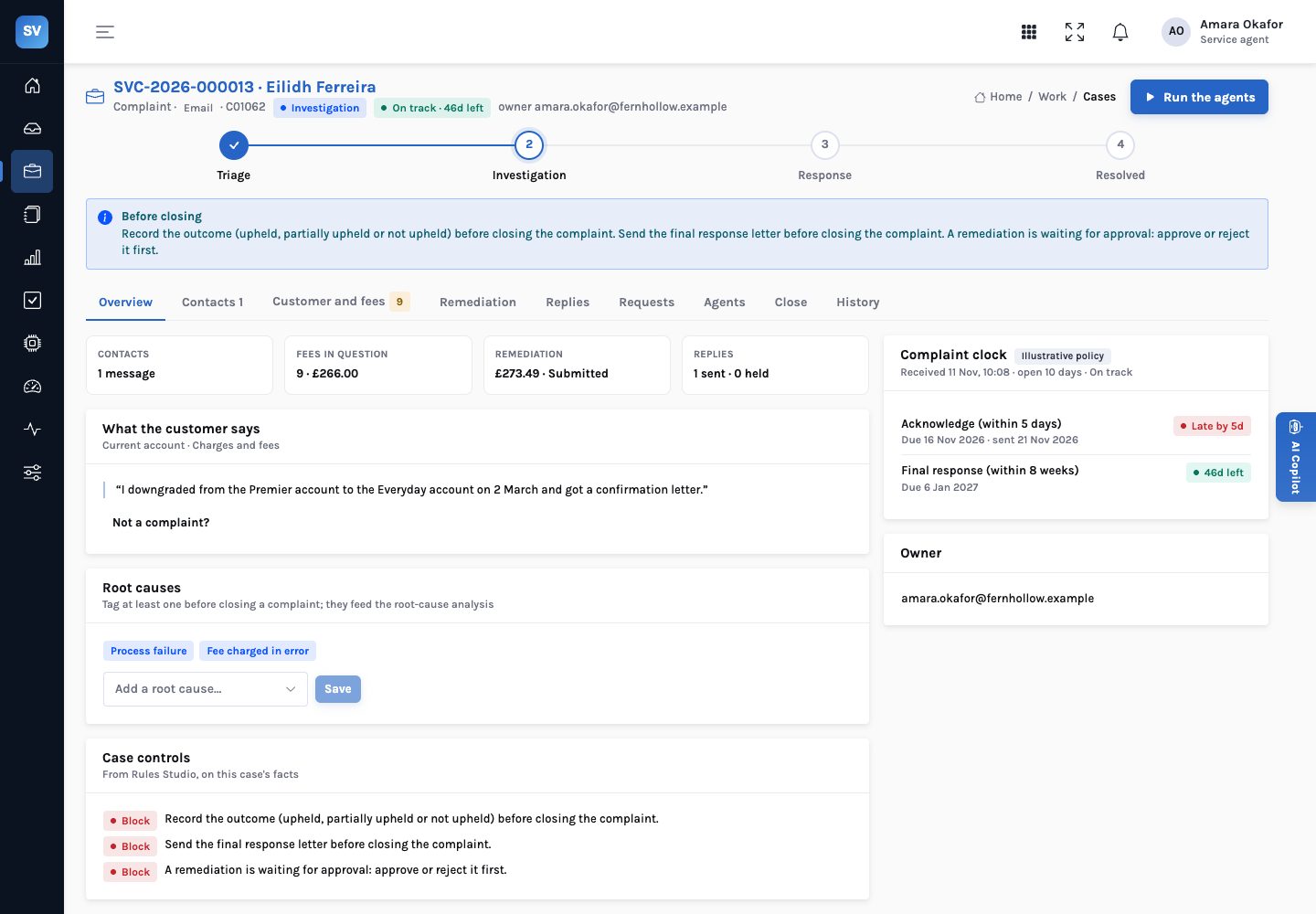
She downgraded in March. The £32 fee carried on.
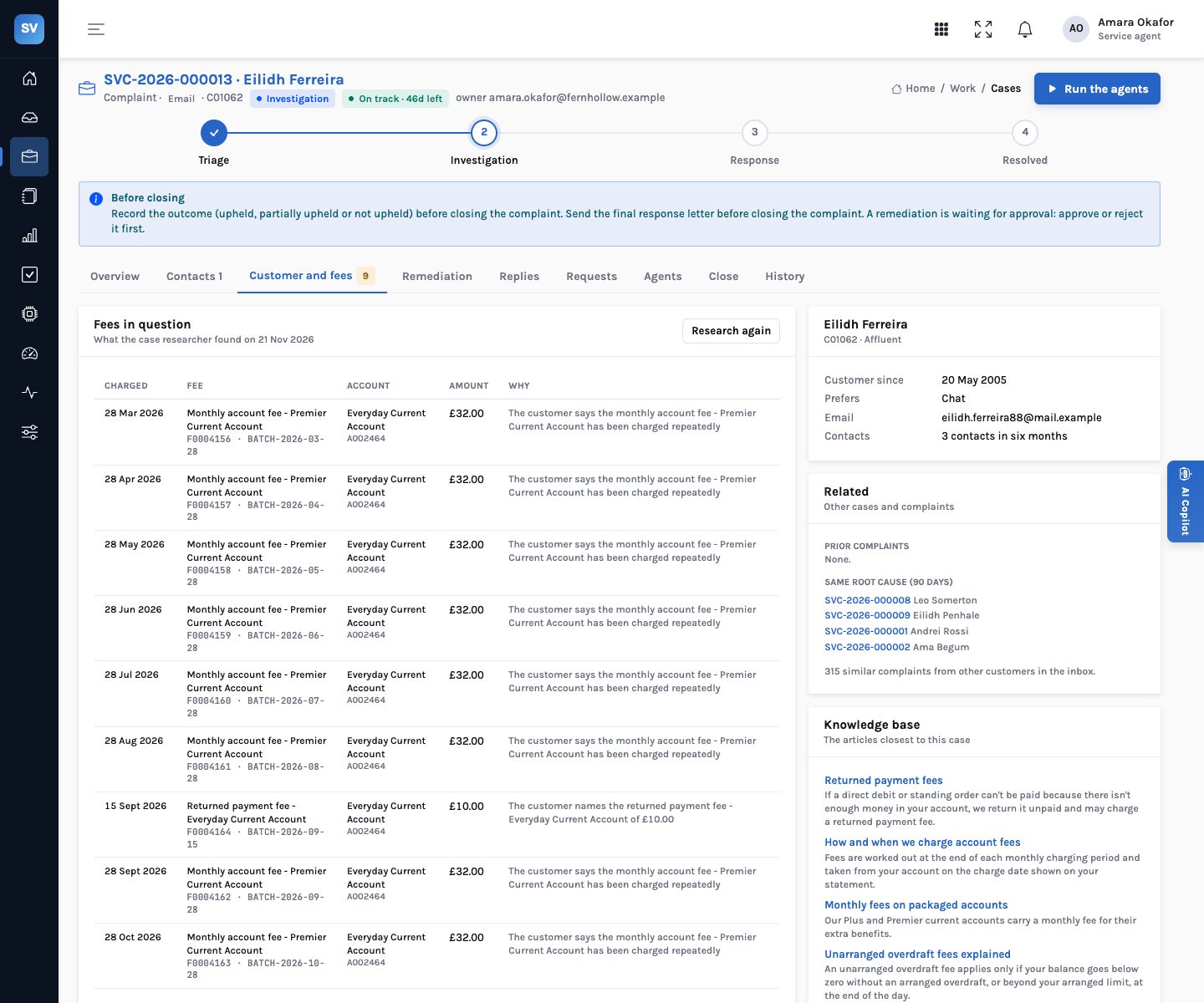
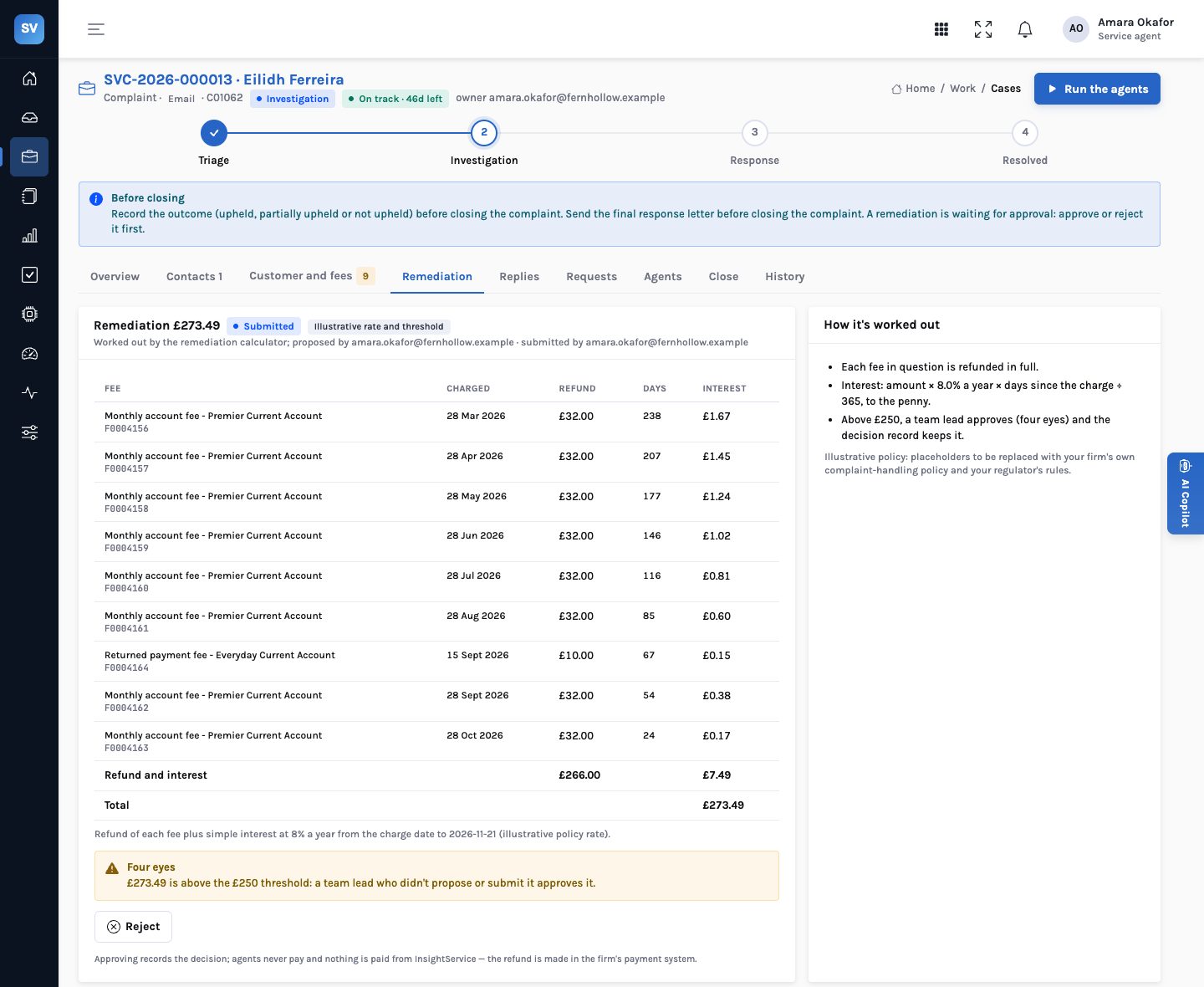
From the demo firm, Fernhollow Bank & Insurance (fictional): Eilidh Ferreira wrote that she moved from the Premier account to the Everyday account on 2 March, kept being charged the £32 monthly fee, and had a direct debit bounce because of it. She wanted it all back, with interest. Here is what InsightService prepared.
Her email, 11 Nov“carried on charging me the £32 monthly fee every single month”quoted by the triage agent
Case research9 fees in questioneight monthly fees from 28 March to 28 October, and a £10 returned payment fee
Remediation£266.00 + £7.49 interestsimple interest per fee, from the day it was charged
Four eyes£273.49 > £250a team lead who didn’t propose or submit it approves it
What it does
Everything a complaint needs, from the inbox to the decision record
Each capability below is in the product today, shown on the demo firm’s data.
Inbox
Classified, and quoted
Intent, product, sentiment, dissatisfaction and vulnerability for every contact, each finding quoted from the sentence it rests on. A person confirms or corrects it, and the correction is kept.
Hidden complaints
Found inside routine requests
One dissatisfied sentence inside a statement request or a change of address makes the contact a complaint, and the case says which sentence.
The clock
Deadlines from receipt
Acknowledge and final-response deadlines on every complaint, due soon and breached flags, all from a configurable policy labelled “illustrative” on every screen.
Research
The fees in question
Duplicate charges and the fees the message names, related cases, prior complaints, and a fee run other complainants share, from the firm’s own records.
Remediation
Refund plus interest, four eyes
Worked out deterministically, per fee, to the penny. Above the threshold a team lead who neither proposed nor submitted it approves it.
Replies
Drafted, cited, held
Acknowledgement, response and final response letter from the case’s facts and your knowledge base. Referral-rights wording is flagged as a template to replace with your approved text.
Customer requests
A link with no login
Ask the customer a question or for a document through a secure link. The request is held until a person sends it; the answer lands on the case.
Close
Nine controls, then a decision
No outcome, no final response, no root cause, vulnerability not addressed, remediation or request pending: each blocks a close. A breach or a repeat complainant goes to a lead.
Oversight
Root causes and QA
Complaints clustered by cause and product across cases, the inbox and prior complaints, with possibly systemic causes flagged; closed cases sampled and checked against a checklist.
Findings that show their evidence
The sentence that made it a complaint, and the run behind a hundred of them
A handler can only disagree with a finding they can see. Every classification in InsightService points at the customer’s words, and every root-cause flag points at the complaints and fees behind it.
A hidden complaint
“Please could you send me statements…”
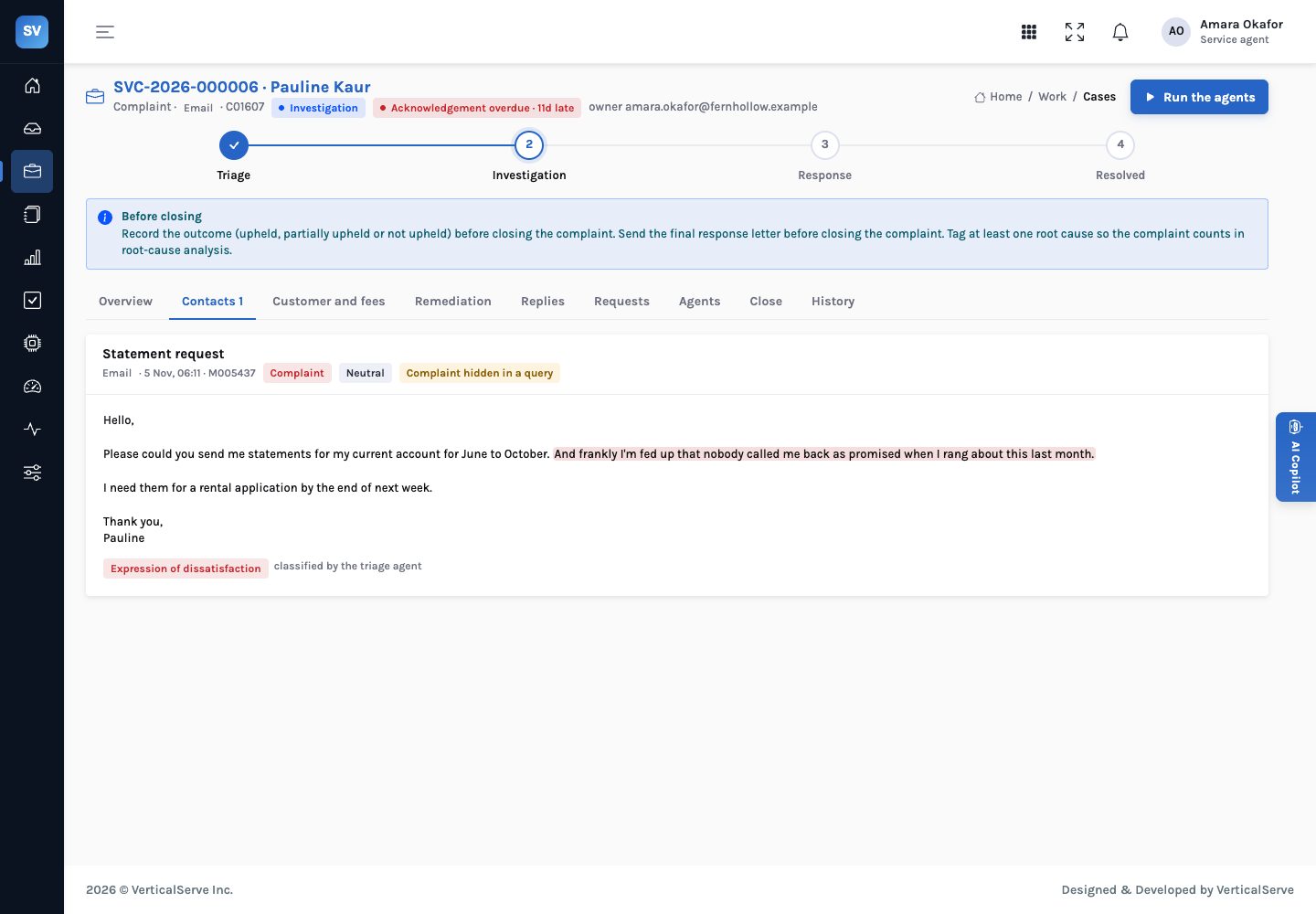
Pauline Kaur, from the demo firm, asked for statements for a rental application. The triage agent classified the email and quoted the one sentence that changes it:
- Underlying intenta service request: statements for June to Octoberrequest
- Expression of dissatisfaction“And frankly I’m fed up that nobody called me back as promised when I rang about this last month.”quoted
- Suggested root causepoor communicationtag
- Result → complaint, clock from receiptcase
A person can mark it “not a complaint” with a reason; the correction and who made it stay on the record.
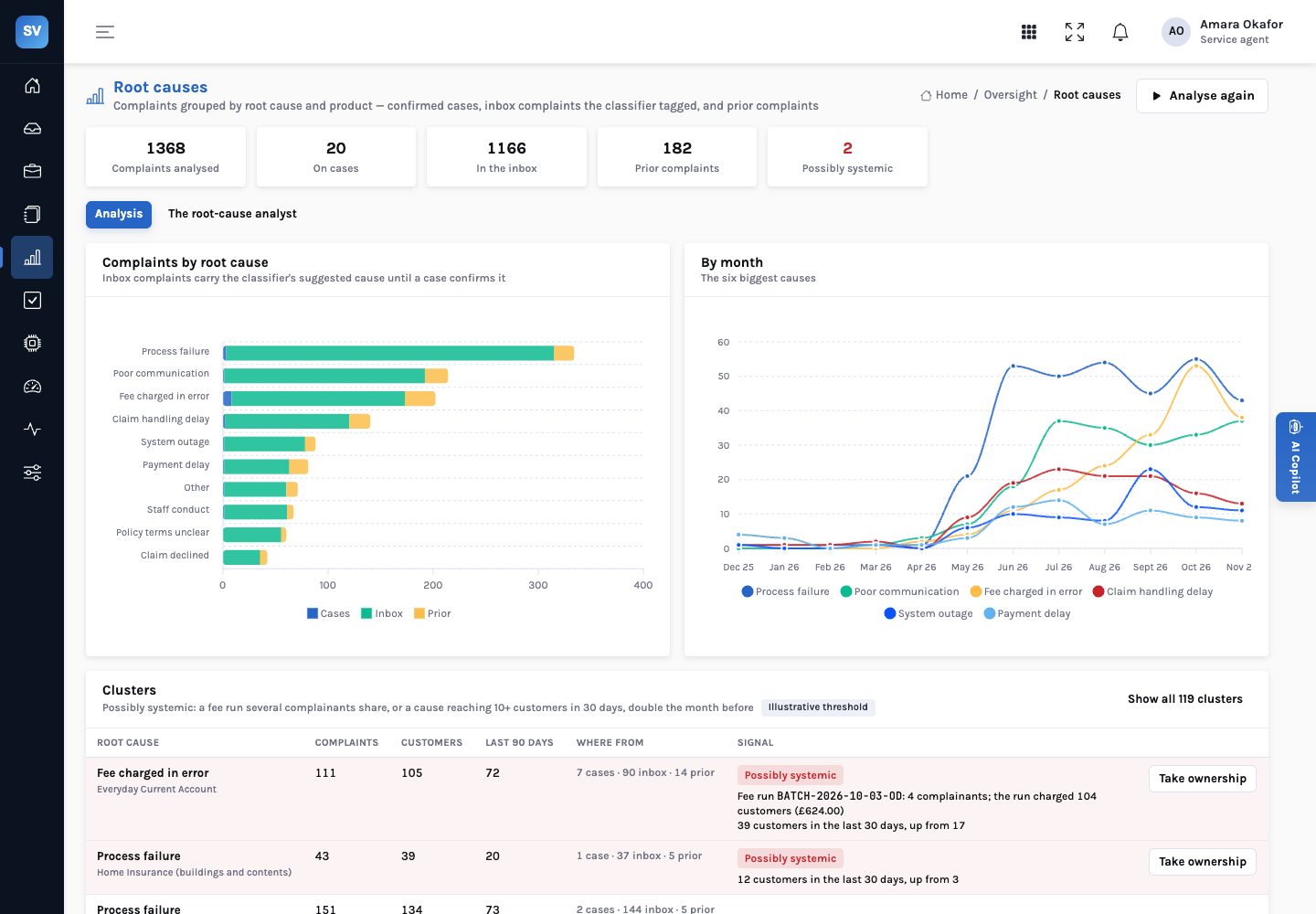
A systemic flag
Fee charged in error, Everyday Current Account
Four complaints about a £6 unarranged overdraft fee taken on 3 October, from customers who were in credit. Case research linked each fee to the same run.
- Fee runBATCH-2026-10-03-OD, every fee an unarranged overdraft fee1 run
- Customers that run charged104 fees, £624.00 in total104
- Complainants sharing iton cases researched so far4
- Cluster → possibly systemic, a person takes ownershipflag
The rising-trend test and its customer threshold are illustrative policy you configure.
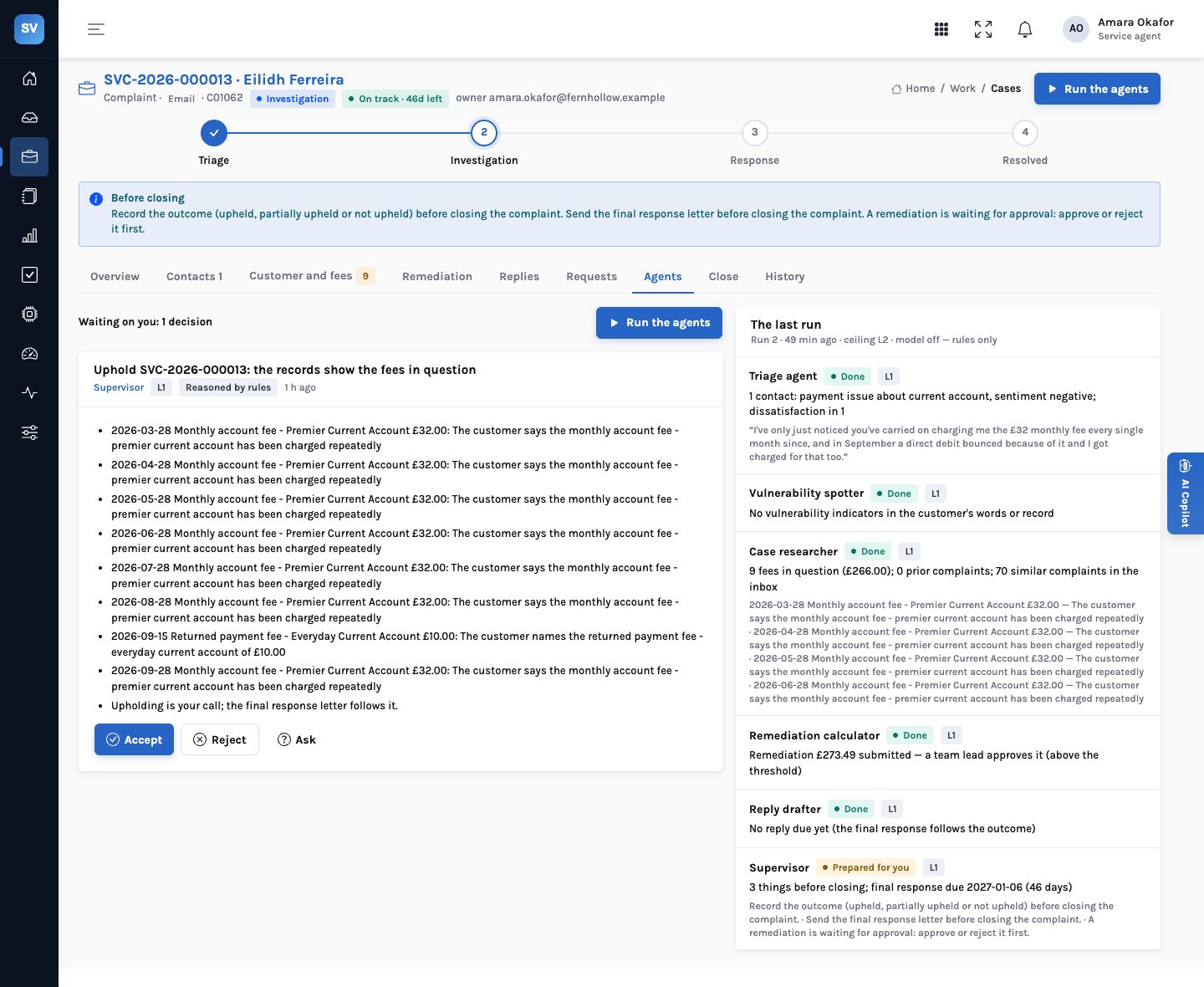
AI agents
Eight agents prepare. None of them sends, pays or closes.
Each agent does one step and stops at a prepared decision: treat this as a complaint, record how the case is adapted, put this remediation on the case, use this drafted letter. You accept, reject or ask. Every answer goes on the record, and how often people agree is how an agent earns more autonomy, up to a ceiling of L2: ask first.
- On a case — triage, vulnerability spotter, case researcher, remediation calculator, reply drafter, supervisor
- In oversight — the triage agent over the inbox, the root-cause analyst and the QA reviewer
- Never on their own — sending to a customer, approving or paying redress, classifying, or closing a case
- Model optional — the classifier, deadlines and amounts are code; with the model off every agent runs on its rules and says so
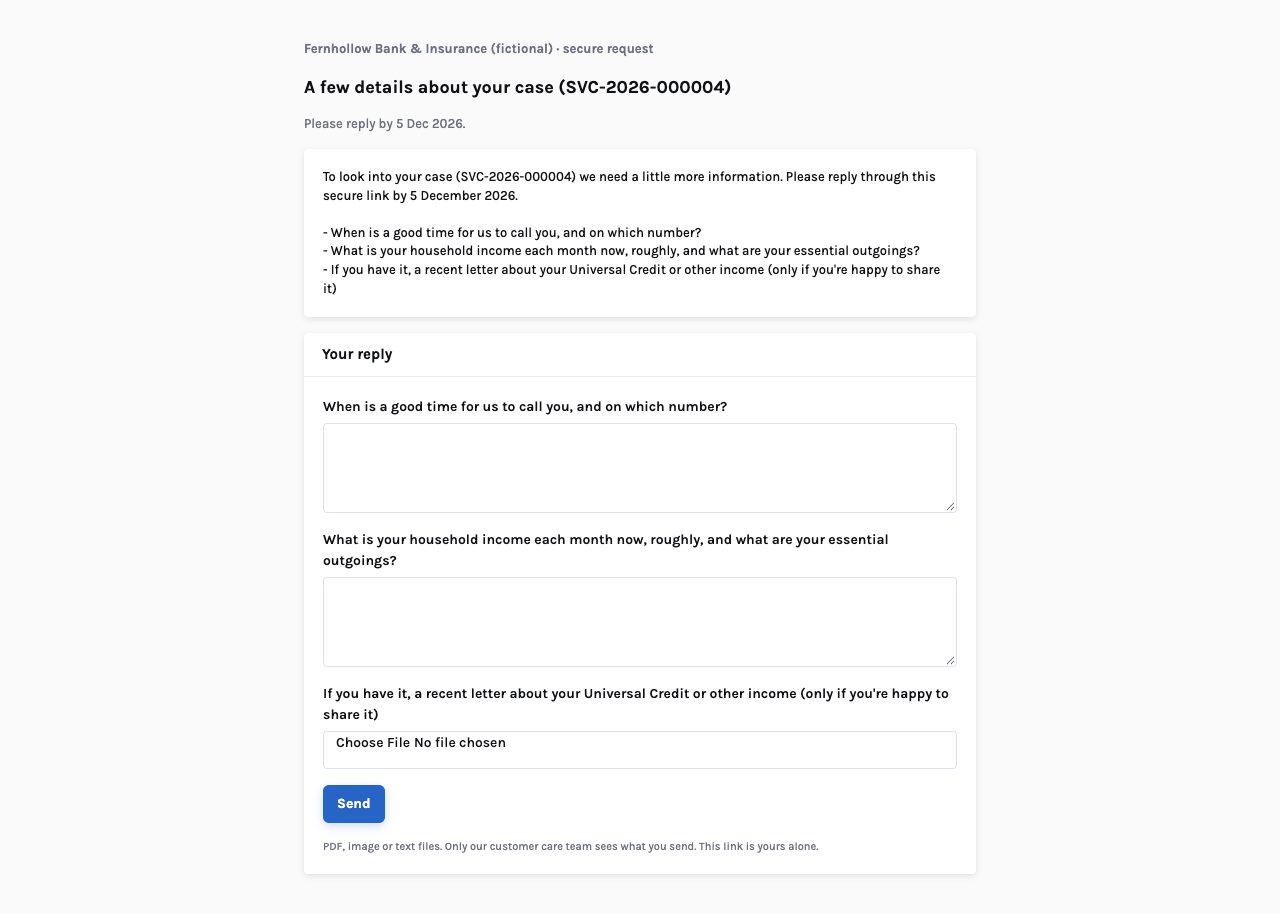
Asking the customer
A secure link, no login, and nothing sent until you send it
When the case needs more from the customer, the handler lists what to ask, one item per line. A question gets a text box and anything else an upload. The request is held for review, and when a person sends it the customer gets their own link.
- Held for review — the message and recipient can be edited until someone sends it
- One link per request — shown once; InsightService keeps only a fingerprint of it
- Withdraw it — a withdrawn request’s link stops working
- A control — an open request blocks the close until it is answered or withdrawn
For complaints and compliance leaders
Answers for the regulator, the ombudsman and the board
The questions a head of complaints is asked are simple. InsightService keeps the evidence for each answer on the case, as it stood when the decision was made.
Are we recording every complaint?
Every contact is classified and every complaint quoted, including those hidden in routine requests. Corrections are a person’s, with a reason.
Are we on time?
Each complaint’s acknowledgement and final-response deadlines, due soon and breached, on the queue and on the home page.
What keeps going wrong?
Root causes by product and month, upheld rates, and the clusters that look systemic, each with an owner.
What did the AI do?
Every agent step, what it prepared, who answered and how, and the agreement rate that decides whether it earns more autonomy.
Design & trust
Built to be checked
A Python API, a React app and PostgreSQL, designed to run in your own cloud account against your own systems. Nothing in a case is a value a model made up.
Grounded
No invented facts
A finding comes from the customer’s sentence, a fee from the firm’s records, a citation from the knowledge base. Classification, deadlines and redress are deterministic code.
Read-only sources
Your systems stay yours
InsightService reads contacts, customers, accounts, fees and prior complaints from your systems and keeps its own work in its own schema. Refunds are paid in your payment system, not here.
Policy
Your rules, configurable
Deadlines, the interest rate and the approval threshold are configuration, labelled illustrative until you set them. What blocks a close is a rule set in Rules Studio.
Roles
Handlers, leads, admins
Service agents prepare, send and submit. Team leads approve redress and sign off referred closes. Administrators set the controls and the agents’ autonomy.