Not every message that needs careful handling is a complaint. Lily Okafor’s web form doesn’t complain about anything. It says she has lost her job, she is behind on everything, she keeps being charged overdraft fees, and she is worried. It asks: “Is there anything you can do?” This post follows her case through InsightService: why it is a query with no complaint clock, why the controls still apply, what the agents prepared, and how a request for the details a handler needs reaches her through a link she can open without signing in.
In short
- A query, not a complaint. No sentence expresses dissatisfaction, so there is no complaint clock. If one did, a person could turn it into a complaint and the clock would run from her first contact.
- Vulnerability is quoted and required. Financial difficulty is quoted from her message; the case is high priority and cannot close until a person records how it is adapted.
- The agents prepare a remediation and a response, and wait. £18.24 for three £6.00 overdraft fees plus interest, and a drafted reply. Neither has been accepted; both are a person’s call.
- The request goes through a no-login link. Held until the handler sent it, answered on a page with a text box per question and an upload per document. While it is open, the case can’t close.
The situation
The case is SVC-2026-000004 in InsightService’s demo data for Fernhollow Bank & Insurance, a fictional firm. Lily used the web form on 13 November 2026:
Reason for contact: Struggling with payments
“I lost my job in September and I’m behind on everything. I’ve had overdraft fees every month since and I can’t make my loan payment this month either. I’m really worried about what happens next. Is there anything you can do?” Product: Everyday Current Account. Preferred contact: Either.
Her record shows an Everyday Current Account and a Classic Credit Card. The fee history shows three unarranged overdraft fees of £6.00 each, on 23 August, 23 September and 23 October 2026.
A query with a vulnerable customer
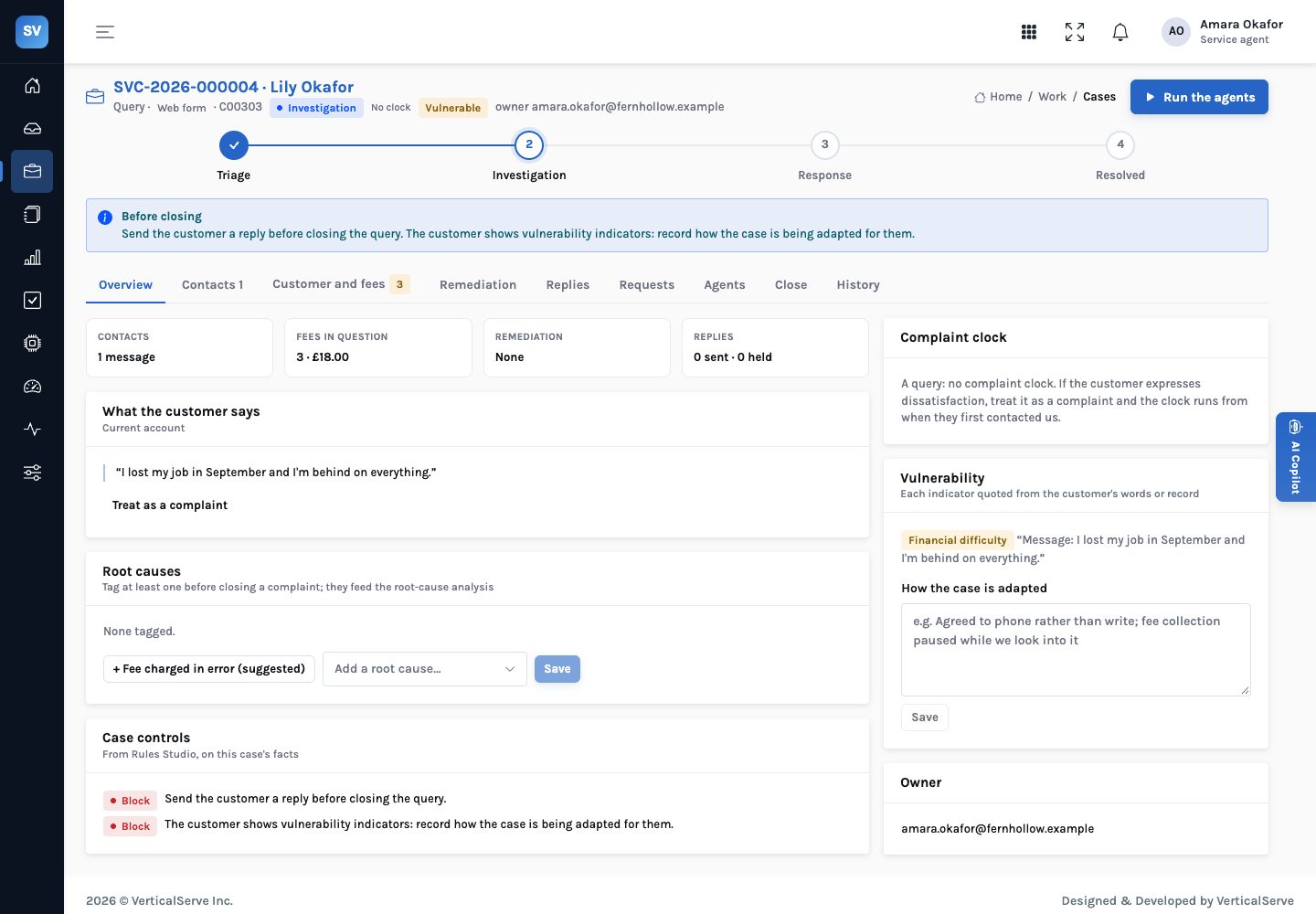
The classifier read her message and found no expression of dissatisfaction. She is worried, and the sentiment is negative, but worry is not a complaint. So it was classified as a query about the current account, and the case was opened as a query: no complaint clock. The case screen says so plainly: “A query: no complaint clock. If the customer expresses dissatisfaction, treat it as a complaint and the clock runs from when they first contacted us.”
The vulnerability finding is separate, and it is there: financial difficulty, quoted from “I lost my job in September and I’m behind on everything.” That one finding is enough to mark the case vulnerable and raise its priority to high.
The FCA’s guidance on vulnerable customers (FG21/1) treats low financial resilience, including a sudden loss of income, as one of the drivers of vulnerability, and the FCA has set out its expectations of firms supporting customers in financial difficulty. A firm’s own policy decides what that support looks like; InsightService’s job is to make sure the sentence is seen and the case can’t be closed without a recorded response to it.
A query from a struggling customer goes into the general service queue, gets a standard reply about fees, and closes. Whether anyone noticed she lost her job depends on who picked it up.
No complaint clock, but the case is high priority, the vulnerability is quoted, and it cannot close until a reply is sent and a person has recorded how the case is adapted.
What the agents prepared
Running the agents produced three prepared decisions on the case, each waiting for the handler.
| Agent | What it prepared |
|---|---|
| Vulnerability spotter | From the knowledge-base article “If you’re struggling financially”: “Contact our support team. Tell us what you can afford. We agree a plan with you.” as the suggested adaptation |
| Remediation calculator | £18.24: three £6.00 unarranged overdraft fees refunded, plus £0.12, £0.08 and £0.04 interest for 90, 59 and 29 days at the illustrative 8% a year |
| Reply drafter | A response that thanks her for her message of 13 November, lists the three fees, and explains how fees work from two cited knowledge-base articles |
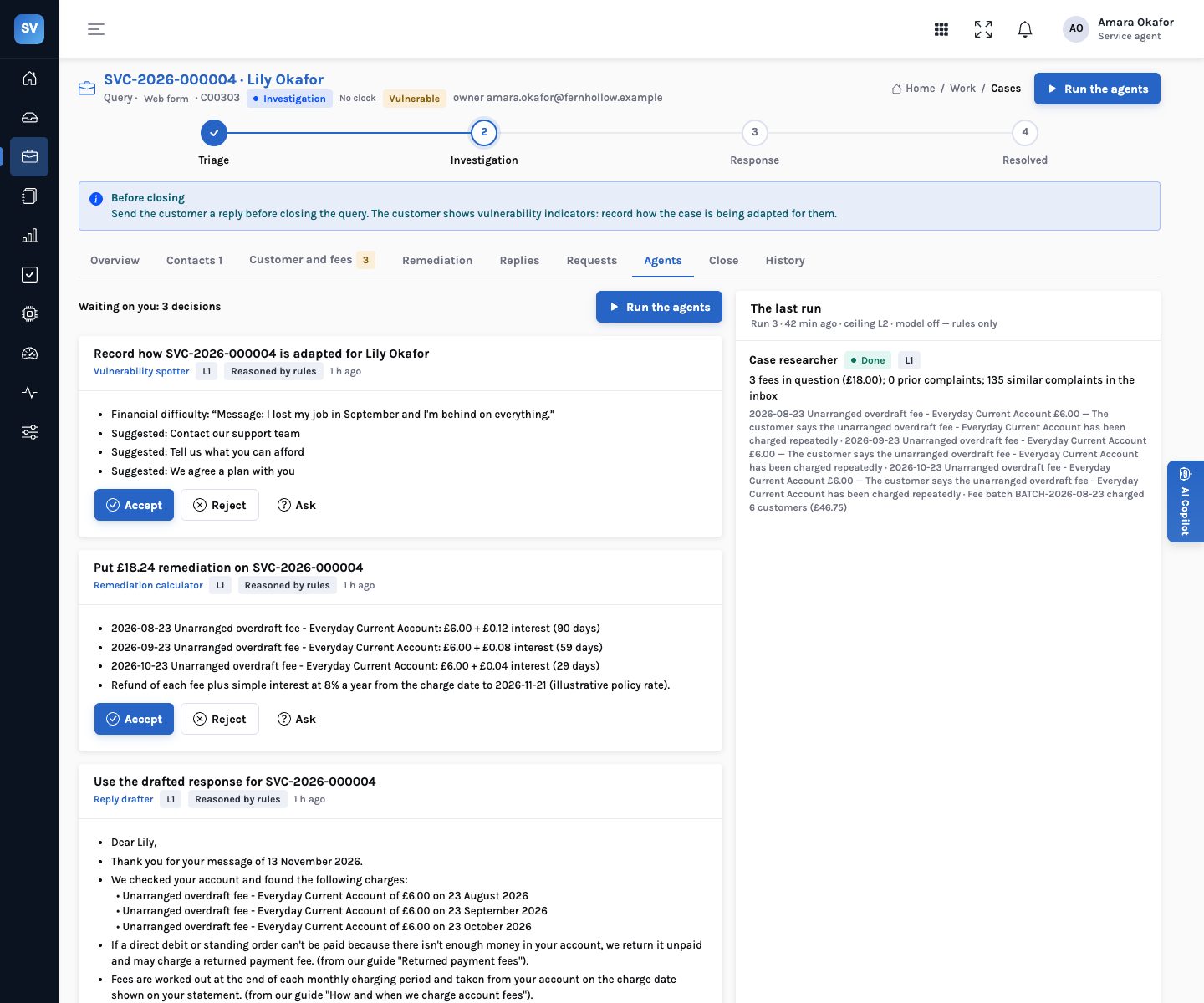
Two points deserve attention. First, the researcher picked the three fees because the message names overdraft fees and uses recurring language (“every month since”); each fee’s reason says the customer says it has been charged repeatedly. Whether the bank should refund fees that were correctly charged to a customer in difficulty is a policy decision, not an arithmetic one, and the August fee predates the job loss she describes. The calculator only says what the refund would be; the handler decides whether there is one.
Second, the drafted response is a factual starting point: it lists fees and explains how they work. For a customer who has written “I’m really worried about what happens next”, it needs a person to add what the firm will actually do. It is held until a person sends it.
Prepared is not done
Every agent in InsightService is capped at L2 (Ask first) and these ran at L1 (Draft). None of them can record the adaptation, put the remediation on the case, or send the reply without a person accepting it. Running with the language model off, as the demo does, each step says “Reasoned by rules”.
Asking her for what the handler needs
To help, the handler needs to know when to call and something about her income and outgoings. Rather than a phone tag or an email asking for documents by reply, the handler wrote a request on the case’s Requests tab, one item per line:
- When is a good time for us to call you, and on which number?
- What is your household income each month now, roughly, and what are your essential outgoings?
- If you have it, a recent letter about your Universal Credit or other income (only if you’re happy to share it)
Lines that ask something get a text box; any other line asks for a file. The request was drafted and held. When the handler sent it, InsightService created a link for this request only, showed it once, and kept only a fingerprint of it.
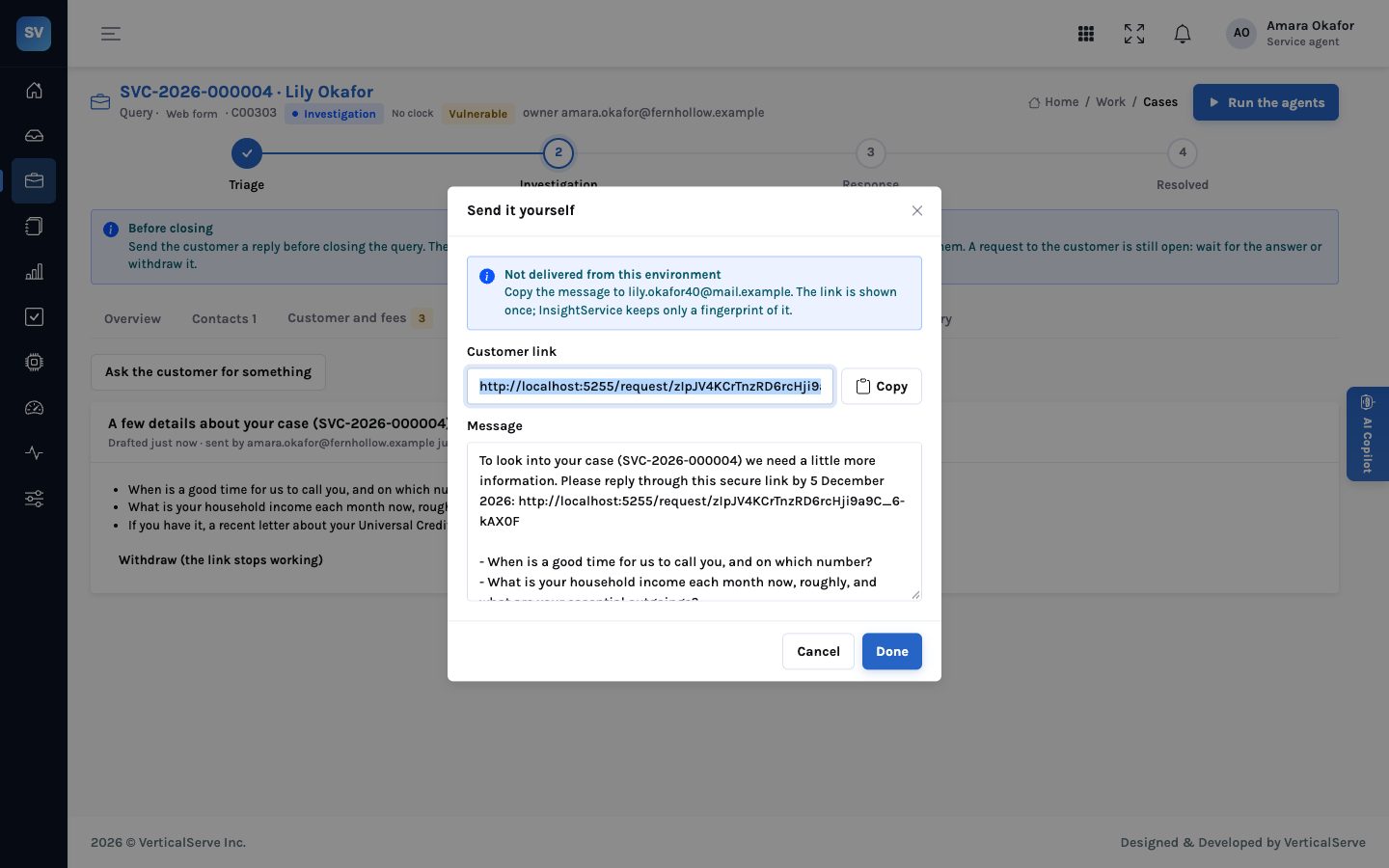
In this demo environment, outbound delivery is off, so the request is recorded as sent but not
delivered, and the dialog hands the message to the sender. With delivery switched on
(SERVICE_COMMS_LIVE), it goes to the customer’s address.
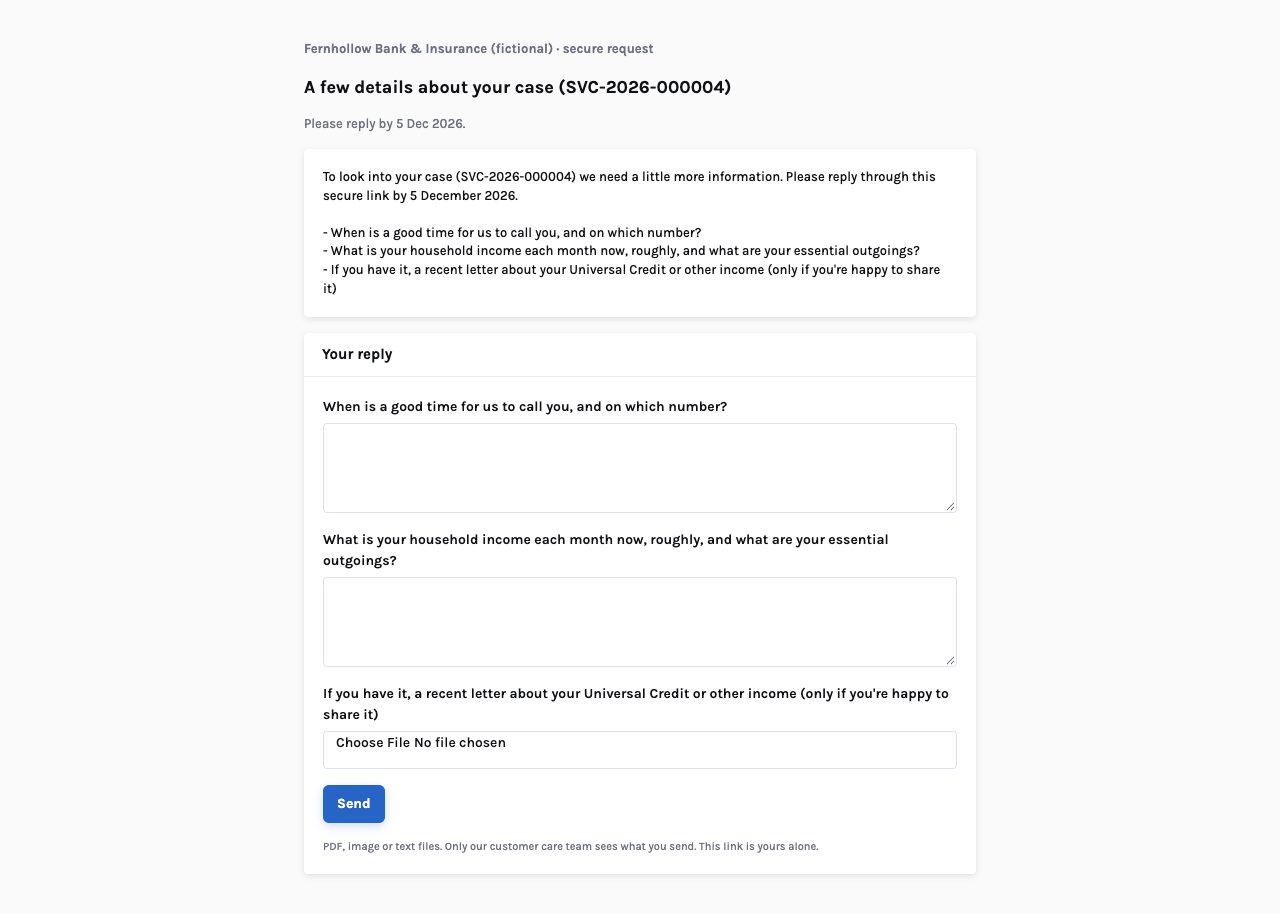
The page accepts PDFs, images and text files up to 8 MB each. When she answers, the answers and files land on the case and the request shows as answered. A withdrawn request’s link stops working.
Who does what on SVC-2026-000004. The steps after the link was sent are still to come in the demo.
What still blocks the close
With the request sent, three case controls block the close:
- Send the customer a reply before closing the query.
- The customer shows vulnerability indicators: record how the case is being adapted for them.
- A request to the customer is still open: wait for the answer or withdraw it.
The controls on a query. If Lily writes back unhappy, a person can turn it into a complaint and the complaint controls apply.
Who does what
A query; financial difficulty quoted. No complaint clock.
Vulnerability raises the priority.
Three £6.00 overdraft fees; the reason each was picked.
A request with questions and an optional document, held until sent, answered through a no-login link.
From the spotter’s suggestion and the firm’s financial-difficulty policy. Required before close.
The calculator’s £18.24 is a figure, not a decision.
Add what the firm will do; send it.
Turn the query into a complaint; the clock runs from 13 November.
What it means
For the head of complaints
Vulnerability is not only a complaints matter. The same controls that protect a bereaved complainant apply to a struggling customer’s query, and the adaptation is on the case for anyone who later reviews it.
Fee refunds for customers in difficulty are a policy choice. The calculator makes the number consistent; your policy makes the decision.
For the service operations lead
The request does the chasing: the customer answers on one page, at her own time, and the answers land on the case.
An open request blocks the close, so a case can’t be closed while the customer is still answering.
For the board
Customers in financial difficulty are where a firm’s support is tested. Each case shows what was noticed, what was offered and who decided.
Agents prepared three things on this case and did none of them.
Next: one faulty fee run behind 104 customers’ charges.