A £6 overdraft fee is the smallest complaint a bank receives. A customer who was in credit sees it, says it isn’t fair, and wants it back. Handled one at a time, each of these complaints is upheld, refunded and closed, and nobody ever asks why they keep arriving. This post follows four of them on the demo firm’s data and shows how the case research links them to one fee run, and how the root-cause analyst turns four small complaints into one question for the people who own the fee engine.
In short
- Four customers, one run. Muhammad Ellery, Ama Zhao, Leo Somerton and Eilidh Penhale each complained about an unarranged overdraft fee of £6.00 charged on 3 October 2026. Case research shows all four fees came from the same fee run,
BATCH-2026-10-03-OD. - The run reached 104 customers. The firm’s records show that run charged 104 customers £624.00 in total. Four complained. The other hundred are the reason root-cause analysis exists.
- The cluster is flagged, not fixed. The root-cause analyst marks “Fee charged in error · Everyday Current Account” as possibly systemic. A person takes ownership; whether to remediate customers who never complained is the firm’s decision.
- Each complaint is still handled on its own clock. Two are closed and upheld with £6.06 refunded. Two are open, and their acknowledgements are overdue: the clock doesn’t wait for the root cause.
Why one complaint is not enough
Regulators expect complaints to be used for more than the complaint. In the UK, the FCA’s complaints sourcebook asks firms to put in place management controls that identify and remedy recurring or systemic problems, and to consider whether a problem found in one complaint may affect customers who did not complain. The practical difficulty is that the evidence for a systemic problem is spread across handlers, channels and weeks. Each handler sees one £6 fee. Nobody sees the run.
data
The FCA’s Dispute Resolution: Complaints sourcebook (DISP 1.3) requires firms to have effective and transparent procedures for handling complaints and, in DISP 1.3.3R, to put in place appropriate management controls and take reasonable steps to ensure that in handling complaints they identify and remedy any recurring or systemic problems. The guidance beside it describes analysing the causes of individual complaints to identify root causes common to types of complaint, and considering whether those root causes may also affect other processes or products, including those not directly complained about.
Source: FCA Handbook, DISP 1.3.3R and 1.3.6G. Other regulators have similar expectations; check the rules that apply to your firm.
The four complaints
The demo uses Fernhollow Bank & Insurance, a fictional firm with invented customers, accounts and fees. These are the four complaints, in the customers’ own words as the classifier quoted them:
| Case | Customer and channel | Received | What they said |
|---|---|---|---|
| SVC-2026-000010 | Muhammad Ellery, web form | 9 Oct 2026 | “I noticed a charge of £6.00 described as an unarranged overdraft fee. I have never had an overdraft and my account has always been in credit.” |
| SVC-2026-000011 | Ama Zhao, chat | 16 Oct 2026 | “You’ve charged me an overdraft fee when I had money in the account. That’s not fair and it’s not the first time I’ve seen people complaining about this online.” |
| SVC-2026-000008 | Leo Somerton, chat | 20 Oct 2026 | “Hello, an overdraft fee was taken on 3 October.” … “My balance was positive, around £3201.” … “I’m quite annoyed to be honest.” |
| SVC-2026-000009 | Eilidh Penhale, call note | 30 Oct 2026 | Cust said: “You’ve charged me an overdraft fee when I had money in the account. That’s not fair … Sort it out.” |
Four channels, four weeks, four different handlers in a real firm. In two of the chats, only the customer’s lines count: the classifier ignores what the adviser typed, so an adviser’s “sorry you’re unhappy” never turns a query into a complaint. In the call note, the customer’s quoted words carry the dissatisfaction. Each contact was classified as a complaint about the current account, and the complaint clock started from receipt.
What case research finds
When a case is researched, the case researcher reads the customer’s accounts and six months of fees from the firm’s records. It looks for two kinds of fee: the same fee charged twice on the same day, and fees the message names. Each of these customers names the unarranged overdraft fee, and each has exactly one, charged on 3 October 2026, for £6.00.
Every fee in the firm’s records carries the fee run that charged it. So the researcher can do something a handler working one case cannot: look at every other open or closed case whose fees in question came from the same run, and ask the firm’s records how far that run reached.
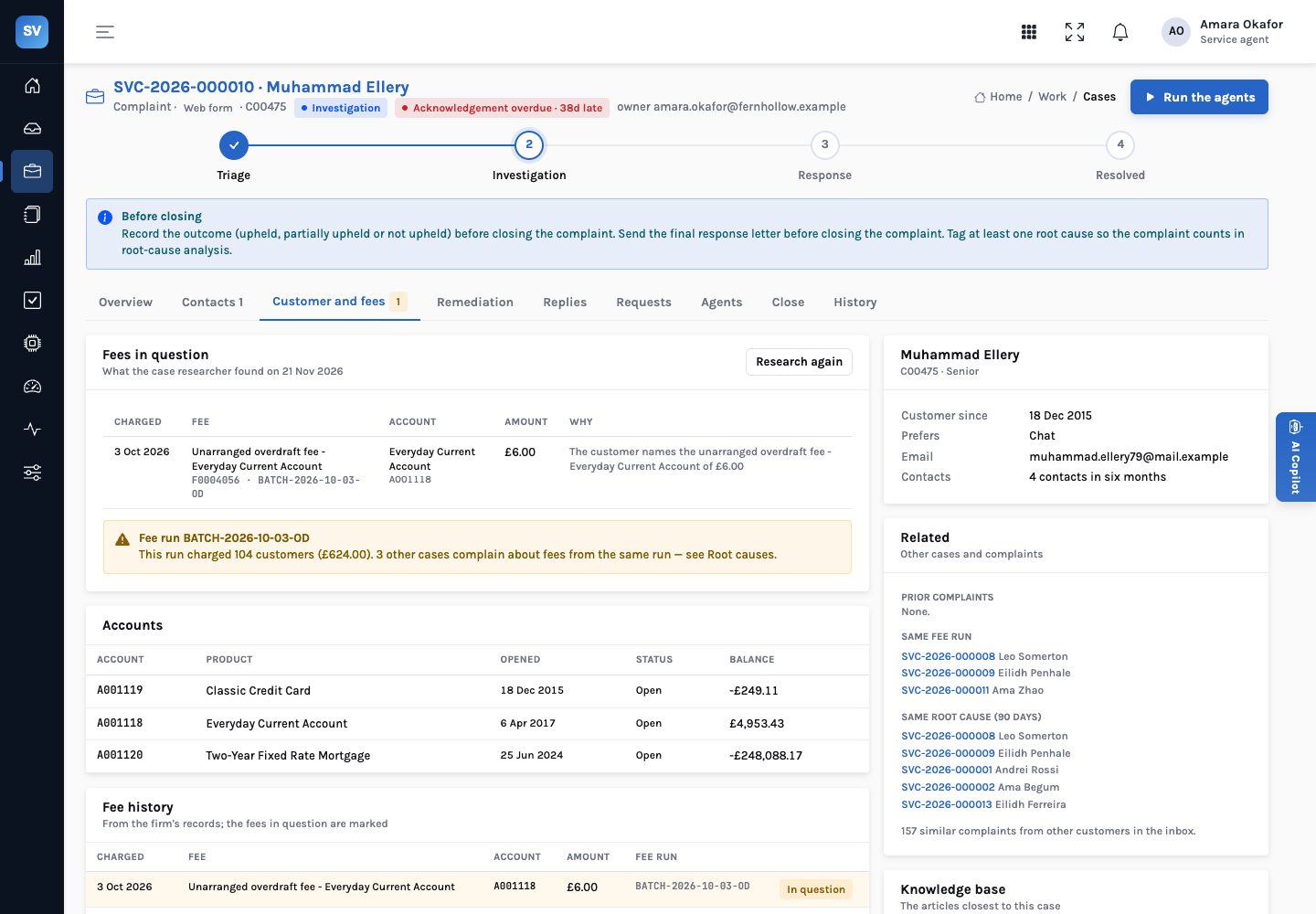
On Muhammad Ellery’s case the research says: one fee in question (£6.00); no prior complaints; three other cases on the same fee batch; 157 similar complaints from other customers in the inbox. The related panel lists the three cases on the same run by reference, and separately the cases that share a root cause in the last 90 days.
One run, 104 customers charged, four complaints. The fee run is in the firm’s records; the cases link to it through research.
From four cases to a cluster
The root-cause analyst works across the whole book, not one case. It groups every complaint the firm
knows of by root cause and product: confirmed cases with tags, complaints in the inbox that the
classifier tagged but nobody has opened a case for, and the firm’s prior complaints handled
before InsightService. A group is flagged as possibly systemic when several complainants
share a fee run, or when a cause reaches at least twice the systemic threshold of customers in the
last 30 days and at least double the 30 days before. The threshold is
SERVICE_SYSTEMIC_CUSTOMERS, five by default: illustrative policy, set to your own.
| The cluster | What the analyst recorded |
|---|---|
| Root cause and product | Fee charged in error · Everyday Current Account |
| Complaints | 111 complaints from 105 customers; 72 in the last 90 days |
| The trend | 39 customers in the last 30 days, up from 17 in the 30 before |
| The shared run | 4 complainants share fee batch BATCH-2026-10-03-OD, which charged 104 customers (£624.00) |
| Where decided | 71% upheld or partially upheld |
| Signal | Possibly systemic |
Both signals fire on this cluster: a shared fee run and a rising cause. Of the 119 clusters in the demo, two are flagged. The other is process failure on home insurance, which is rising (12 customers in the last 30 days, up from 3) without a fee run behind it.
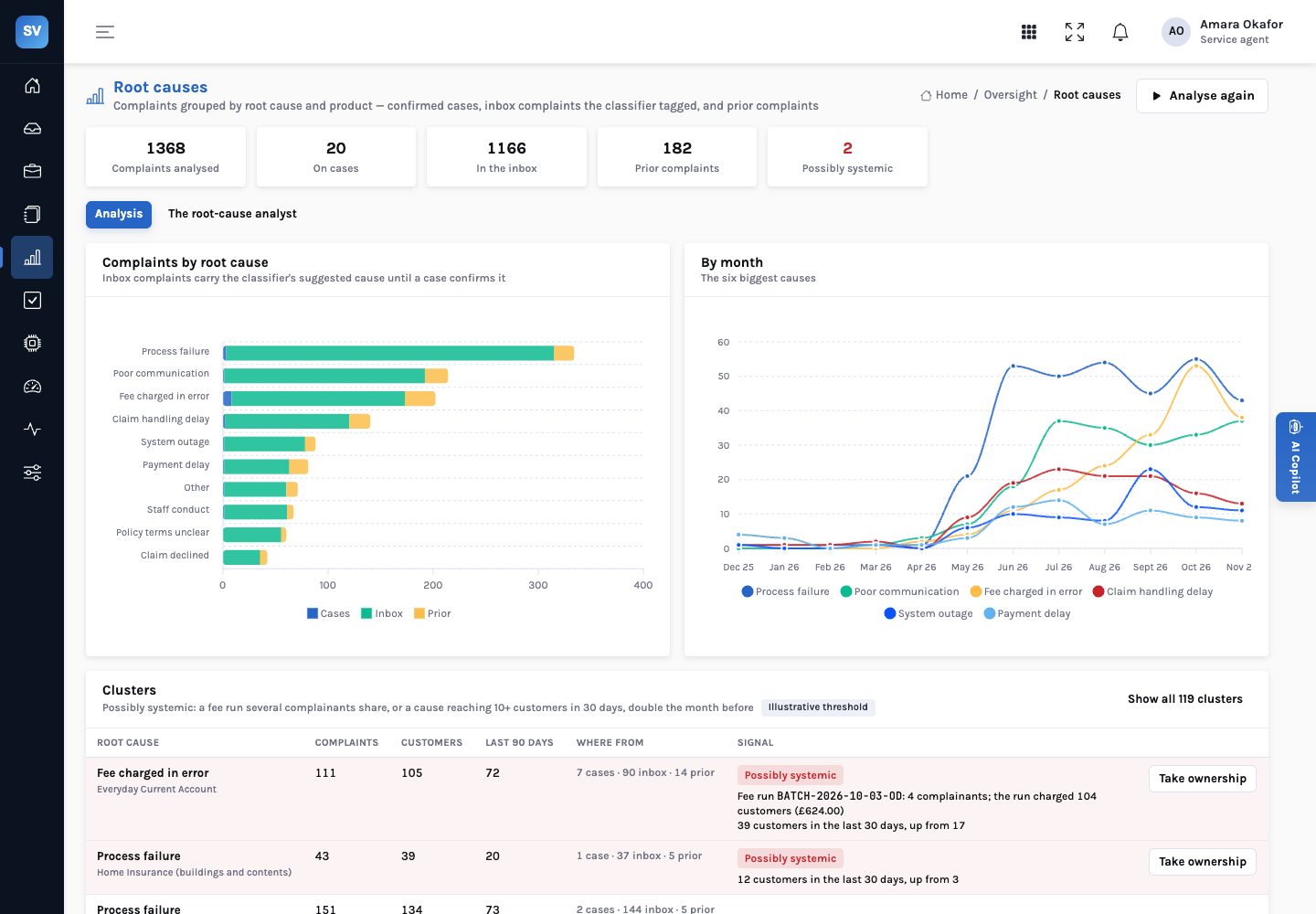
How a cluster is flagged. Both thresholds come from configuration.
What happens to each complaint
The root cause does not replace the individual complaints. Each one is still a complaint on its own clock, owed an acknowledgement, a decision and a final response. Two of the four have been taken all the way through in the demo; two are still open.
The triage agent quoted the dissatisfied sentence. The case researcher found one fee in question, £6.00 on 3 October.
Accepted the researcher’s proposal: fee charged in error.
£6.00 refund plus £0.06 interest at the illustrative 8% simple rate: £6.06. Below the £250 threshold, so no second approver is needed.
Approved with the note “Fee from the faulty overdraft run”.
The reply drafter’s acknowledgement, accepted and sent on 21 November, against an illustrative due date of 25 October. The clock records it as missed, and QA sampling would fail that check. In the demo nothing is delivered: SERVICE_COMMS_LIVE is off.
Upheld: “The overdraft fee was charged in error by a faulty fee run.”
The final response letter, with the refund and the template referral-rights wording, sent well inside the illustrative eight-week deadline of 15 December. No control blocked the close.
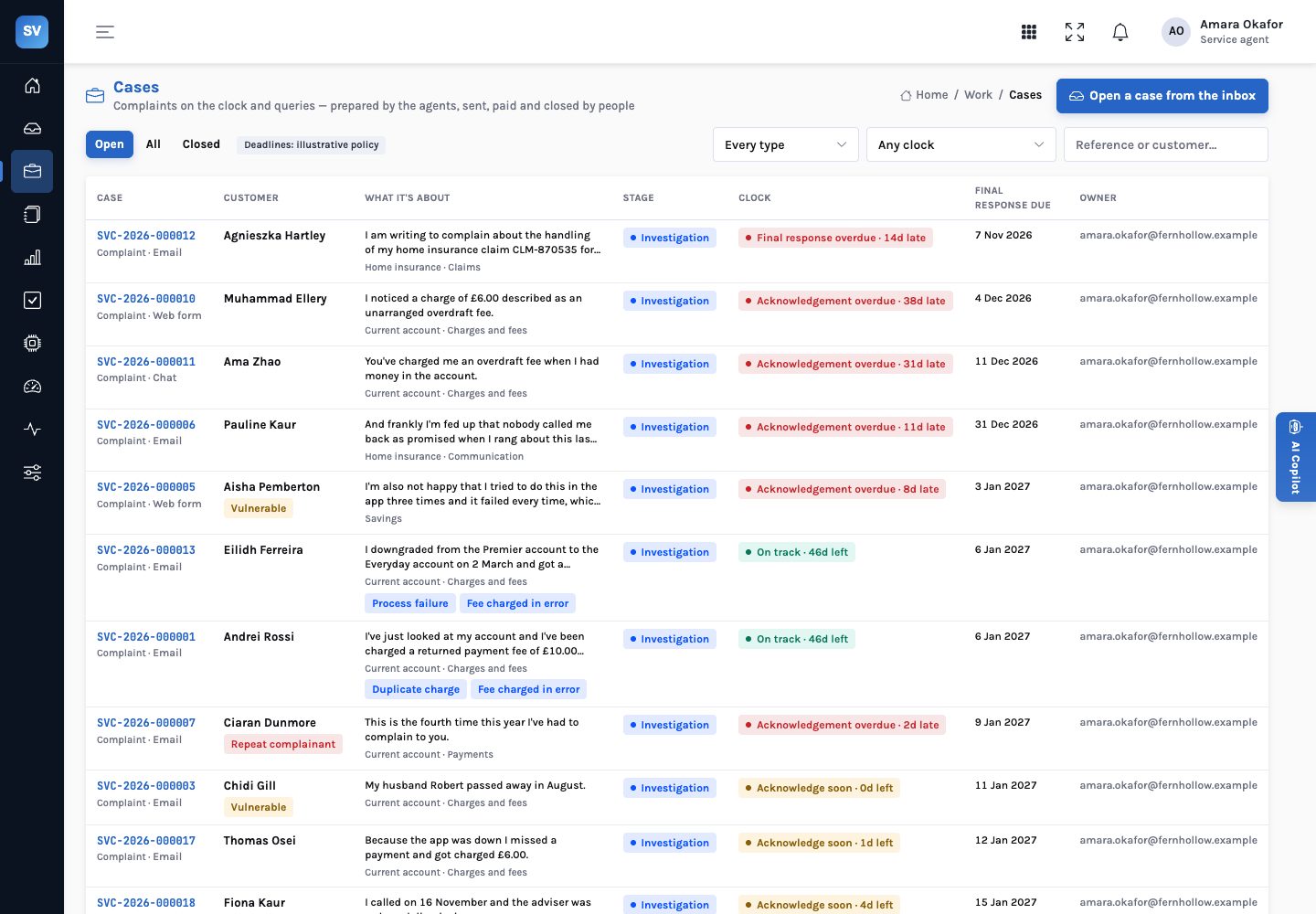
Eilidh Penhale’s case followed the same path, including a late acknowledgement; the QA sample later failed her case on exactly that check. Muhammad Ellery’s and Ama Zhao’s are still under investigation, and both show the same prepared decisions: tag the root cause as fee charged in error, put a £6.06 remediation on the case, use the drafted acknowledgement, and uphold. On both, the acknowledgement is overdue against the illustrative five-day policy: 38 days late for Muhammad Ellery, 31 for Ama Zhao. That is visible on the case header and on the case queue, and the case controls will not let either close without an outcome, a root cause and a sent final response.
What the people who own the problem do
“Possibly systemic” is a prompt for a person, not a conclusion. The root-cause analyst prepares a single decision on the Root causes page: take ownership of the flagged clusters. A person who accepts it becomes the owner on the record, with a note. From there, the work is outside the complaint queue:
- Confirm the fault. The run is evidence that something went wrong with fees charged on 3 October. Whether every one of the 104 fees was wrong is for the team that runs the fee engine to establish.
- Decide on proactive remediation. Refunding customers who didn’t complain is a business decision with its own governance. InsightService shows the reach of the run; it does not refund anyone, and nothing is paid from it.
- Fix the cause. The fee-run defect itself, so the next run doesn’t repeat it.
- Keep handling the complaints. Complaints that arrive about the same run keep being handled individually, with the researcher linking each one to the run.
For the head of complaints
Four complaints about £6 are a reporting line. One fee run that reached 104 customers is a conversation with the business owner and, depending on the outcome, possibly your regulator. The cluster gives you the evidence in one place.
For the service operations lead
Your handlers don’t need to spot the pattern. The research links each new complaint to the run, and the prepared remediation and drafts are the same for every case, so four handlers reach four consistent answers.
For the board
The board should hear about the run, not the four complaints: how many customers it reached, what it cost them, who owns the fix, and whether customers who didn’t complain are being put right.
What this shows
Complaints are the cheapest early warning a firm has, because customers do the detecting. The cost of using them is joining up the evidence: the fee and its run from the firm’s records, the complaints across channels, the trend over months. In InsightService that join is deterministic. The same data gives the same clusters every time, every count is a real complaint, and the flag is raised for a person to own rather than acted on by a machine.