Business cases for complaint-handling automation usually fail in one of two ways. Some borrow a vendor’s headline percentage, and finance discounts the whole case the moment it asks where the number came from. Others count only handler hours, and miss the costs that actually worry a board: deadlines missed, redress worked out differently by different people, and a systemic problem found by the regulator before the firm. This post sets out a method built from your own numbers. It contains no figures of ours, because the only figures that matter are yours.
In short
- Measure before you model. A two-week time sample of how handlers actually spend a complaint is worth more than any benchmark. Split it into preparation and decision.
- Four value lines, not one. Handler time on preparation; deadlines missed; redress that has to be redone; and the cost of finding a systemic problem late.
- The variable that decides it is the share of time spent preparing. Agents prepare; people decide. If most of a handler’s time is decision, the case is weak, and you should know that before you buy.
- Count the costs honestly. Integration with your source systems, policy set-up, validation, training and the people who answer what agents prepare are all real costs.
Start with a time sample
Pick a representative two weeks and ask handlers to log, per complaint, the time spent on each activity below. Use your own categories if you have them. What matters is separating work that prepares a decision from the decision itself, because that is the line along which work can move to agents.
| Activity | Preparation or decision? | What to measure |
|---|---|---|
| Reading the contact, deciding whether it is a complaint | Preparation, then a decision | Minutes per contact; share later reclassified |
| Finding the customer, accounts, fees and history | Preparation | Minutes per case; systems opened |
| Spotting vulnerability | Preparation | Share of vulnerable customers identified only later |
| Working out redress and interest | Preparation | Minutes per case; share corrected at QA or approval |
| Drafting the acknowledgement, response and final letter | Preparation | Minutes per letter; share rewritten by a reviewer |
| Deciding the outcome | Decision | Minutes per case |
| Approving redress, signing off referred closes | Decision | Minutes per approval |
| Root-cause tagging and analysis | Preparation for a decision | Minutes per case; hours per month for MI |
| QA re-reading | Check | Minutes per sampled case |
Also pull, from your existing records, the counts the model needs: complaints per month by product, the share that missed each deadline, the share of redress changed after the first calculation, and any complaints the firm reclassified from “query” after the fact.
The model
Each line below is a formula with your inputs. Keep the inputs in a spreadsheet the finance partner can audit, and show a low, central and high case rather than a single number.
| Value line | Formula (your inputs) | Where the input comes from |
|---|---|---|
| Preparation time released | Complaints per year × preparation minutes per complaint × share of preparation agents take on × loaded cost per handler minute | The time sample; the pilot measures the share |
| Deadlines kept | Complaints per year × share currently missing a deadline × reduction observed in the pilot × cost per missed deadline | Your MI; your own estimate of handling and ombudsman cost per late case |
| Redress done once | Remediations per year × share recalculated or corrected × cost of rework per case | QA findings; approval rejections |
| Hidden complaints found | Contacts per year × share with dissatisfaction not recorded as a complaint | A manual audit of a sample of queries |
| Systemic issues found earlier | Scenario: a past systemic issue, and what finding it a month earlier would have saved | Your incident history; a scenario, not a forecast |
The last two lines are deliberately not money in the first version. A hidden complaint is an under-reported complaint, which is a compliance exposure before it is a cost. A systemic issue found late is a scenario, not a forecast. Present them as risk reduction with the evidence from your own audit, and let the committee weigh them.
Where each input comes from. Nothing in the model is a benchmark.
Where the value comes from, and where it doesn’t
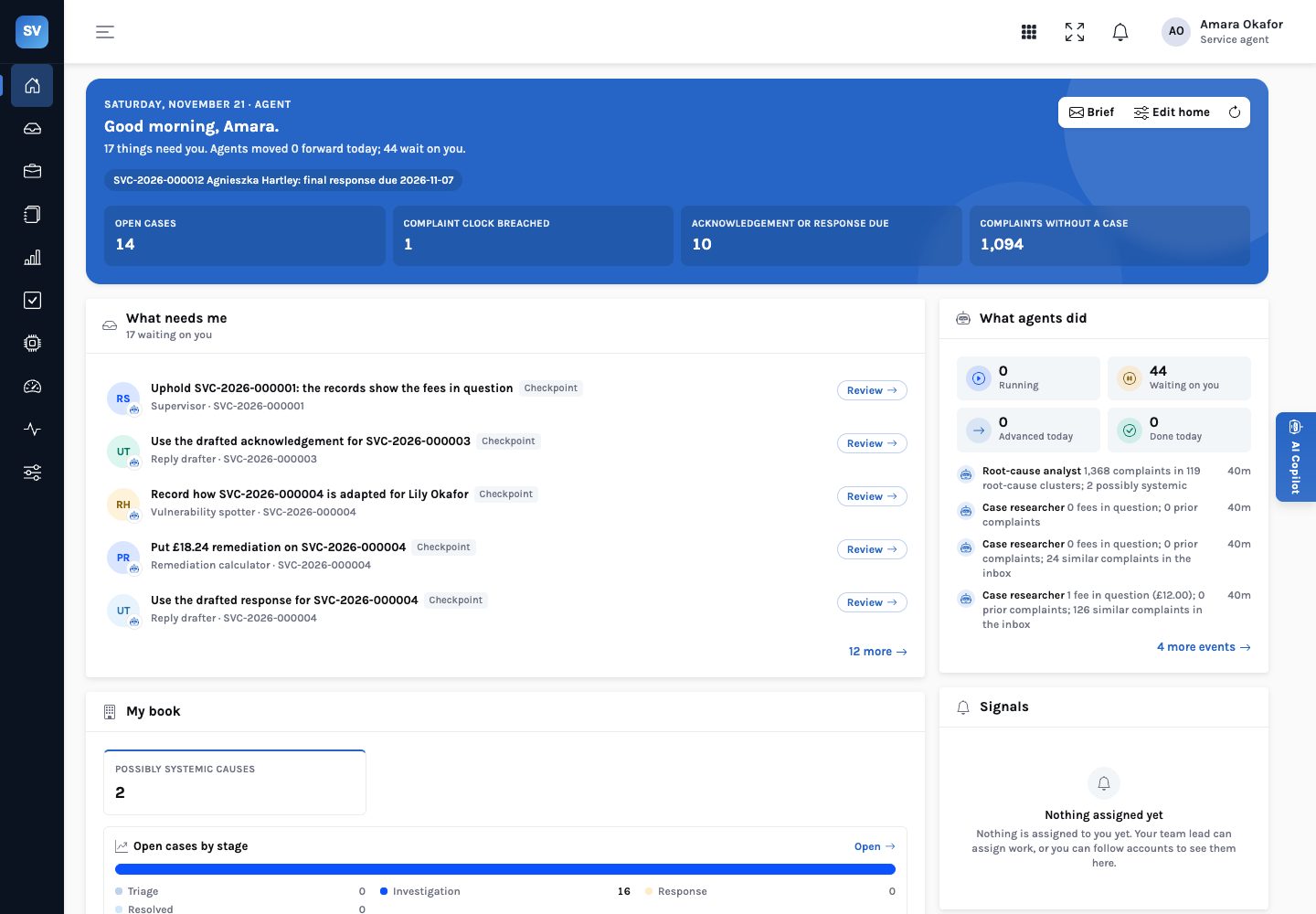
It helps to be precise about what an agent-first product changes. In InsightService, agents classify contacts and quote the sentence that makes one a complaint, research the customer’s fees and history, spot vulnerability, work out redress with a deterministic calculator, draft replies from the knowledge base, and say what still blocks a close. People decide whether it is a complaint, record the outcome, send every reply, approve redress, and close the case. Agents never send, pay, classify, close or approve.
A case that assumes the product will decide outcomes or approve redress counts savings that will never arrive, because those steps stay with people.
A case built on preparation time, deadlines kept and redress done once counts what actually moves. Decision time stays, and is better informed.
There is also value that does not reduce cost at all but changes what a firm can show. A decision record per case; every control’s outcome at the close; redress anyone can recalculate; QA that recomputes the deadlines and the redress. These matter most to the person who has to explain the complaints function to a regulator or an ombudsman, and they are worth stating separately.
Costs to include
| Cost | What it covers | Often forgotten? |
|---|---|---|
| Licences or build | The product, or the team that builds and runs your own | No |
| Source connections | Read access to contacts, customers, accounts, fees, policies, claims and prior complaints; views or extracts where needed | Often underestimated |
| Policy set-up | Your deadlines, redress rate, approval threshold, sampling rate and systemic threshold; your case controls in Rules Studio; your approved letter wording | Yes |
| Knowledge base | The articles replies are drafted from must be current and approved | Yes |
| Classifier tuning | The dissatisfaction and vulnerability lexicons are a starting point a firm tunes | Yes |
| Validation | Model risk or internal audit review of the agents and the calculator | Yes |
| Training and change | Handlers and leads learn to accept, reject and ask rather than prepare | Sometimes |
| Answering prepared decisions | Every agent output at L1 and L2 waits for a person; that time is real | Very often |
| Run cost | Hosting in your cloud account and, if enabled, language-model usage | Sometimes |
The variable that decides it
Run the model with the share of handler time spent on preparation from your time sample. If preparation is a small share, because your complaints are few and complex and most of the time is judgement, the time line will be small and the case will rest on deadlines, consistency and evidence. That can still be a good case, but it is a different one, and it should be presented that way.
Volume and the share of preparation decide which value lines dominate.
Replacing assumptions with measurements
Every input marked “the pilot measures” should be measured in the product itself rather than estimated. In InsightService, every agent step and every person’s answer to what an agent prepared is recorded: accepted, changed, rejected or asked about. The agreement rate by agent and action is the share of preparation that people kept, which is the share the time line depends on. Deadlines come from each case’s own dates, and redress corrections show as differences between the calculator’s figure and the approved one.
How the pilot feeds the model: each answer is a data point.
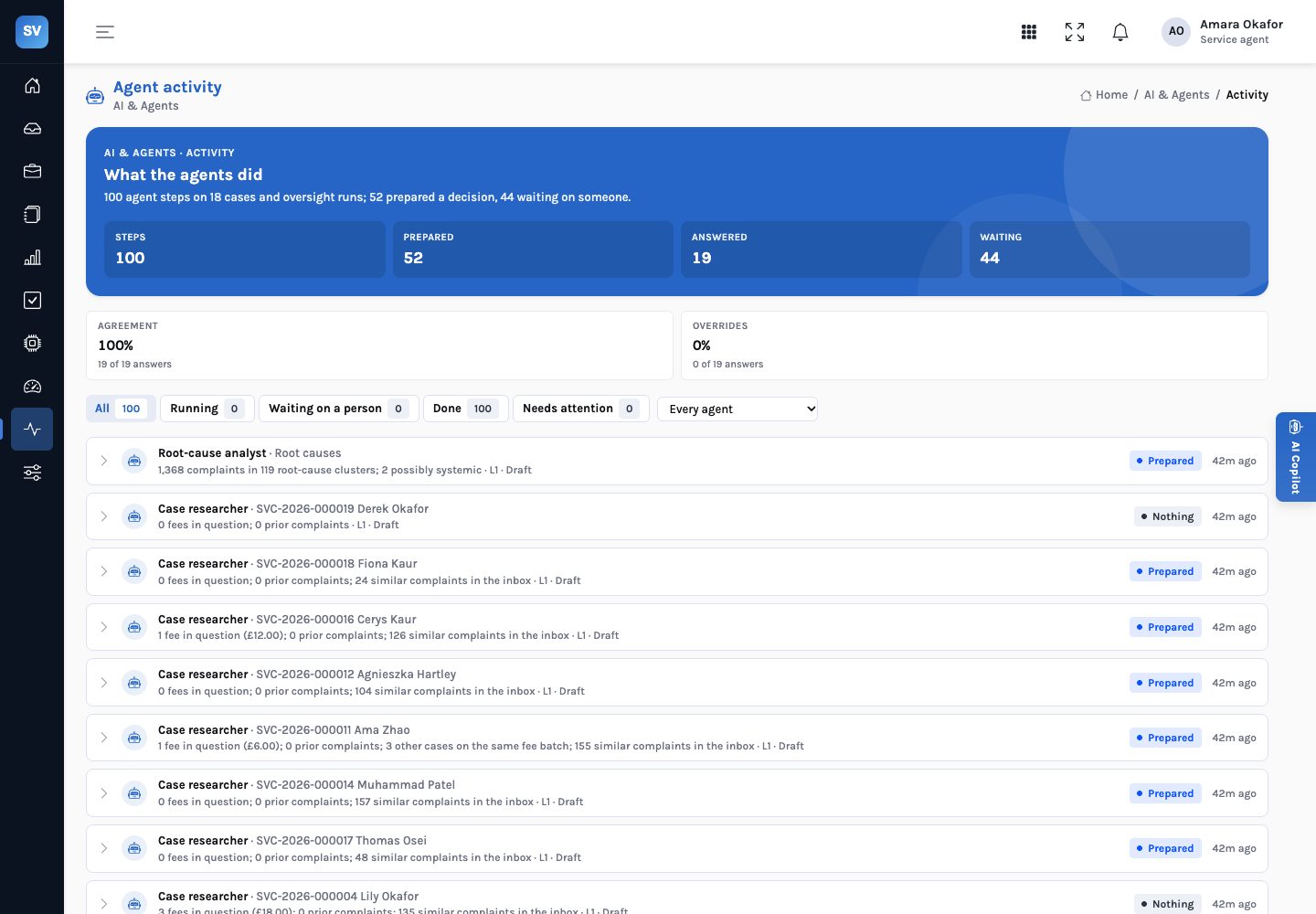
Two cautions. Agreement measured in the first weeks is usually lower than it will settle at, because the classifier lexicons and the knowledge base are still being tuned; report the trend, not the first week. And agreement says people kept what was prepared, not that it was right; the sample worked both ways and QA sampling are what check quality.
Questions finance will ask
- Where does each input come from? Every number should trace to the time sample, your MI or the pilot.
- What happens to the released time? Fewer contractors, absorbed growth, faster handling, more QA. Say which; they are valued differently.
- What if agreement with the agents is low? Then the preparation share they take on is low too, and the time line shrinks. The pilot measures agreement directly.
- What does the downside look like? Show the low case with the full cost line.
- Can we stop? The product reads your systems and keeps its work in its own schema; stopping means stopping, not migrating your records back.
How we would run the pilot
One product line with enough complaints to measure in a few weeks. Agents prepare every case; handlers decide every case. A fixed sample is also worked the old way. Measure preparation minutes, agreement with what the agents prepared, deadlines kept and redress corrected. The first ninety days sets out the plan.
What it means for each audience
For the head of complaints
The strongest part of the case for you is not hours. It is deadlines kept, vulnerability noticed, redress that is the same for every customer, and a record you can show. Ask for those to be measured in the pilot.
For the service operations lead
Your time sample is the foundation. Run it honestly, including the time it takes to answer what agents prepare, and you will know whether the time line is real before anyone signs.
For the board
Ask for a low, central and high case built only from the firm’s own numbers, and for the risk lines to be shown separately from the cost lines.
A business case built on your own numbers survives the first question.
Measure how handlers spend a complaint, separate preparation from decision, and model only what agents actually take on.
Then let a pilot replace every assumption with a measurement.