Eilidh Ferreira downgraded her current account in March. The bank confirmed it in writing, and then kept charging her the old account’s £32 monthly fee for eight months. In September a direct debit bounced and she was charged for that too. Her complaint is easy to understand and easy to uphold. The work is in getting the redress exactly right, and in making sure that a sum above the firm’s threshold is approved by someone other than the person who worked it out. This post follows her case on the demo firm’s data.
In short
- Nine fees in question. The case researcher found eight £32 Premier monthly fees from 28 March to 28 October 2026 and a £10 returned payment fee on 15 September: £266.00.
- Interest worked out to the penny. Each fee is refunded with simple interest at the illustrative 8% a year from the day it was charged: £7.49 in all, £273.49 in total.
- Above the threshold, so four eyes. £273.49 is above the illustrative £250 approval threshold. The service agent submitted it; only a team lead who neither proposed nor submitted it can approve it.
- The approval is on the record. The decision record keeps the items, the rate, the threshold, who proposed, who submitted and who approved. Nothing is paid from InsightService; the refund is made in the firm’s payment system.
The complaint
The demo firm is Fernhollow Bank & Insurance, fictional, with invented customers and fees. The email arrived on 11 November 2026 with the subject “Still being charged for Premier account”:
Eilidh Ferreira, by email
“I downgraded from the Premier account to the Everyday account on 2 March and got a confirmation letter. I’ve only just noticed you’ve carried on charging me the £32 monthly fee every single month since, and in September a direct debit bounced because of it and I got charged for that too. That’s hundreds of pounds. I want all of it back with interest and an explanation of how this happened.”
The triage agent classified it as a complaint about the current account and quoted the sentence that carries the dissatisfaction. The case opened as SVC-2026-000013, and the complaint clock started from receipt: an acknowledgement due by 16 November and a final response by 6 January 2027, under the demo’s illustrative policy of five days and eight weeks.
Finding the fees
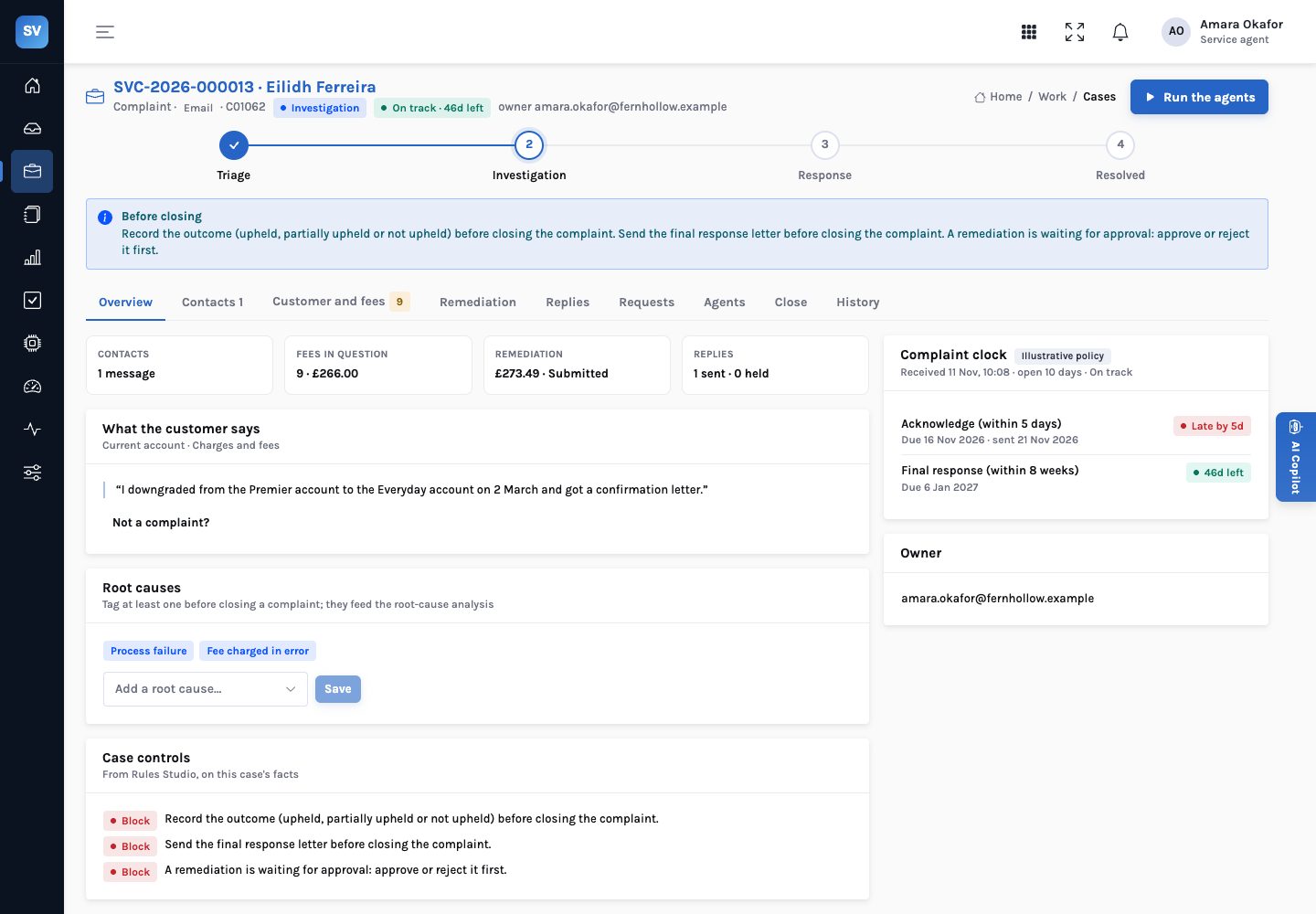
Customers rarely list every fee, and handlers rarely have time to scroll six months of statements. The case researcher reads the customer’s accounts and fees from the firm’s records and picks out the fees the message names. Two things in her email matter. She names the monthly fee, and she uses recurring language (“every single month since”), so every monthly fee in the window is in question, not just the latest. She also names the returned payment, so that fee is in question too.
| Charged | Fee | Amount | Why it is in question |
|---|---|---|---|
| 28 Mar 2026 | Monthly account fee · Premier Current Account | £32.00 | Charged repeatedly, as the customer says |
| 28 Apr 2026 | Monthly account fee · Premier Current Account | £32.00 | Charged repeatedly |
| 28 May 2026 | Monthly account fee · Premier Current Account | £32.00 | Charged repeatedly |
| 28 Jun 2026 | Monthly account fee · Premier Current Account | £32.00 | Charged repeatedly |
| 28 Jul 2026 | Monthly account fee · Premier Current Account | £32.00 | Charged repeatedly |
| 28 Aug 2026 | Monthly account fee · Premier Current Account | £32.00 | Charged repeatedly |
| 15 Sep 2026 | Returned payment fee · Everyday Current Account | £10.00 | The customer names the returned payment fee |
| 28 Sep 2026 | Monthly account fee · Premier Current Account | £32.00 | Charged repeatedly |
| 28 Oct 2026 | Monthly account fee · Premier Current Account | £32.00 | Charged repeatedly |
Every row is a fee in the firm’s records, with its fee identifier and the run that charged it. The researcher never invents a charge; if the records held no such fee, it would say so. The fee history underneath marks the nine as “in question” so the handler can see them in context.
Working out the redress
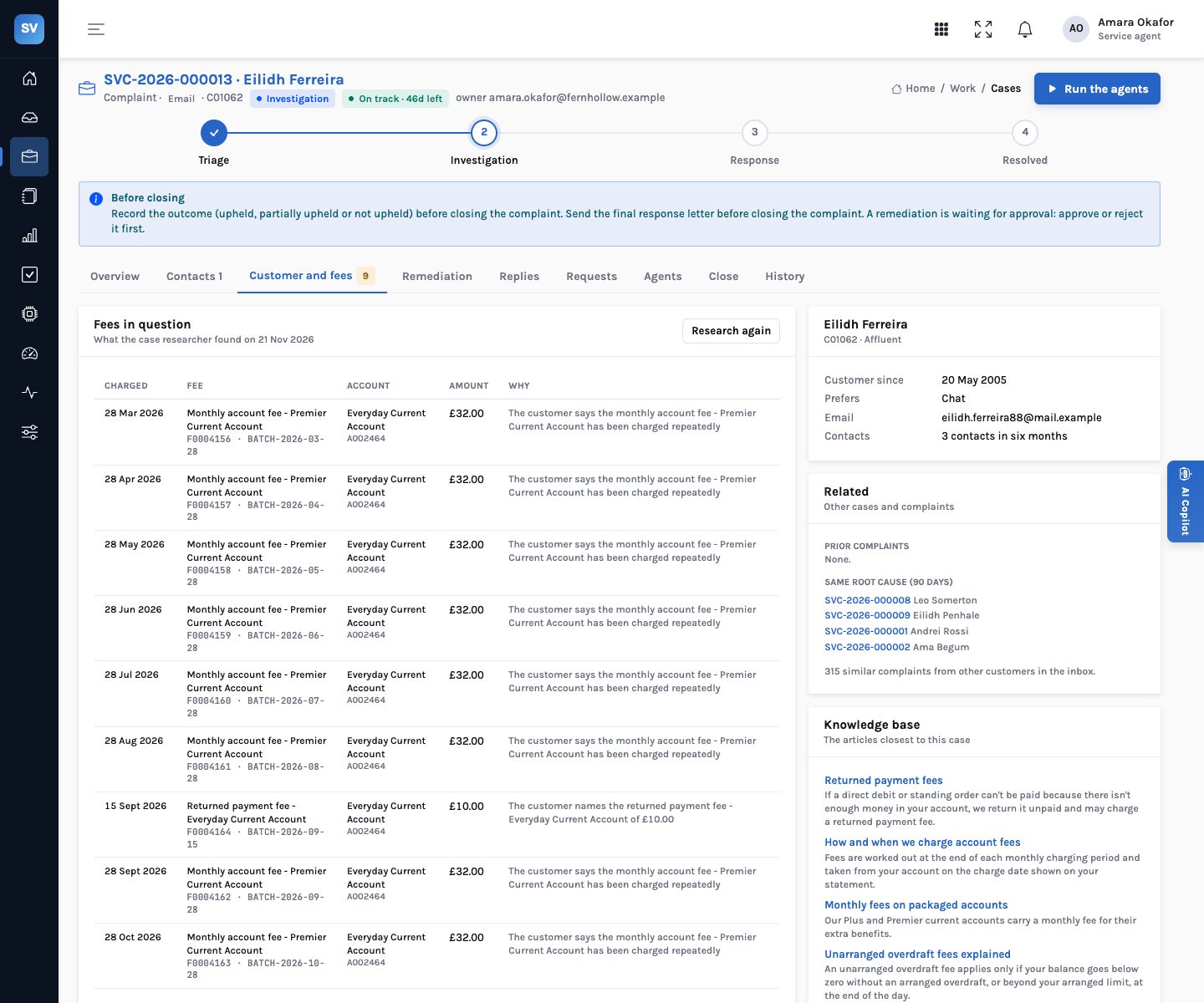
The remediation calculator is deterministic code, not a model. For each fee it refunds the amount and
adds simple interest: the amount, times the rate, times the days since the charge, divided by 365,
rounded to the penny. The rate is SERVICE_REMEDIATION_RATE, 8% a year in the demo.
That figure is an illustrative placeholder; your firm sets its own redress policy.
| Fee | Charged | Refund | Days to 21 Nov | Interest |
|---|---|---|---|---|
| Premier monthly fee | 28 Mar 2026 | £32.00 | 238 | £1.67 |
| Premier monthly fee | 28 Apr 2026 | £32.00 | 207 | £1.45 |
| Premier monthly fee | 28 May 2026 | £32.00 | 177 | £1.24 |
| Premier monthly fee | 28 Jun 2026 | £32.00 | 146 | £1.02 |
| Premier monthly fee | 28 Jul 2026 | £32.00 | 116 | £0.81 |
| Premier monthly fee | 28 Aug 2026 | £32.00 | 85 | £0.60 |
| Returned payment fee | 15 Sep 2026 | £10.00 | 67 | £0.15 |
| Premier monthly fee | 28 Sep 2026 | £32.00 | 54 | £0.38 |
| Premier monthly fee | 28 Oct 2026 | £32.00 | 24 | £0.17 |
| Total | £266.00 | £7.49 |
The first row, as a check anyone can do: £32.00 × 8% × 238 ÷ 365 = £1.669, which rounds to £1.67. The total redress is £273.49. Because it is code, the QA reviewer can recalculate it later from the same items and confirm the case paid what the calculation says.
The calculation and the routing. Rate and threshold are illustrative configuration.
Four eyes, enforced
The remediation calculator prepared the remediation; Amara Okafor, the service agent, accepted it, and
it went on the case as proposed. Because £273.49 is above the £250 threshold
(SERVICE_APPROVAL_THRESHOLD, illustrative), she couldn’t approve it. She submitted it
for a team lead’s approval instead.
The rule isn’t a reminder on screen; the API refuses. An approval above the threshold must come from someone with the team-lead role, and that person must not be the one who proposed or submitted it. An agent can never approve or pay at all, at any amount.
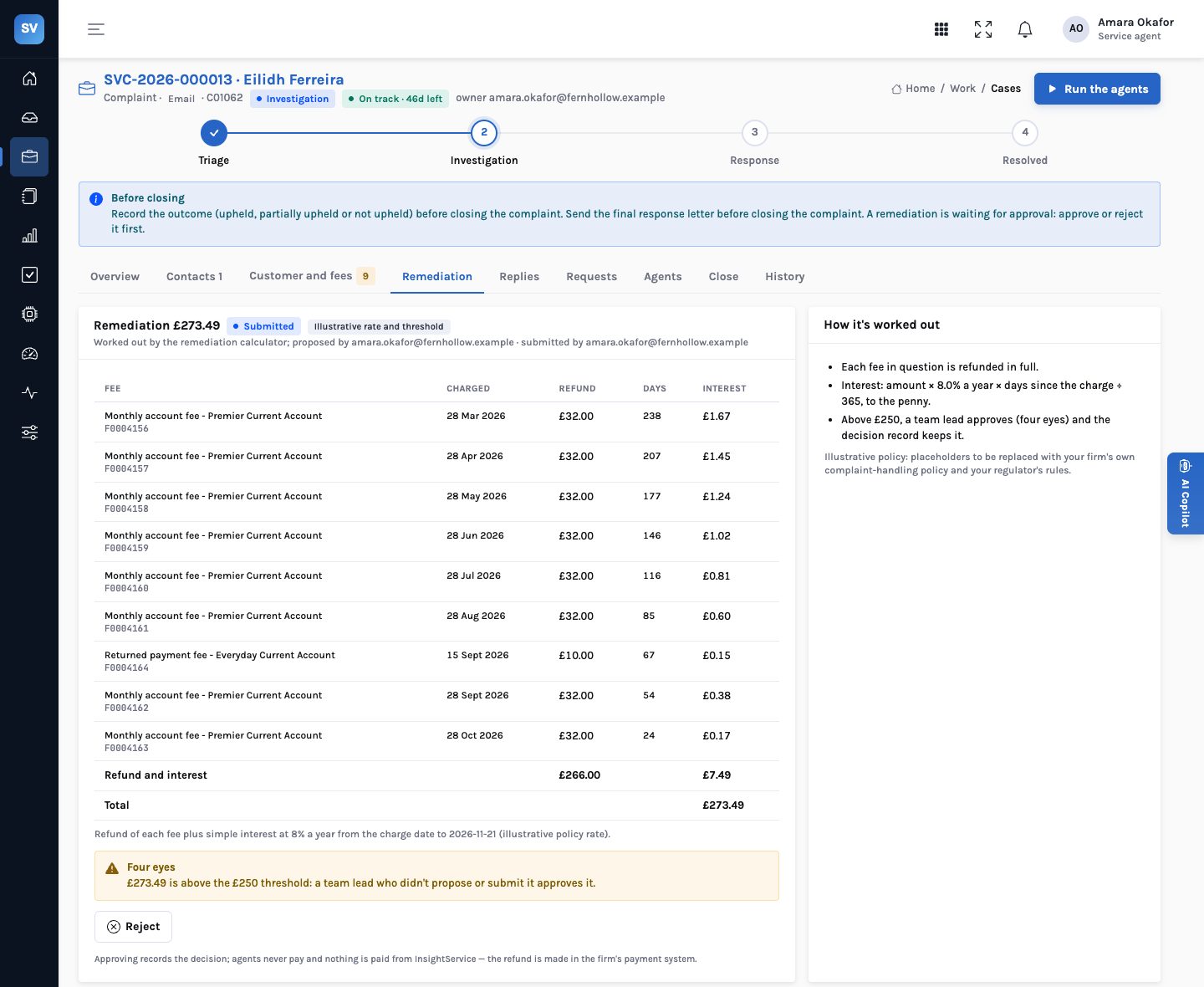
Tom Hartley is a team lead. On his home page, the first thing that needs him is the approval. On the case, he sees the same calculation with an Approve button that Amara never had.
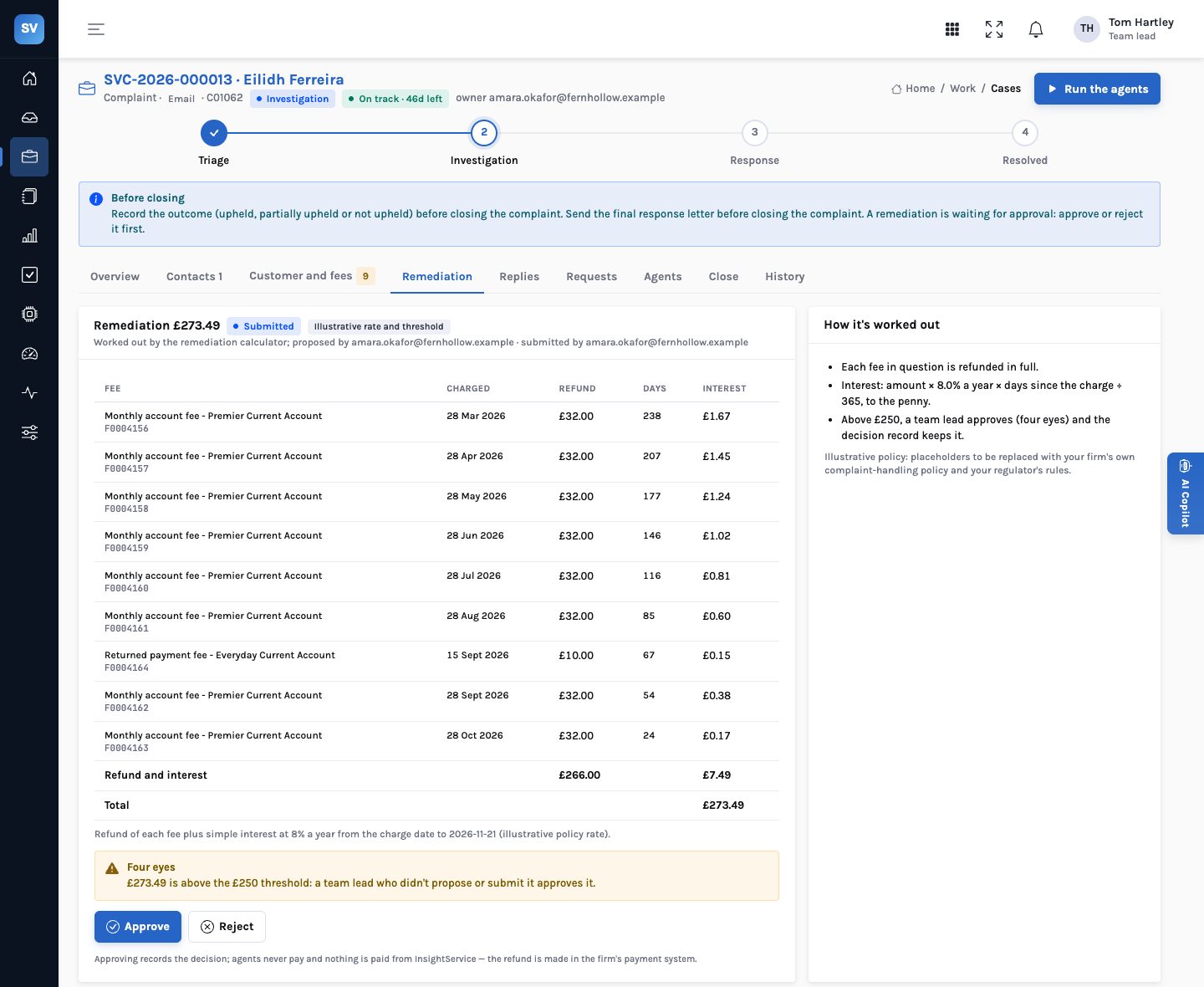
Who does what. The agent prepares; two different people propose and approve.
The runbook
Complaint about the current account, the dissatisfied sentence quoted. The clock starts from 11 November.
Nine fees in question, £266.00. No prior complaints. Root causes proposed: process failure, fee charged in error.
Accepted the proposal. The tags feed root-cause analysis.
£273.49 with each item’s interest. Above the threshold.
Amara Okafor submits it; she can no longer approve it.
Sent on 21 November, five days after the illustrative due date; the clock shows it as late.
Tom Hartley, who neither proposed nor submitted it. Waiting.
The supervisor proposes “upheld: the records show the fees in question”. A person records it.
Drafted with the approved refund and interest, the fees listed and cited, and the referral-rights wording flagged as a template. Held until sent.
Only once no control blocks it.
Until the lead decides, three case controls block a close: no outcome recorded, the final response not sent, and a remediation waiting for a decision. The reply drafter also won’t produce a final response while the remediation is pending, because the letter has to state the redress that was actually approved.
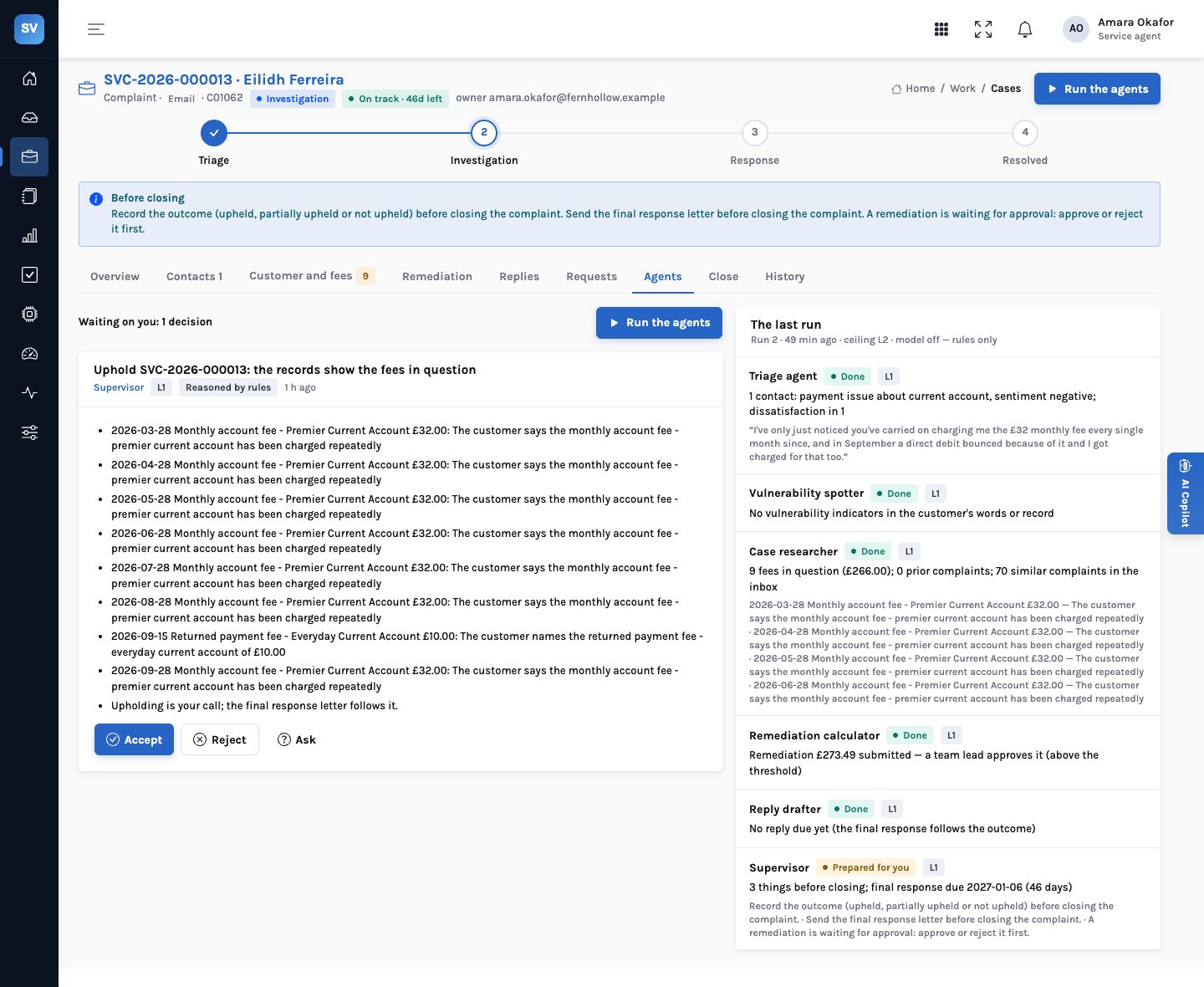
Asking the copilot
A team lead picking up the approval can ask the copilot about the case. It reads the case through read-only tools and never sends, pays, classifies or closes. In the demo the language model is switched off, so it answers from the case’s headline facts and says so.
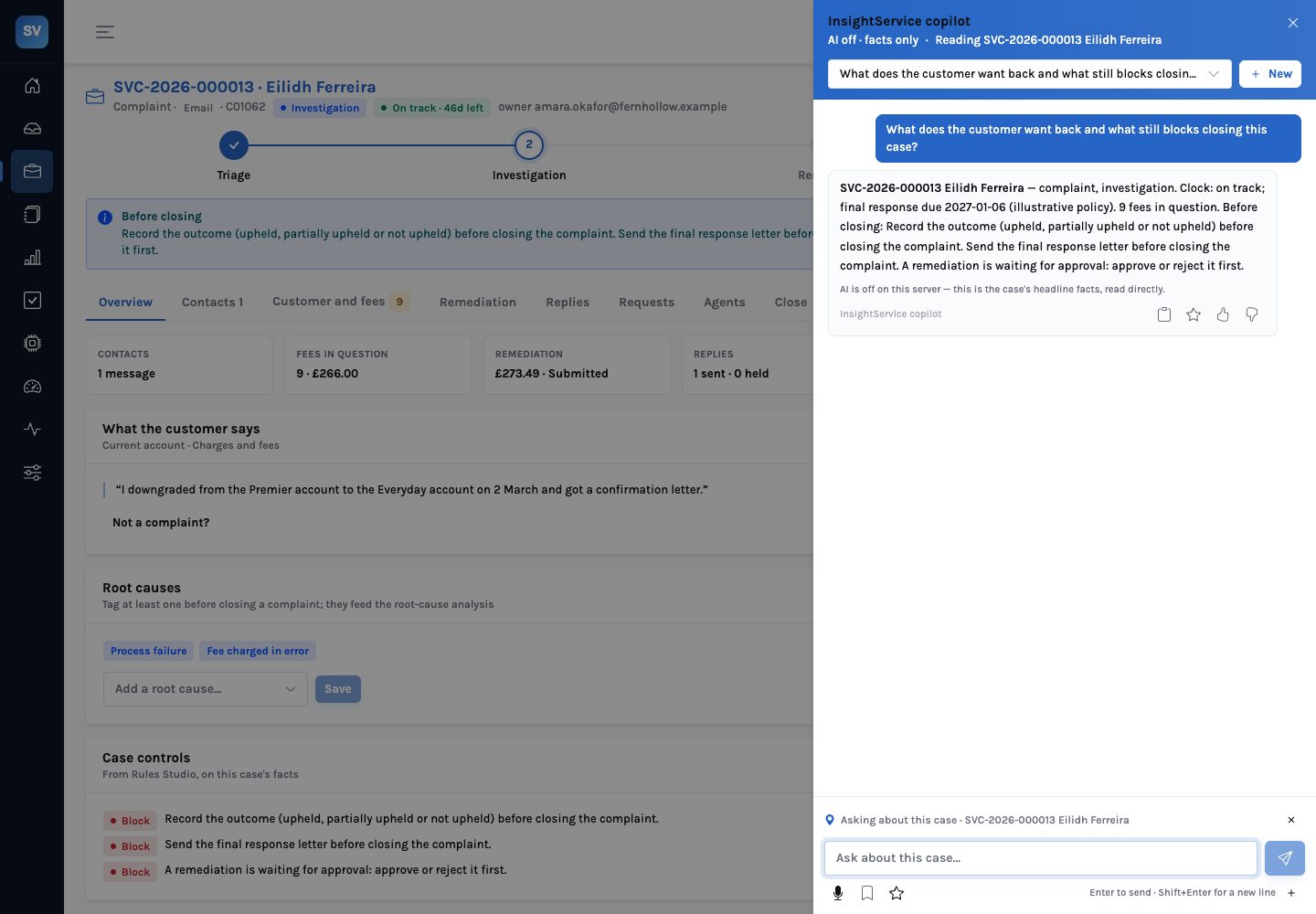
For the head of complaints
Inconsistent redress is one of the commonest complaint-handling findings. Here the method is the same on every case, the rate and threshold are your policy, and the approval above it is enforced, not requested.
For the service operations lead
Your handlers stop doing interest arithmetic by hand. They check the fees in question, accept or correct, and route the approval. A lead’s queue shows exactly what needs a second pair of eyes.
For the board
The board can ask how much redress was paid above the threshold, and who approved each sum. The decision record answers both.
What this shows
Getting the outcome right was never the hard part of Eilidh Ferreira’s complaint. Getting nine fees, nine interest periods and a second approver right, every time and for every handler, is. The calculation is code anyone can rerun, the threshold is configuration, and the four-eyes rule is something the system refuses to skip.