Most complaint controls are about getting a case right. Two are about noticing when a case has already gone wrong: when the deadline for the final response has passed, and when the customer is complaining for the fourth time in a year. Neither should stop the case from being resolved. Both should make sure that someone senior looks at it before it closes. This post follows two such cases on the demo firm’s data, and shows how a referral to a team lead is enforced rather than requested.
In short
- A breached clock. Agnieszka Hartley complained on 12 September 2026 about her home insurance claim. Under the demo’s illustrative eight-week policy her final response was due on 7 November. On 21 November it is 14 days overdue, and she has not been acknowledged.
- A repeat complainant. Ciaran Dunmore writes that “this is the fourth time this year”. The firm’s records hold three prior complaints from him in 2026, so the case is flagged as a repeat complaint.
- Refer, not block. In Rules Studio, both are case controls whose effect is refer: the case can still be resolved, but it must be submitted by one person and closed by a team lead who isn’t the submitter.
- Seen again afterwards. QA sampling always includes closed cases that breached the clock or came from a repeat complainant, whatever the sampling rate.
What the deadline is, and what it isn’t
The demo’s deadlines are illustrative policy, set in configuration
(SERVICE_ACK_DAYS, five days, and SERVICE_FINAL_WEEKS, eight weeks) and
labelled that way on every screen. They are placeholders a firm replaces with its own policy and the
rules that apply to it. Eight weeks is chosen because it mirrors the best-known UK timescale:
data
In the UK, DISP 1.6.2R requires a firm, within eight weeks of receiving a complaint, to send either a final response or a written response explaining why it is not yet in a position to give one and when it expects to, and telling the complainant that they may refer the complaint to the Financial Ombudsman Service. Shorter timescales apply to some complaints, for example about payment services. A complainant generally has six months from the final response to refer the complaint to the ombudsman.
Sources: FCA Handbook DISP 1.6.2R and 1.6.2AR; DISP 2.8.2R. Check the rules and any exceptions that apply to your firm and product.
So a passed deadline is not only an internal service failure. It changes the customer’s position, and the firm should have told them so. That is why a breach should bring a senior person into the case rather than simply turning a label red.
Case one: the claim that wasn’t settled
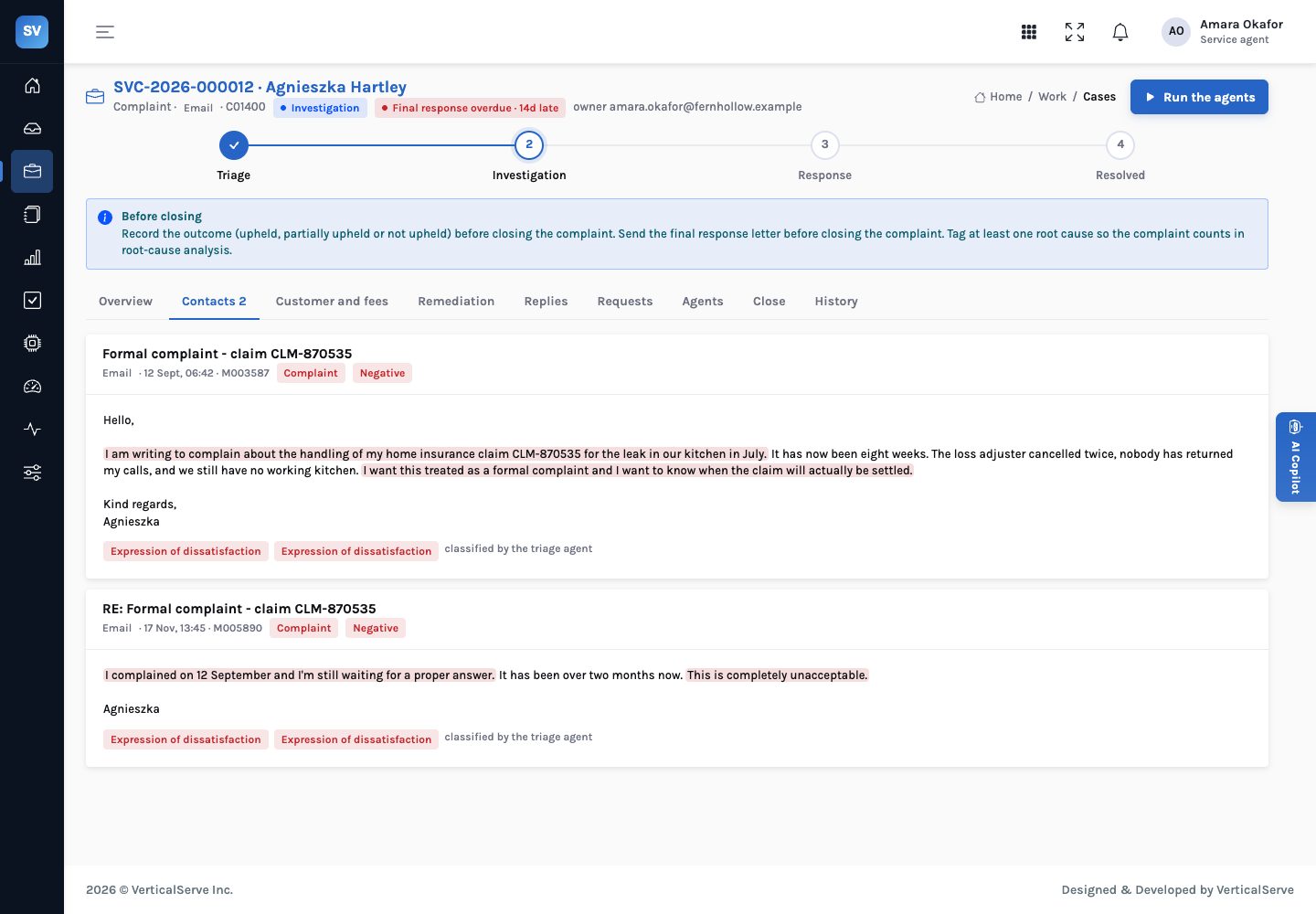
The demo firm is Fernhollow Bank & Insurance, fictional, with invented customers and claims. Agnieszka Hartley emailed on 12 September 2026 with the subject “Formal complaint – claim CLM-870535”:
Agnieszka Hartley, 12 September
“I am writing to complain about the handling of my home insurance claim CLM-870535 for the leak in our kitchen in July. It has now been eight weeks. The loss adjuster cancelled twice, nobody has returned my calls, and we still have no working kitchen. I want this treated as a formal complaint and I want to know when the claim will actually be settled.”
She wrote again on 17 November: “I complained on 12 September and I’m still waiting for a proper answer. It has been over two months now. This is completely unacceptable.” Both emails are on the case, in one thread, each with the sentences the classifier marked as dissatisfaction.
The clock runs from the first contact’s receipt, not from when someone opened the case:
| Leg | Due (illustrative policy) | Done | Status on 21 Nov |
|---|---|---|---|
| Acknowledgement, 5 days | 17 Sep 2026 | Not yet | Overdue by 65 days |
| Final response, 8 weeks | 7 Nov 2026 | Not yet | Overdue by 14 days |
The case header says “Final response overdue”. The home page of every handler and lead shows one complaint clock breached and names the case, and the case queue sorts by the final-response deadline so it sits at the top.
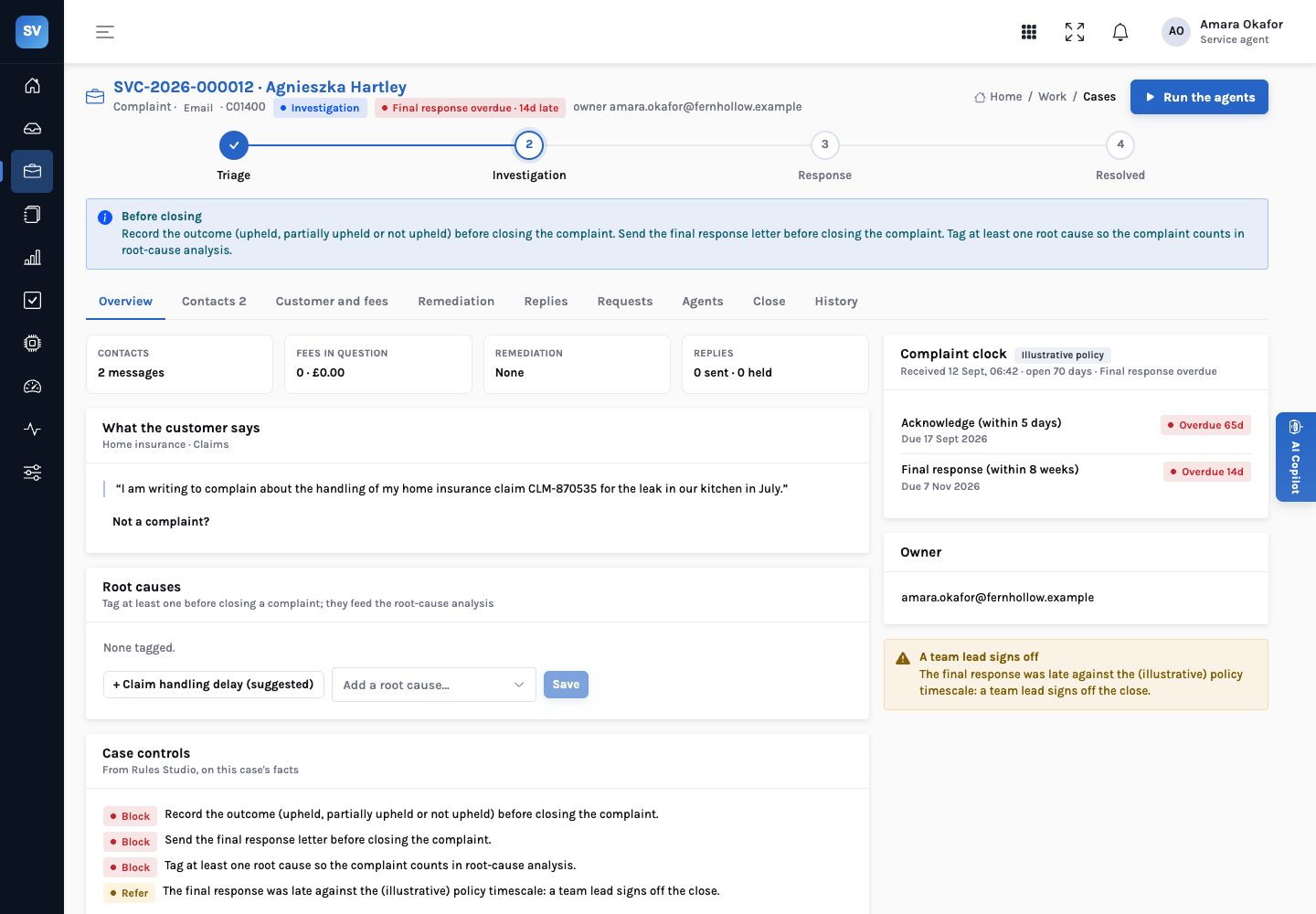
The case researcher found no fees in question (it is a claim complaint, not a fee complaint), no prior complaints from her, and 104 similar complaints from other customers in the inbox. It proposes “claim handling delay” as the root cause. The reply drafter has an acknowledgement ready, quoting her own words, held until a person sends it.
Case two: the fourth complaint this year
Ciaran Dunmore emailed on 14 November 2026:
Ciaran Dunmore, 14 November
“This is the fourth time this year I’ve had to complain to you. Once again a standing order I set up in the app didn’t go out and my gym membership was cancelled. I’m sick of being told it won’t happen again. I want someone senior to look at this properly.”
He is right. The firm’s records of prior complaints hold three from him this year:
| Opened | Root cause | Outcome |
|---|---|---|
| 4 Jan 2026 | Payment delay | Partially upheld |
| 14 May 2026 | Process failure | Upheld |
| 17 Aug 2026 | Poor communication | Upheld |
When a case opens, InsightService counts the customer’s prior complaints in the twelve months before receipt. Two or more make the customer a repeat complainant, and the case is opened at high priority. The research step checks again and also counts his other open cases. The case researcher proposes “payment delay” as the root cause and notes: “Repeat complainant: 3 complaints in the last 12 months”.
His acknowledgement was due on 19 November and is two days overdue. The final response is due on 9 January 2027. Nothing about his case is breached; it is referred because of who he is to the firm, not because of a deadline.
How the controls work
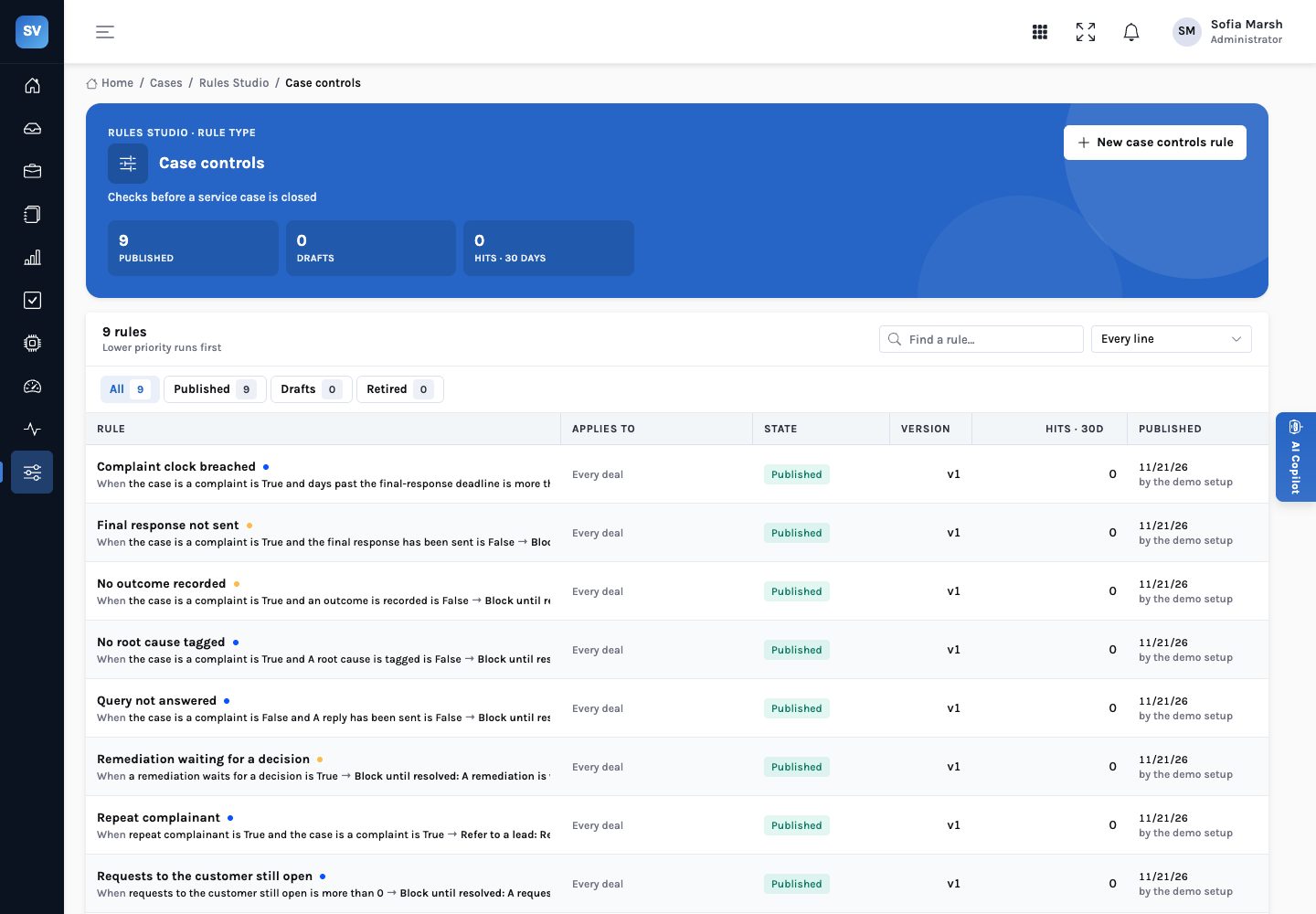
Nine case controls are published in Rules Studio. Seven block a close until something is done. Two refer it:
| Control | Fires when | Effect |
|---|---|---|
| Complaint clock breached | The final response was, or is, later than the policy deadline | Refer: a team lead signs off the close |
| Repeat complainant | Two or more prior complaints in the last twelve months, or two other cases | Refer: a team lead reviews the case before it closes |
| No outcome, final response not sent, no root cause | Any complaint without them | Block |
| Vulnerability not addressed | Indicators but no note of how the case is adapted | Block |
| Remediation pending, requests open | Anything still waiting for a decision or an answer | Block |
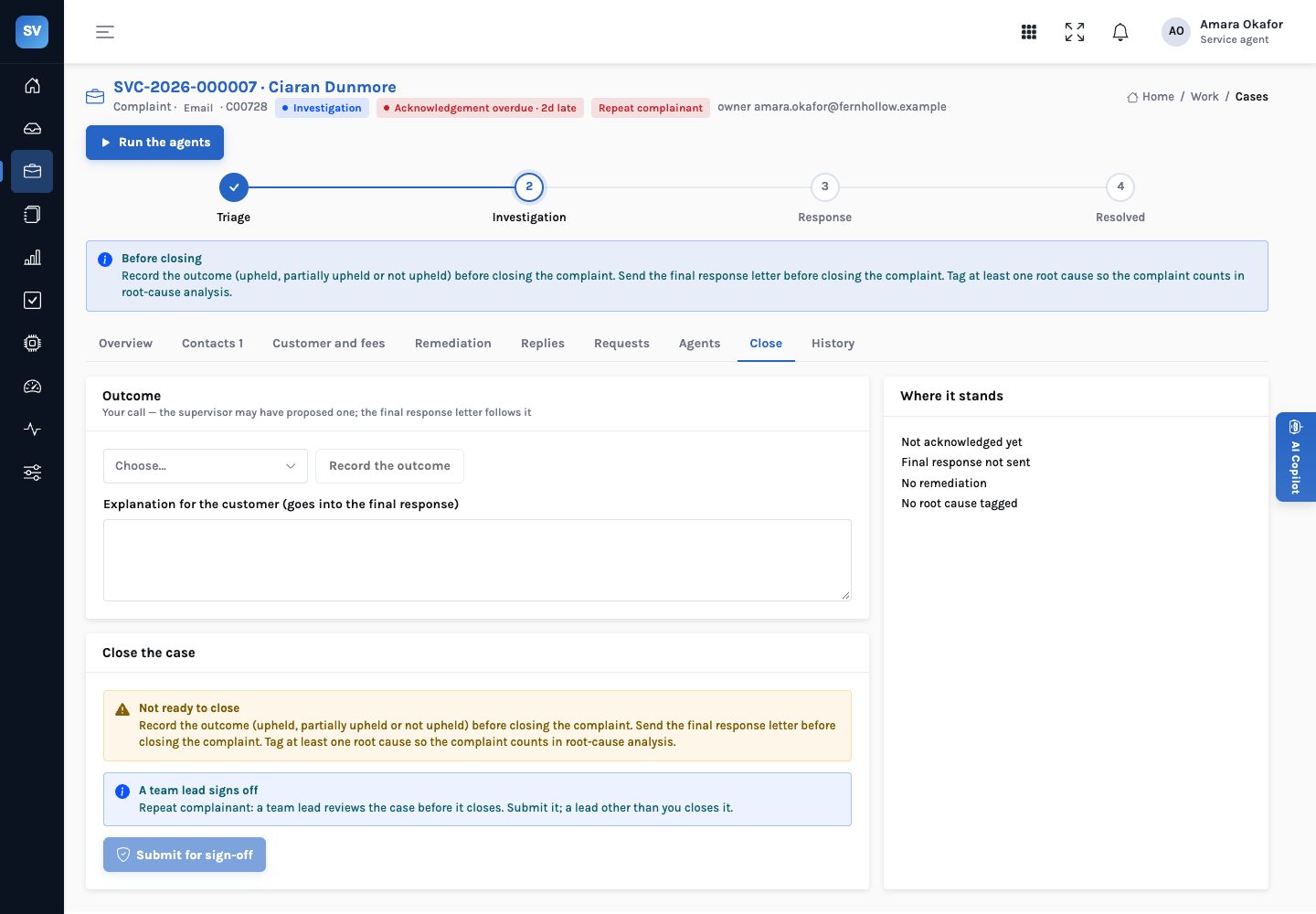
A referred close works in two steps. First, once nothing blocks the case, someone submits it for sign-off. Then a person with the team-lead role closes it, and the system refuses if that person is the one who submitted. An agent can do neither: agents never close a case.
The close, with and without a referral. Both checks are enforced by the API.
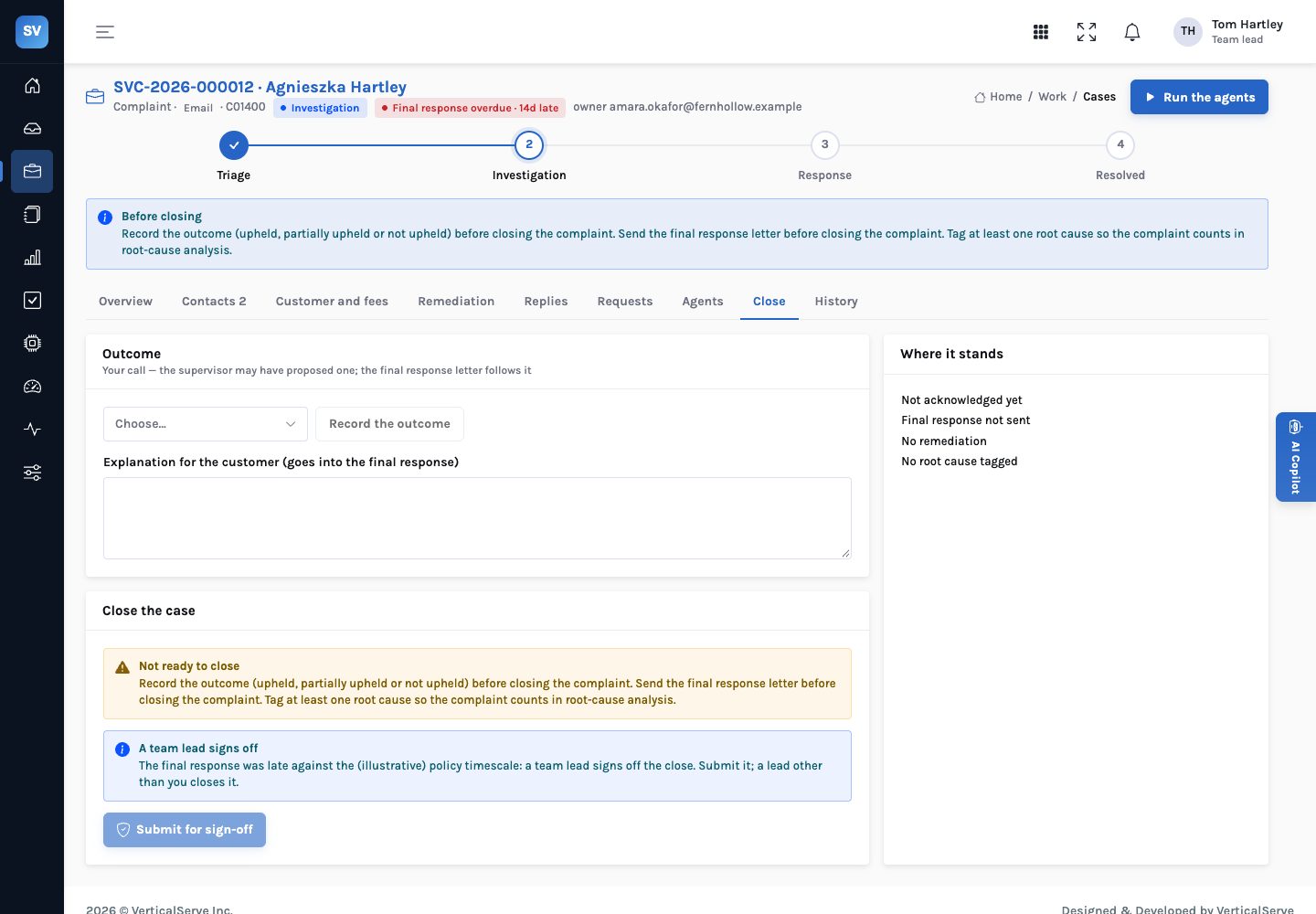
Both cases are still a long way from that point. On Ciaran Dunmore’s case, the Close tab says so plainly: what blocks it, that a team lead signs off because he is a repeat complainant, and a Submit button that stays disabled until the blocks are cleared.
Signed in as Tom Hartley, the team lead, Agnieszka Hartley’s case shows the same structure: the outcome he or the handler will record, what still blocks the close, and the referral because the final response is late against the illustrative policy.
The runbook for a breached complaint
Send the drafted acknowledgement. It is late; sending it late is better than not at all, and the clock will record when it went.
The deadline has passed. A response explaining the delay, when she can expect the outcome, and her right to go to the ombudsman, using the firm’s approved wording.
The claim itself sits in the claims system. Agree a date with the claims team and record it on the case.
Accept or correct the proposed “claim handling delay”.
Upheld, partially upheld or not upheld, with an explanation that goes into the final response letter.
Drafted from the case’s facts and the knowledge base, with the referral-rights wording flagged as a template to replace with the firm’s approved text.
Once nothing blocks the close.
A lead who didn’t submit it. The decision record keeps the controls, the clock and who signed off.
Breached cases are always in the QA sample. The checklist will fail the acknowledgement and final-response timeliness checks, and a reviewer records the result.
Where a breached complaint goes from here.
Why enforce it
Most firms already have a rule that a manager reviews late or repeat complaints. The difficulty is that a rule in a procedure document relies on the handler remembering it on a busy day. When the referral is a published control, the case cannot close any other way, and the decision record shows that it didn’t.
For the head of complaints
A breached deadline and a fourth complaint are exactly the cases an ombudsman or supervisor will pick out. The record shows which control fired, who submitted, and which lead signed off.
For the service operations lead
Handlers can see their breaches and repeat complainants on the queue and the home page, and know before they start that these closes need a lead. Leads see them waiting, with the reason.
For the board
The number of breached complaints and repeat complainants is a measure of service, not only of compliance. Both are counted from the cases, not from a separate return.
What this shows
A referral is only as good as its enforcement. In InsightService the deadline is configuration, the breach is computed from the case’s own dates, the referral is a rule anyone can read, and the four-eyes close is something the system refuses to skip. The agents prepare the acknowledgement and the root cause; they never close the case, and nobody closes it alone.