A complaint handler’s day is mostly preparation. Read the message, decide whether it is a complaint, notice the sentence about a husband who has died, open the account, find the fee, work out the interest, look up the right article, write the acknowledgement. The decisions, whether to uphold, what to pay, what to say, take a fraction of the time and carry all of the accountability. InsightService puts eight agents on the preparation and leaves every decision with a person.
In short
- Eight agents, one job each. Six work on a case in order (triage, vulnerability, research, remediation, reply, supervisor); three work across the book (the triage agent over the inbox, the root-cause analyst, the QA reviewer).
- Each stops at a prepared decision. Accept carries it out in the person’s name, Reject records the disagreement, Ask sends a question back.
- None of them can send, pay, classify, close or approve. The API refuses those actions from an agent, whatever its level.
- Autonomy is capped at L2, Ask first, and every agent starts at L1. The numbers come from deterministic engines; a model, when switched on, only explains them, over numbered facts it must cite.
The eight agents
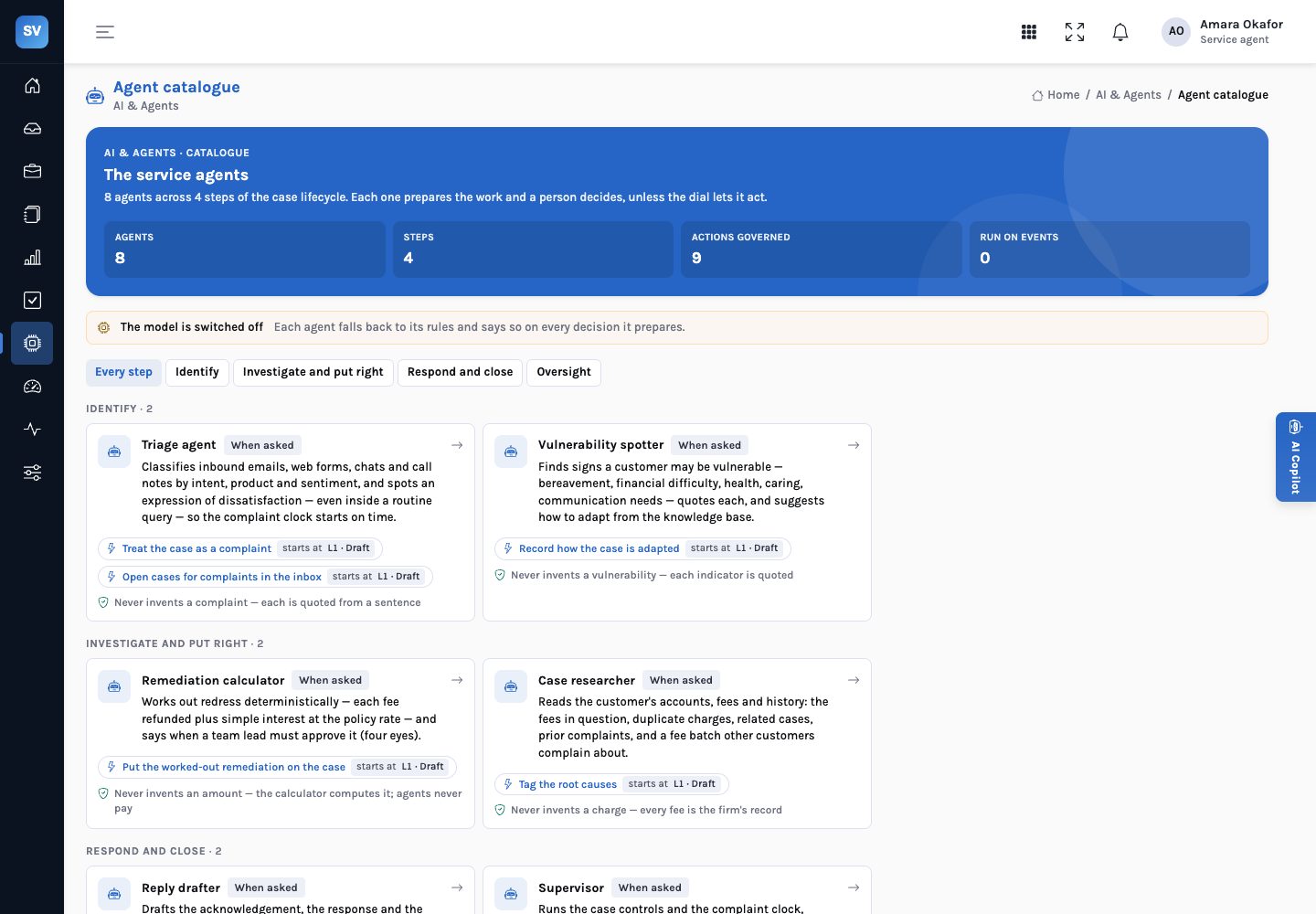
Each agent is defined once, with what it does, what it is grounded in, the one thing it never invents, and the action it may prepare. The catalogue in the product shows the same list.
| Agent | Where | What it prepares | It never invents |
|---|---|---|---|
| Triage agent | Case and inbox | Treat the case as a complaint (quoting the sentence); open cases for inbox complaints without one | A complaint: each is quoted from a sentence |
| Vulnerability spotter | Case | How to adapt the case, from the indicators and the knowledge base | A vulnerability: each indicator is quoted |
| Case researcher | Case | Root-cause tags, after reading accounts, fees, related cases, prior complaints and fee runs | A charge: every fee is the firm’s record |
| Remediation calculator | Case | The worked-out remediation: refunds plus simple interest | An amount: the calculator computes it |
| Reply drafter | Case | The acknowledgement, response or final response, held | A promise: referral wording is a marked template |
| Supervisor | Case | An outcome where the records support one, and what still blocks the close | A decision: people close cases |
| Root-cause analyst | Oversight | Ownership of the clusters that look systemic | A cause: every cluster counts real complaints |
| QA reviewer | Oversight | Passes for the sampled cases whose checks all passed | A pass: a person records each result |
A run on a case
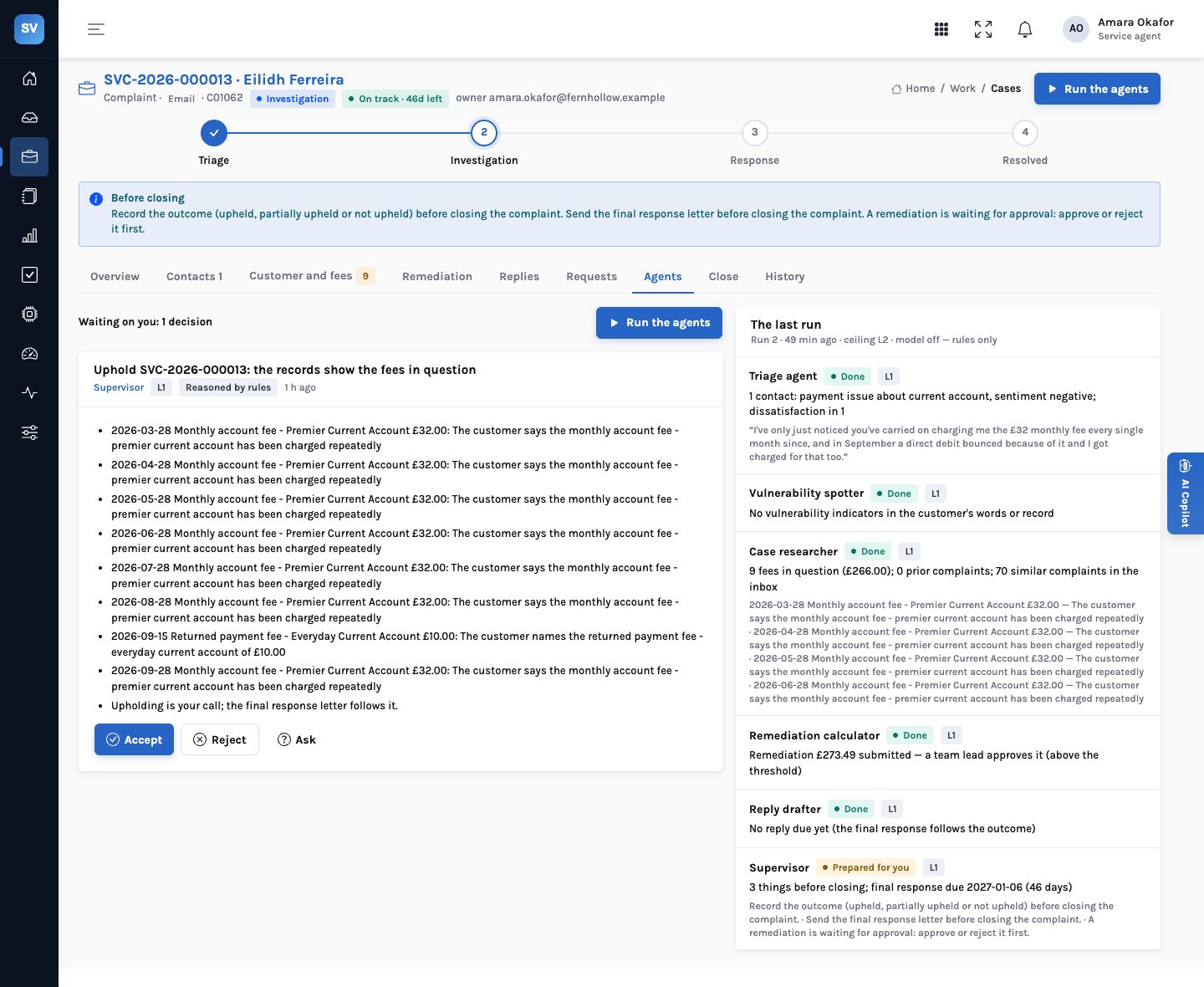
“Run the agents” on a case runs the six case agents in order on the shared agent pipeline, each as itself and at its own autonomy level. Each step reads what the engines computed, writes a short finding with its evidence, and, if there is something for a person to do, prepares it.
Six case agents in order. Each one prepares; none of them acts on the case without the handler.
On Eilidh Ferreira’s complaint about a Premier fee she kept paying after downgrading, the last run shows what each agent found: the triage agent quoted her sentence about being charged “the £32 monthly fee every single month since”; the vulnerability spotter found no indicators in her words or her record; the case researcher found nine fees in question, £266.00; the remediation calculator’s £273.49 had been submitted for a team lead because it is above the threshold; the reply drafter said no reply was due until the outcome; and the supervisor listed three things standing between the case and its close, then prepared “Uphold SVC-2026-000013: the records show the fees in question” for the handler to accept, reject or ask about.
Across the book: the inbox, root causes and QA
Three runs work on the whole book rather than one case. Over the inbox, the triage agent classifies new contacts and prepares cases for the complaints that don’t have one yet, most urgent first; on the demo there are 1,094 classified complaints without a case, which is exactly the backlog a person should not have to sort by hand. The root-cause analyst clusters every complaint and prepares ownership of the ones that look systemic. The QA reviewer samples closed cases and prepares passes for the clean ones. In each, the pattern is the same as on a case: the engine computes, the agent prepares one decision, and a person answers it.
Accept, reject or ask
A prepared decision appears on the case and on the person’s home page under “What needs me”. There are three answers:
| Answer | What happens |
|---|---|
| Accept | The action is carried out in the person’s name: the case becomes a complaint, the tags are saved, the remediation is proposed, the reply is put on the case held, the outcome is recorded |
| Reject | Nothing changes on the case; the disagreement is recorded and counts against the agent’s agreement rate |
| Ask | A question goes back; the decision stays open |
This is the important detail: accepting a prepared outcome records the outcome as the person’s. The audit trail says who accepted, from which agent, and when. Whether a case is a complaint is a person’s call “the triage agent only proposes it”; the outcome is a person’s call “the supervisor only proposes it”. Those are the API’s own refusal messages when an agent tries.
The decisions no agent can take
| Action | Who can do it | The API’s answer to an agent |
|---|---|---|
| Classify a contact as a complaint or not | A person | “A person corrects the classification.” |
| Send a reply or a request to the customer | A person | “An agent can’t send to a customer; a person sends it.” |
| Approve or pay a remediation | A person (a team lead above the threshold) | “An agent can’t approve or pay a remediation; a person does.” |
| Record the outcome | A person | “The outcome is a person’s call; the supervisor only proposes it.” |
| Close the case | A person (a team lead when referred) | “Closing a case is a person’s call.” |
| Own a root cause, record a QA result | A person | Refused |
These refusals don’t depend on the autonomy level. Even at the highest level the platform defines, an agent couldn’t do them in InsightService, because the operations themselves check who is acting.
Autonomy is earned, and capped
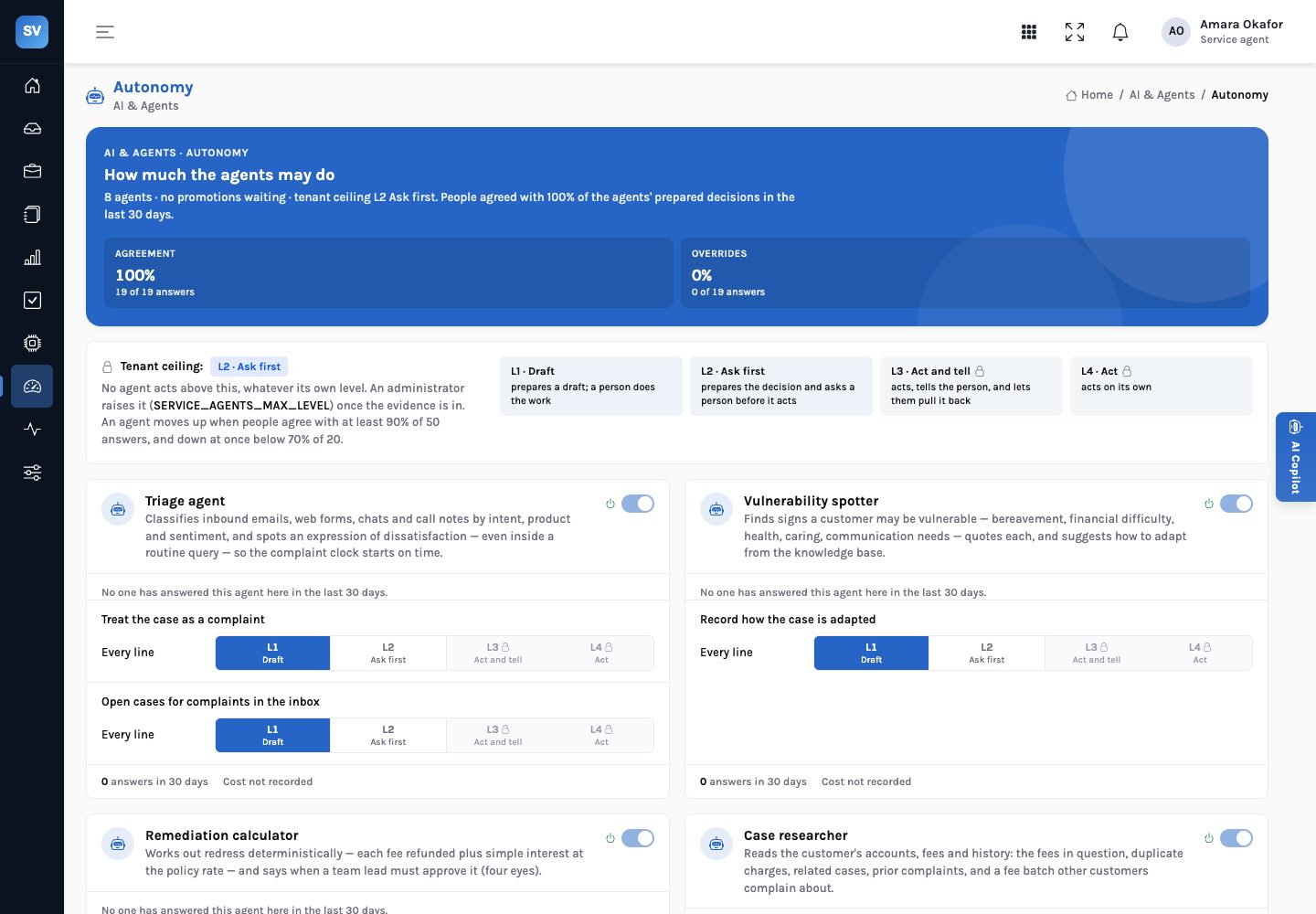
The shared agent platform has four levels. InsightService uses the first two.
| Level | Name | In InsightService |
|---|---|---|
| L1 | Draft | Where every agent starts: it prepares, a person acts |
| L2 | Ask first | The ceiling for every agent action (a hard cap in the code), and the tenant ceiling via SERVICE_AGENTS_MAX_LEVEL |
| L3 | Act and tell | Not available |
| L4 | Act | Not available |
The platform’s default thresholds for recommending a change of level. An administrator makes the change; the cap holds regardless.
Every answer a person gives to a prepared decision is counted. The autonomy page shows each agent’s agreement and override rates over 30 days, per action. The platform’s defaults recommend raising an agent a level only when people agreed with at least 90% of at least 50 answers in that window, and lowering it when agreement falls below 70% over at least 20. A recommendation is just that: an administrator decides, the reason is recorded, and the hard cap at L2 means no recommendation can take an InsightService agent past Ask first.
The model explains; it never supplies the facts
Every classification, deadline, match and amount in InsightService comes from a deterministic engine:
the classifier’s lexicons, the clock, case research over the firm’s records, the remediation
calculator, the case controls. The agents run those engines. Where a language model is switched on
(SERVICE_AGENTS_LLM), it receives the engine’s results as numbered facts, [F1], [F2]
and so on, with an instruction to state nothing that isn’t in them and to cite what it relies on.
An answer that carries a name or a number not in the facts is thrown away.
Model off is a supported mode
With the model switched off, as in the demo (SERVICE_AGENTS_LLM=0), every agent runs on its rules and says so: the case shows “Reasoned by rules” on each prepared decision and “model off — rules only” on the run. The product works the same; the explanations are shorter.
The copilot reads, and only reads
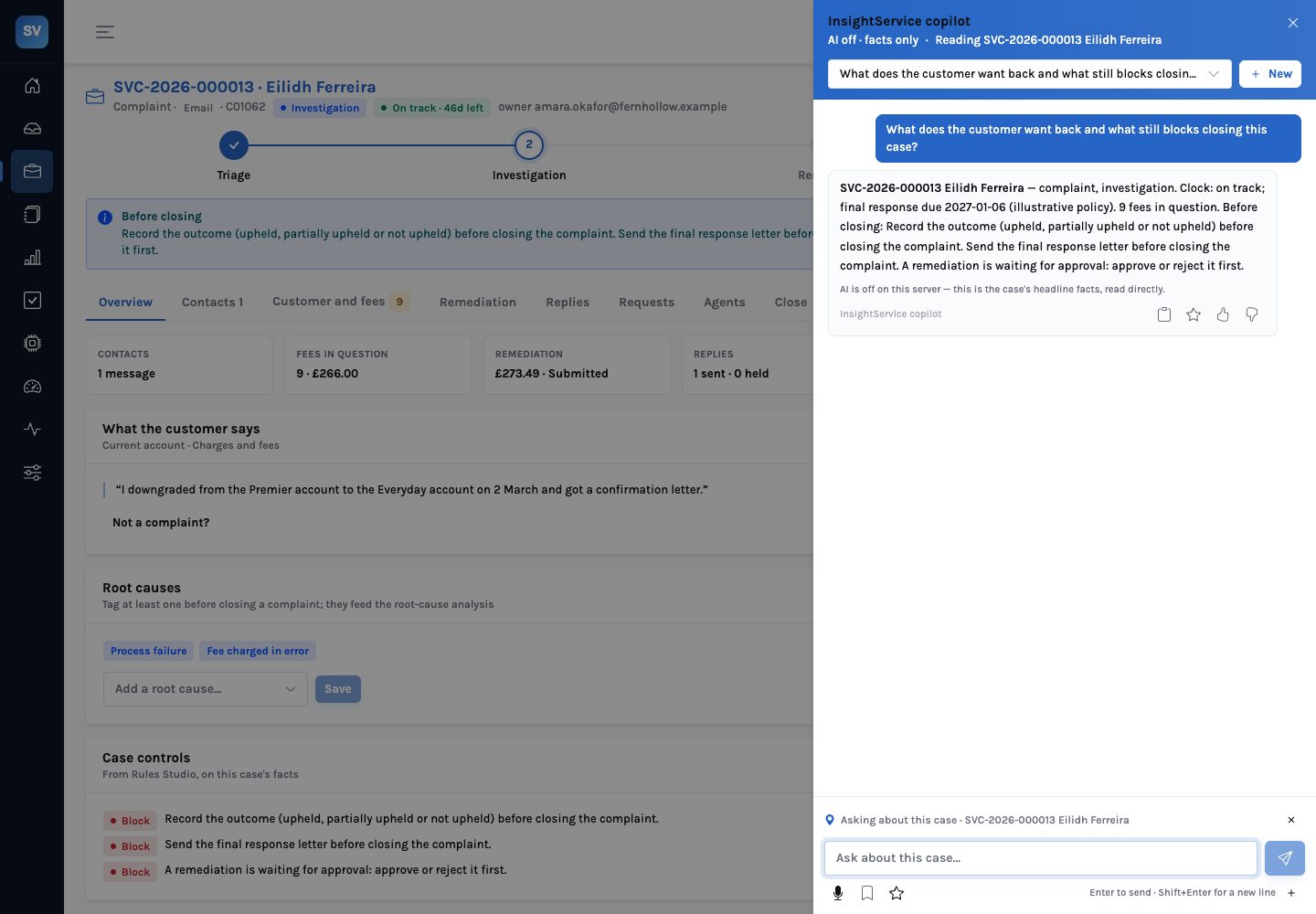
Beside the agents sits a copilot for the person working the case. It answers questions about the open case through read-only tools: the summary and clock, the contacts, the customer’s accounts and fees, the research and related cases, the knowledge base, the remediation, the replies, what the agents prepared and the root causes. It never sends, pays, classifies or closes anything. With the model off it answers from the case’s headline facts, and says so.
Everything on the record
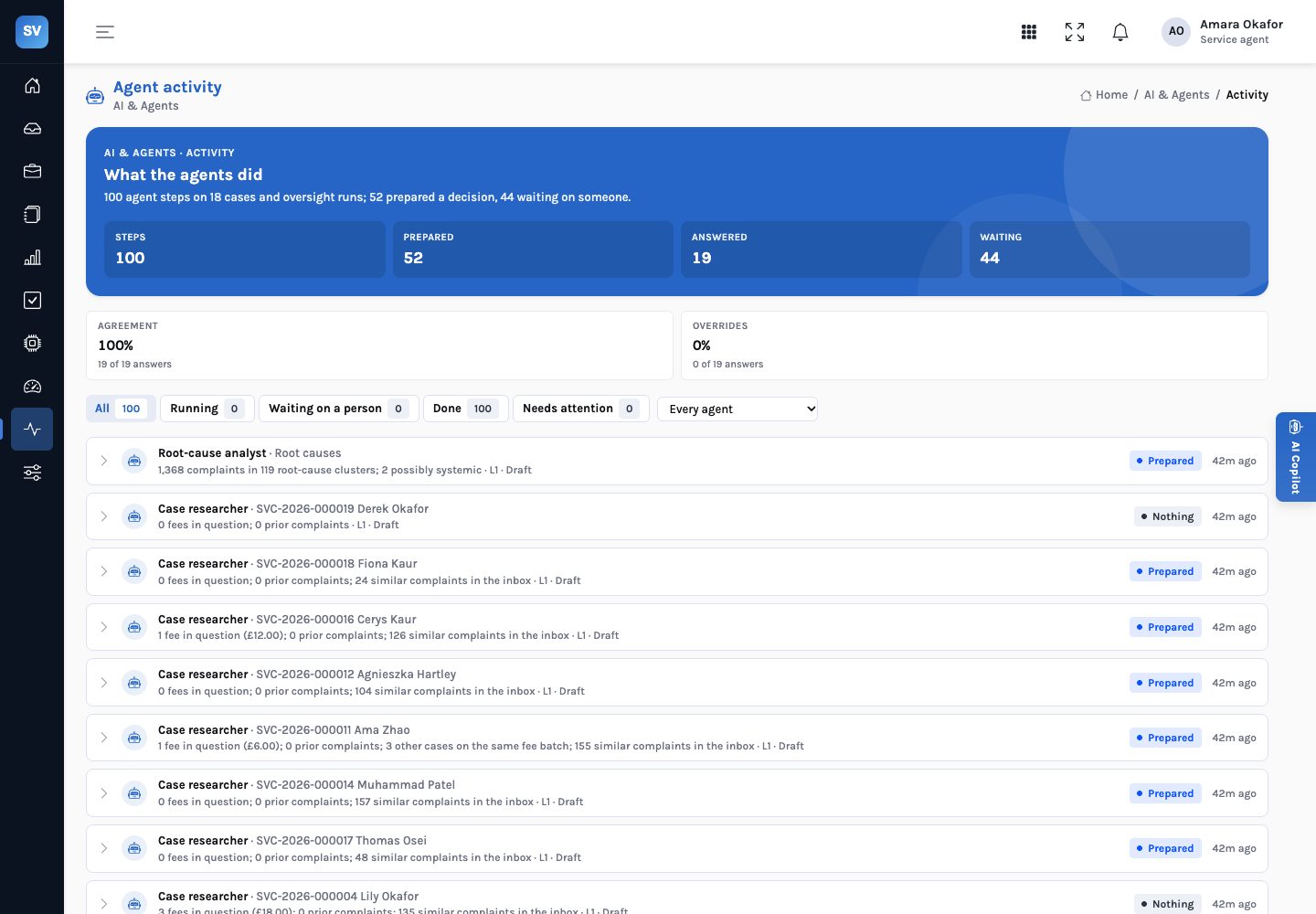
The activity log lists every agent step on every case and in oversight: when it ran, at what level, what it found, what it prepared and whether that is still waiting on someone. The case’s own history interleaves agent steps and people’s actions, so a reviewer can see, line by line, that the supervisor proposed an outcome and the handler accepted it, or that the remediation calculator prepared £20.06 and the handler proposed it.
For the head of complaints
The decisions that carry regulatory accountability, classification, outcome, redress approval, sending and closing, are a person’s by construction, not by policy.
The record shows which agent prepared what and who accepted it.
For the service operations lead
Handlers start every case with the research done, the remediation worked out and the letter drafted.
Agreement rates show which agents the team trusts and which need work.
For the board
Automation that can’t send, pay or close on its own is automation the firm can explain to a regulator and an ombudsman.
Autonomy only grows with evidence, and never past Ask first.
Let the agents do the preparing. Keep the deciding.
Eight agents read, research, calculate and draft. They stop at a prepared decision every time.
People classify, approve, send and close, and the record says so.