Of all the complaints a retail bank receives, “you charged me twice” should be the easiest. The customer has done the investigation already: same amount, same day, same description. Yet it still takes a handler several screens to confirm it, a calculator or a spreadsheet to work out the refund, a template to write the letter, and a memory of which control applies before the case can close. This post follows two duplicate-fee complaints through InsightService: one still open, one taken all the way to a closed, upheld complaint.
In short
- The researcher finds the duplicate in the firm’s records. Two fees on the same account, with the same code, amount and date, are flagged as a duplicate; the fee the customer names is added too.
- Redress is arithmetic, not judgement. Each fee refunded plus simple interest at the policy rate from the charge date, to the penny. The rate (8%) and the approval threshold (£250) are illustrative, configurable policy in the demo.
- People decide. The supervisor agent proposes “upheld”; the handler records it. The reply drafter writes the letters; the handler sends them.
- The close is gated. No outcome, no final response, or a remediation still waiting for a decision each block the close, and the decision record keeps what happened.
The situation
Both cases come from InsightService’s demo data for Fernhollow Bank & Insurance, a fictional firm with invented customers, accounts and fees. The demo’s “today” is 21 November 2026.
| Case | Customer and channel | What the customer said | Where it stands |
|---|---|---|---|
| SVC-2026-000001 | Andrei Rossi, email, 11 November 2026 | “I’ve just looked at my account and I’ve been charged a returned payment fee of £10.00 twice on 8 November.” | Open, in investigation. Remediation of £20.06 proposed; acknowledgement sent. |
| SVC-2026-000002 | Ama Begum, web chat, 17 November 2026 | “hi, theres two overdraft fees on my account on the same day” … “both £6.00 on 11/11/2026” … “i want my money back, not happy” | Closed, upheld. £12.02 approved; final response sent in time. |
Andrei’s email is a model complaint: “Same amount, same day, same description. Even if one of them was right (and I’m not sure it was), you can’t charge me for the same thing twice. I’m really annoyed about this. Please refund the duplicate and tell me why it happened.” Ama’s chat is the opposite: short lines, no capitals, the dissatisfaction in four words. Both are complaints. Under the FCA’s definition in the DISP sourcebook, a complaint is any expression of dissatisfaction, oral or written, whether justified or not; the tone and the channel don’t matter.
Why this simple complaint costs more than it should
- The facts are spread across systems. The message is in the contact centre platform, the fees in the core banking ledger, and the fee run that produced them in a batch log. The handler has to join them by hand.
- Redress drifts. One handler refunds the duplicate, another refunds both, a third adds interest, a fourth adds a goodwill payment. Each decision is defensible; together they are inconsistent, and inconsistency is what a quality review or a regulator notices.
- The letter repeats the investigation. The final response has to say what was found, what will be paid and what the customer can do next. Typing that again from the screens is where mistakes creep in.
- The clock runs anyway. A complaint is on the clock from receipt, whether or not the handler has opened it yet.
Read the email, find the account, scroll the fee history, decide what to refund, work out interest in a spreadsheet, type the letter from a template, and remember which checks apply before closing.
The message is classified and quoted, the duplicate is found in the fee records, the refund and interest are calculated, the letters are drafted with citations, and the case controls say what still blocks the close.
Step 1: the complaint is recognised and the clock starts
The triage classifier reads each inbound contact sentence by sentence. In Andrei’s email it found three sentences carrying dissatisfaction, among them “I’m really annoyed about this” and “Please refund the duplicate and tell me why it happened.” In Ama’s chat it counted only the customer’s lines; the adviser’s lines don’t count, so a polite “Is there anything else I can help with today?” can’t turn into the customer’s sentiment. Both contacts were classified as complaints about the current account, with “duplicate charge” and “fee charged in error” suggested as root causes.
When a case is opened from a complaint, the clock runs from the moment the contact was received, not
from when the case was opened. In the demo the policy is five calendar days to acknowledge and eight
weeks for the final response. Those numbers are illustrative, configurable policy
(SERVICE_ACK_DAYS, SERVICE_FINAL_WEEKS) and are labelled that way on every
screen. The FCA’s DISP rules ask for a prompt acknowledgement and a final response within eight
weeks for most complaints; your firm sets its own values to its own rules.
For Andrei’s complaint, received on 11 November, the acknowledgement was due on 16 November and the final response is due on 6 January 2027. The acknowledgement went out on 21 November, so the case shows it as five days late. The clock does not hide that: a late leg stays late on the record, and the QA checklist will see it.
Step 2: the researcher reads the fee records
The case researcher is deterministic: the same data gives the same answer. For a fee complaint it does two things. It looks for the same fee charged twice on the same account on the same day, and it looks for fees the message names. Andrei named a “returned payment fee” and the amount, so both of his £10.00 fees on 8 November were found: one because he named it, and the second, F0004046, because it repeats F0004045 exactly.
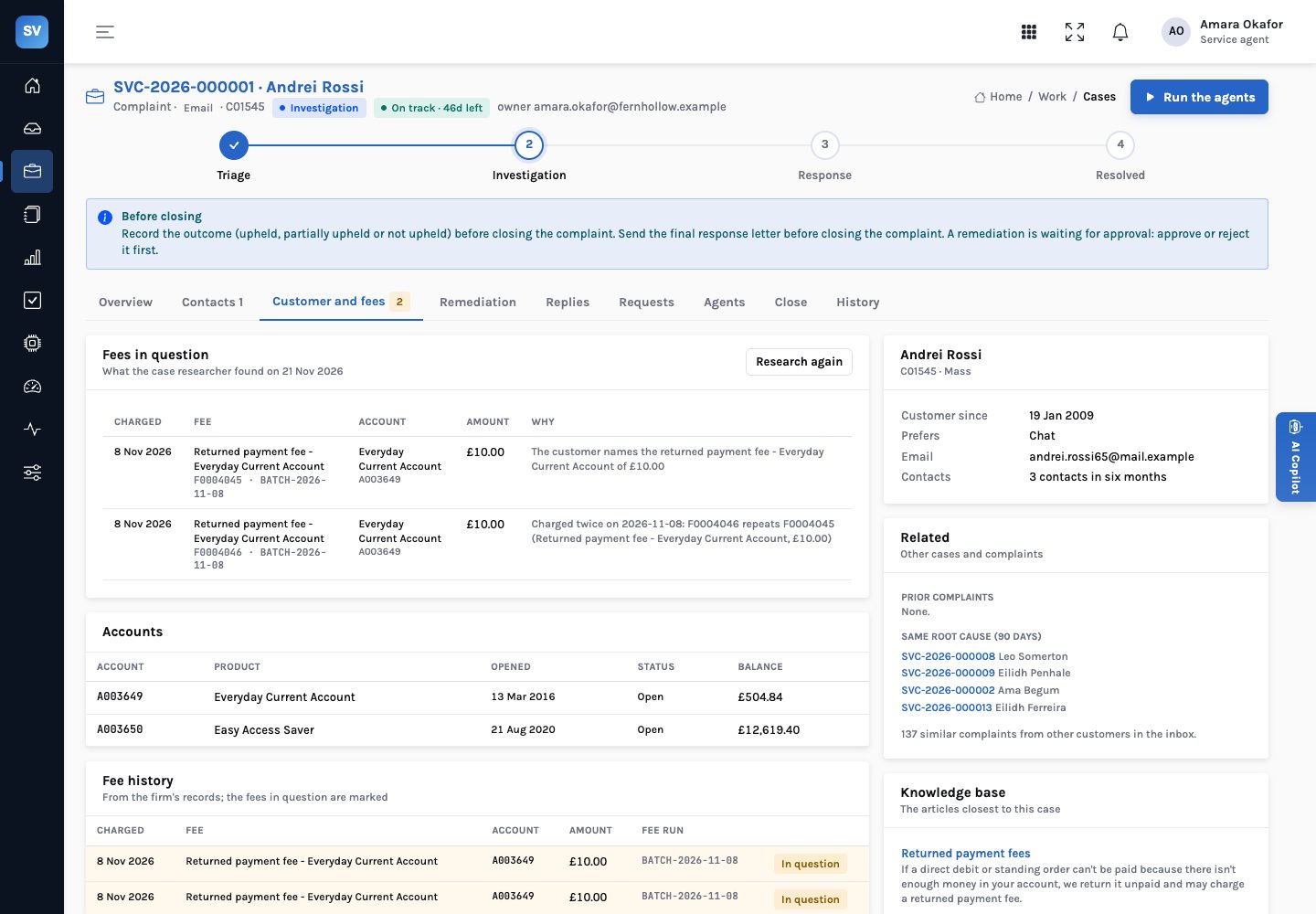
The same screen puts the fees in context. It lists Andrei’s accounts (an Everyday Current Account and an Easy Access Saver), shows that he has no prior complaints, links other recent cases with the same root cause, and suggests the knowledge-base articles closest to the case, starting with “Returned payment fees” and “Seeing a payment or fee twice”. Each fee also carries its fee run identifier, so if the same run had charged other complainants the case would link them; in this case it hadn’t.
How the fees in question are found: from the firm’s records, never from the model.
Step 3: the remediation is calculated, not negotiated
The remediation calculator refunds each fee in question in full and adds simple interest at the policy rate, from the day the fee was charged to the as-of date: amount × rate × days ÷ 365, rounded to the penny per item. For Andrei, two fees of £10.00 charged on 8 November, 13 days before 21 November, at the demo’s illustrative 8% a year, give £0.03 interest each: £20.00 refund plus £0.06 interest, £20.06 in total.
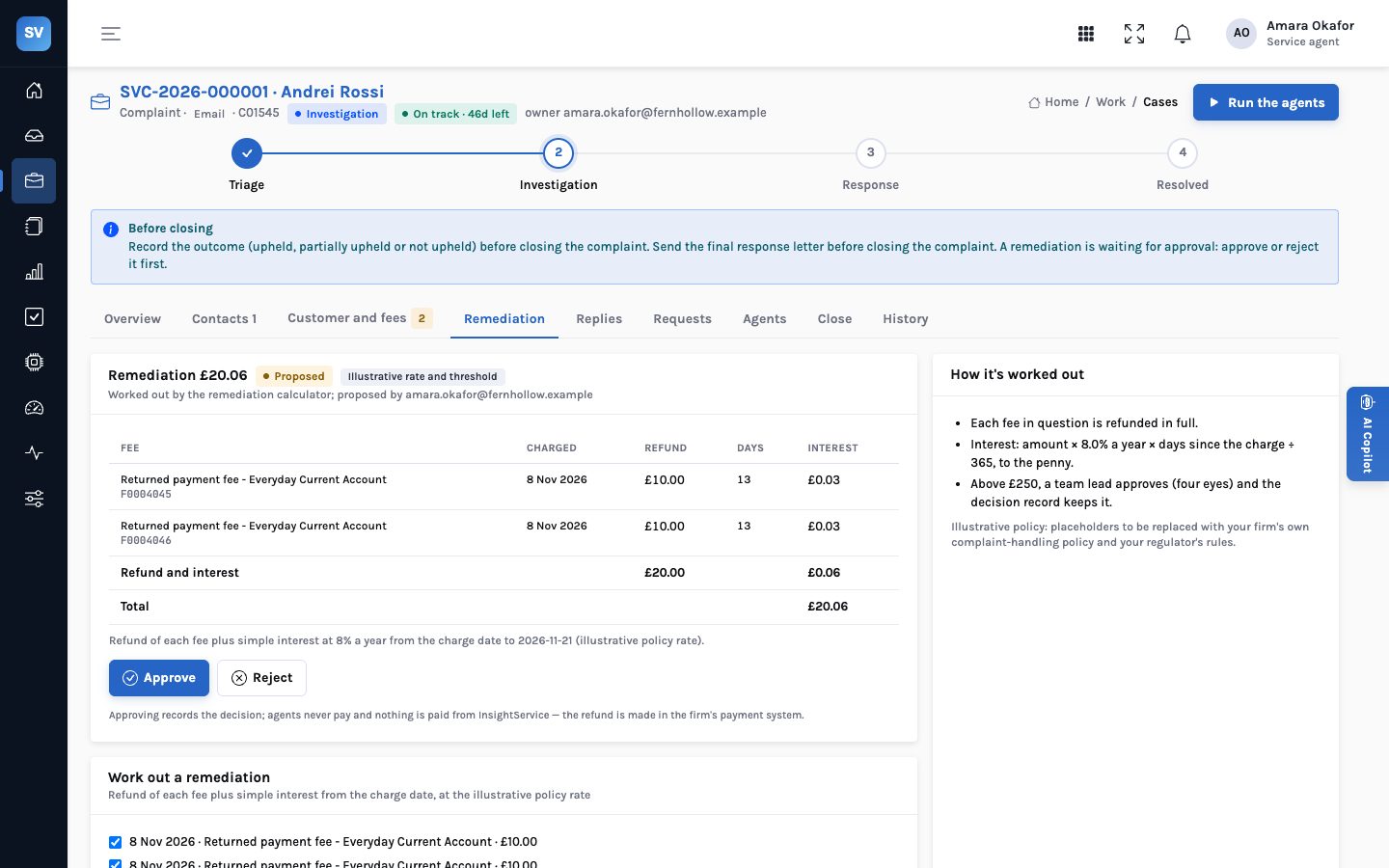
A rate of 8% simple a year is a figure the UK Financial Ombudsman Service commonly uses when it awards
interest, which is why it is the demo’s placeholder. In InsightService it is
SERVICE_REMEDIATION_RATE, and your policy decides it. The same goes for the approval
threshold (SERVICE_APPROVAL_THRESHOLD, £250 in the demo): at £20.06 this
remediation is well below it, so the handler can approve it herself. Above the threshold, a team lead
who neither proposed nor submitted it must approve it; the
four-eyes post follows one of those.
Nothing is paid from InsightService
Approving a remediation records the decision. The refund itself is made in the firm’s payment system. Agents never approve or pay: the remediation calculator prepares the figure and the remediation agent can only put it on the case as a proposal.
Step 4: what is still open on Andrei’s case
The supervisor agent has prepared an outcome for Andrei’s case: “Uphold SVC-2026-000001: the records show the fees in question.” It lists both fees and ends with a line that is true of every outcome in the product: “Upholding is your call; the final response letter follows it.” Until the handler accepts or changes it, three case controls block the close:
- Record the outcome (upheld, partially upheld or not upheld) before closing the complaint.
- Send the final response letter before closing the complaint.
- A remediation is waiting for approval: approve or reject it first.
Those sentences come from Rules Studio, where the controls are rules compliance can read and change, not code. The handler sees them at the top of the case, in the same words.
The same journey, finished: SVC-2026-000002
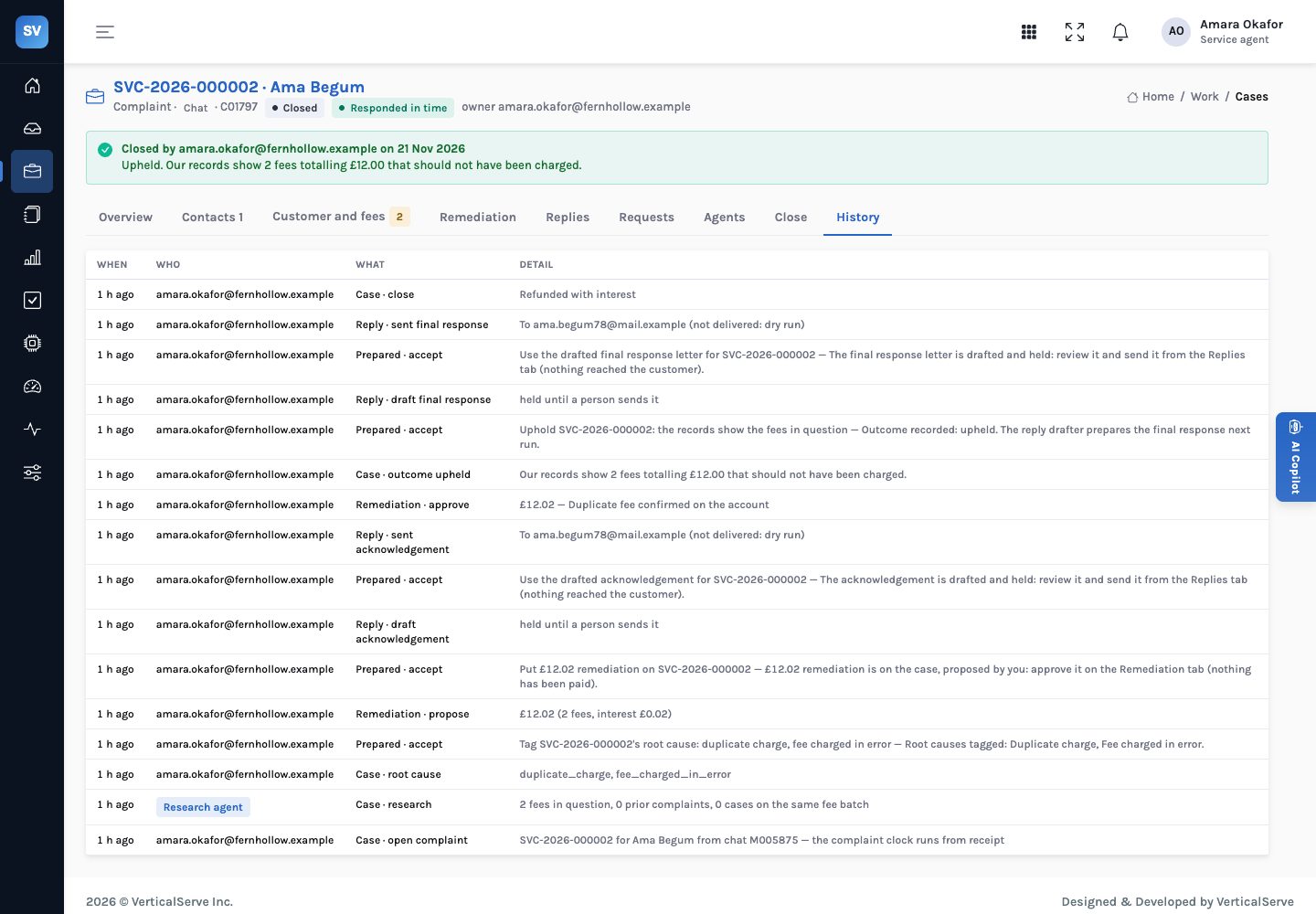
Ama Begum’s chat shows the rest of the path. The researcher found two unarranged overdraft fees of £6.00 on 11 November 2026, F0004048 repeating F0004047. The calculator worked out £12.00 plus £0.02 interest, £12.02. Then the people took over:
Who did what on SVC-2026-000002. Every arrow into the customer is a person’s.
The final response letter was drafted from the case’s own facts and the knowledge base. It quotes the customer, states the outcome and the note the handler recorded (“Our records show 2 fees totalling £12.00 that should not have been charged”), lists both charges, says “To put this right we will refund £12.00, plus £0.02 interest — £12.02 in total — to your account”, and explains the fees with a sentence from each of two cited articles.
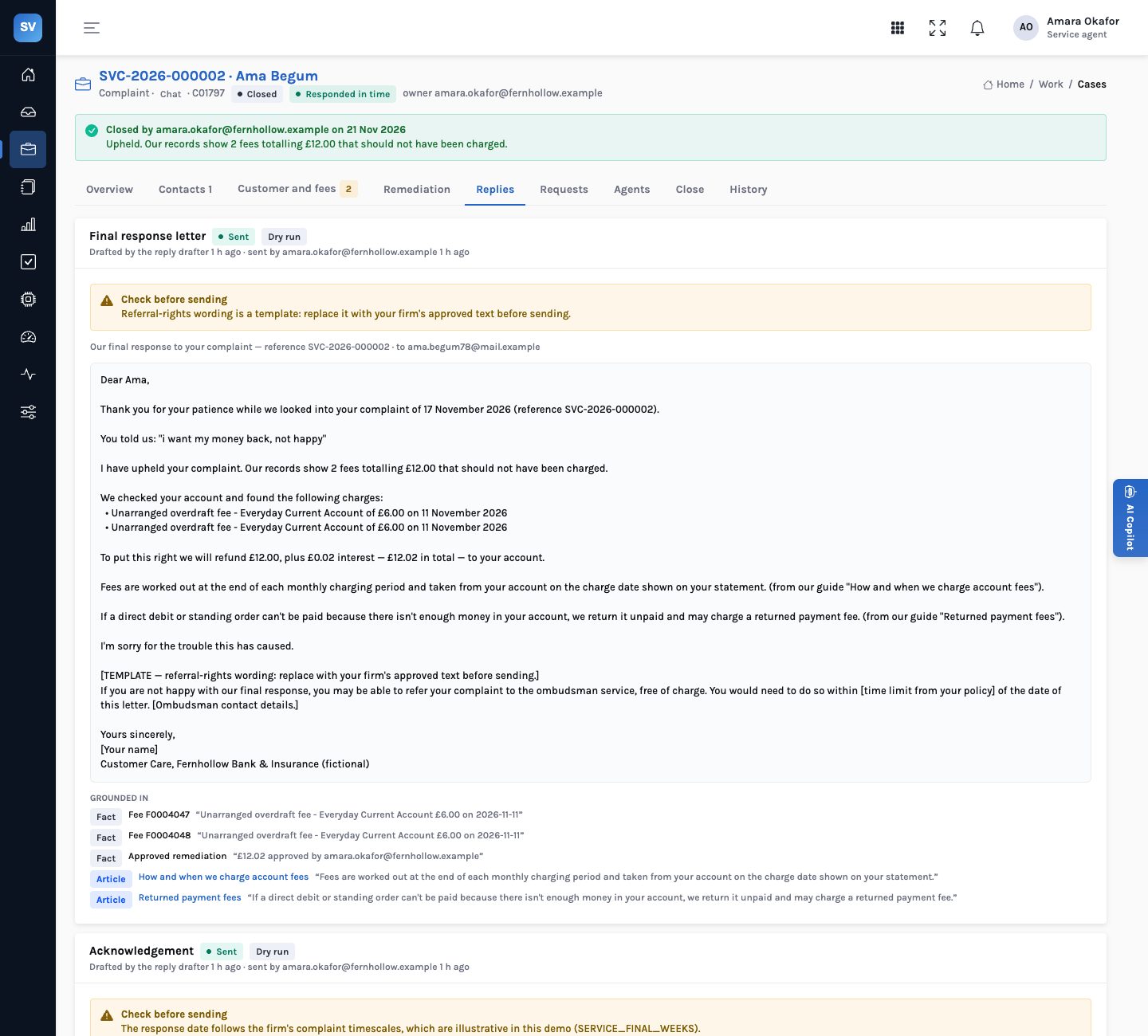
Two details matter. First, every citation points at something on the case: a fee identifier, the approved remediation, a knowledge-base article. The drafter does not invent a figure. Second, the paragraph about referring the complaint to the ombudsman is deliberately a template: “[TEMPLATE — referral-rights wording: replace with your firm’s approved text before sending.]” The product flags it on screen, because that wording is regulated and must be your firm’s approved text, not a draft.
Read this honestly: one person approved her own remediation
On SVC-2026-000002 the same handler proposed and approved the £12.02. That is allowed because £12.02 is below the illustrative £250 threshold, and the decision record says so (“within the threshold”). If your policy wants a second person on every remediation, set the threshold to zero.
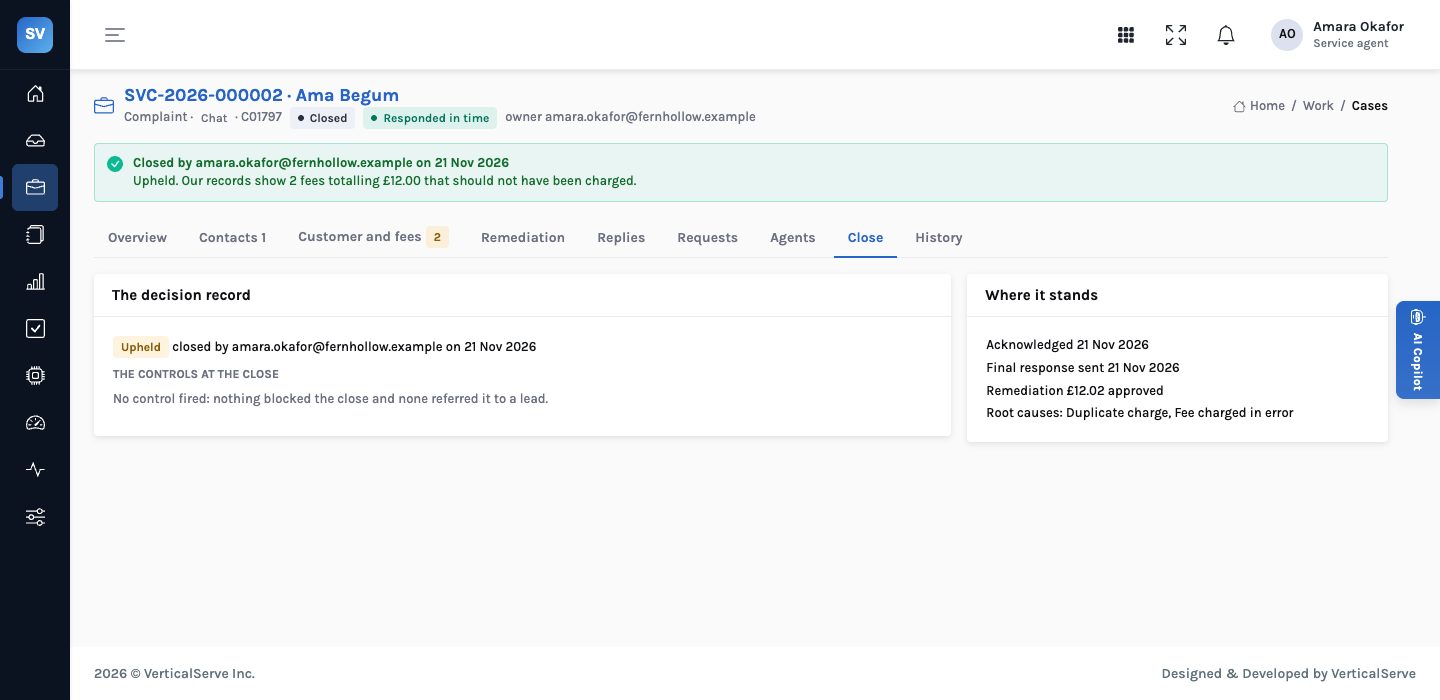
With the outcome recorded, the remediation approved and the final response sent, no control blocked the close, and none referred it to a team lead. The handler closed it with the note “Refunded with interest”. The acknowledgement and the final response both went out within the illustrative timescales, so the case shows “Responded in time”.
The controls that gate the close
The case controls that apply to a duplicate-fee complaint. Vulnerability and open requests are checked too; neither applied here.
Who does what
Complaint, current account, negative; the sentences quoted. The clock runs from receipt.
From the inbox. The case takes the acknowledgement and final-response deadlines from the illustrative policy.
Duplicates on the same account, day, code and amount; fees the message names; the fee run; related cases.
Each fee refunded plus simple interest to the penny. Below the threshold the handler may approve; above it a team lead must.
The decision record keeps the total, the rate, the threshold and who proposed and approved it.
Drafted and held; a person sends it.
The supervisor agent proposes “upheld” when the records show the fees; a person records it.
Replace the template referral-rights wording with the firm’s approved text before sending.
No blocking control may fire. The decision record keeps the controls, the clock, the remediation and the root causes.
What it means
For the head of complaints
A duplicate-fee complaint is low value and high volume. What matters is that every one is handled the same way: the same redress method, the same letter structure, the same controls. That consistency is visible on every case and in QA.
The root-cause tags (duplicate charge, fee charged in error) feed the root-cause analysis, so a run of duplicates from one fee batch shows up as a cluster, not as unrelated complaints.
For the service operations lead
The handler’s time goes on the two decisions that are hers: whether to uphold, and what to send. Finding the fees, calculating interest and drafting the letters is prepared before she opens the case.
Every action is on the history, so a team lead can see exactly where a case is without asking.
For the board
Redress is calculated, recorded and recalculable. Nothing is paid by the software, and no agent can approve, send or close.
The deadlines, the interest rate and the approval threshold are policy settings, not hard-coded numbers: change them to your own.
The next posts follow complaints that are harder to see: one hidden inside a routine request, and a single fee run behind several complaints.