Most complaints don’t say “complaint”. They arrive as a request for statements, a change of address, a question about a payment, and somewhere in the middle there is one sentence that says the customer is unhappy. A handler working a queue of service requests answers the request and moves on. The complaint is never logged, the clock never starts, and the cause never reaches anyone who could fix it. This post follows two of those messages through InsightService.
In short
- Dissatisfaction is found sentence by sentence. The classifier scores every sentence and quotes the one that carries the dissatisfaction, so a person can see exactly why a request became a complaint.
- A hidden complaint is flagged as hidden. One dissatisfied sentence inside a routine request, under a routine subject, gets its own label and its own inbox filter.
- The clock runs from receipt. Not from when someone noticed. In the demo both acknowledgements are already overdue against the illustrative five-day policy, and the case says so.
- A person confirms or corrects it. The triage agent prepares “treat this as a complaint”; it cannot decide it. A correction needs a reason and goes on the record.
The situation
Both messages are from InsightService’s demo data for Fernhollow Bank & Insurance, a fictional firm. The demo’s “today” is 21 November 2026.
| Case | Subject the customer used | The sentence that makes it a complaint |
|---|---|---|
| SVC-2026-000006 Pauline Kaur, email, 5 November | Statement request | “And frankly I’m fed up that nobody called me back as promised when I rang about this last month.” |
| SVC-2026-000005 Aisha Pemberton, web form, 8 November | Change of address | “I’m also not happy that I tried to do this in the app three times and it failed every time, which is ridiculous in 2026.” |
Pauline’s whole email is four short paragraphs: “Please could you send me statements for my current account for June to October. And frankly I’m fed up that nobody called me back as promised when I rang about this last month. I need them for a rental application by the end of next week.” The request is the first and third sentences. The complaint is the second.
Aisha’s web form says “I’ve moved to a new flat and need to update my address on my account and my home insurance”, then the sentence about the app, then the new address. Her record also carries something the message doesn’t: a health condition noted on 1 July 2026.
Why hidden complaints matter
The FCA’s definition of a complaint in the DISP sourcebook is deliberately broad: any oral or written expression of dissatisfaction, whether justified or not, about a financial service, which alleges the customer has suffered, or may suffer, financial loss, material distress or material inconvenience. It says nothing about the subject line or about the word “complaint”. If the dissatisfaction is there, the complaint-handling rules apply, including the timescales in DISP 1.6.
- Under-recording. Complaints that are never logged don’t appear in complaints data, root-cause analysis or regulatory returns.
- Missed deadlines. A complaint the firm didn’t recognise still has a clock running from the day it arrived.
- The cause stays hidden. “Nobody called back” and “the app failed three times” are exactly the operational signals a firm wants to count.
A handler sorts the queue by subject, sends the statements or updates the address, and closes the contact. The dissatisfaction is never recorded.
The classifier quotes the dissatisfied sentence, labels the contact as a complaint hidden in a query, and the case runs on the complaint clock from receipt.
How the classifier finds it
InsightService’s inbound classifier is deterministic and explainable. It splits each message into sentences (and, for a chat, keeps only the customer’s lines). Each sentence is scored against a lexicon of dissatisfaction: “fed up”, “not happy”, “nobody called back”, “ridiculous”, “still waiting” and many more, each with a weight. A strong phrase is enough on its own; weaker ones add up. Phrases such as “this is not a complaint” count against it. The sentence with the strongest signal becomes the quote on the case.
A complaint is labelled hidden when the underlying request is routine (a query, a service request or a payment issue), exactly one sentence carries the dissatisfaction, the signal is moderate, the subject line is routine, the customer never uses the word “complain”, and the dissatisfied sentence isn’t the opening one. Both messages here meet every condition.
How a routine request becomes a complaint. The lexicons are a starting point a firm tunes; every finding is quoted.
The inbox has a filter for exactly these contacts. In the demo’s inbox of 5,984 contacts, the “Hidden in a query” filter shows these two, each with its quote, a Complaint label and a Hidden label.
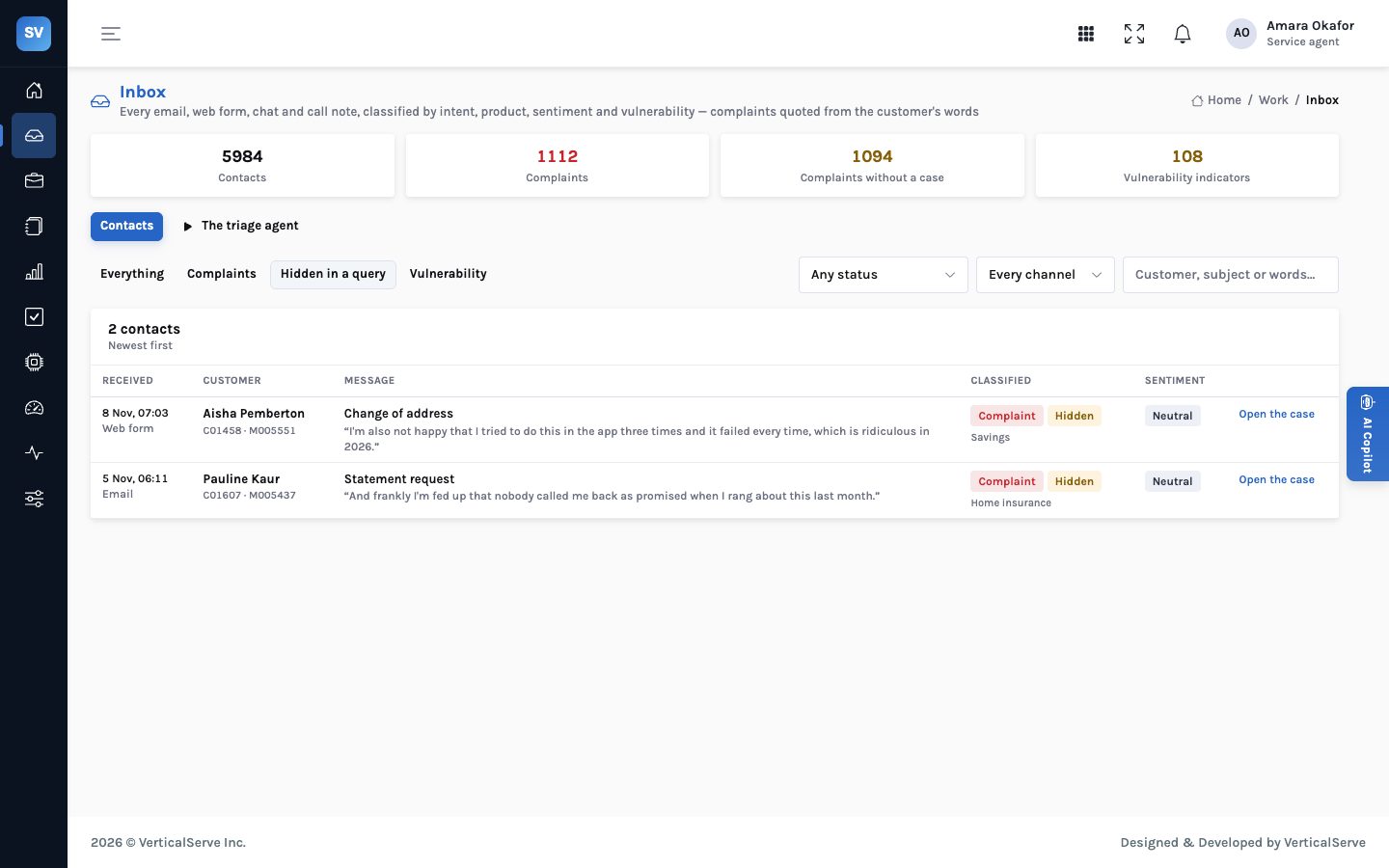
Notice the sentiment: both are neutral. Pauline’s email is polite and ends “Thank you”; Aisha’s ends “Thanks”. A sentiment score alone would not have caught either. Dissatisfaction is a separate finding from sentiment, and the complaint decision rests on dissatisfaction.
Step by step: Pauline’s statement request
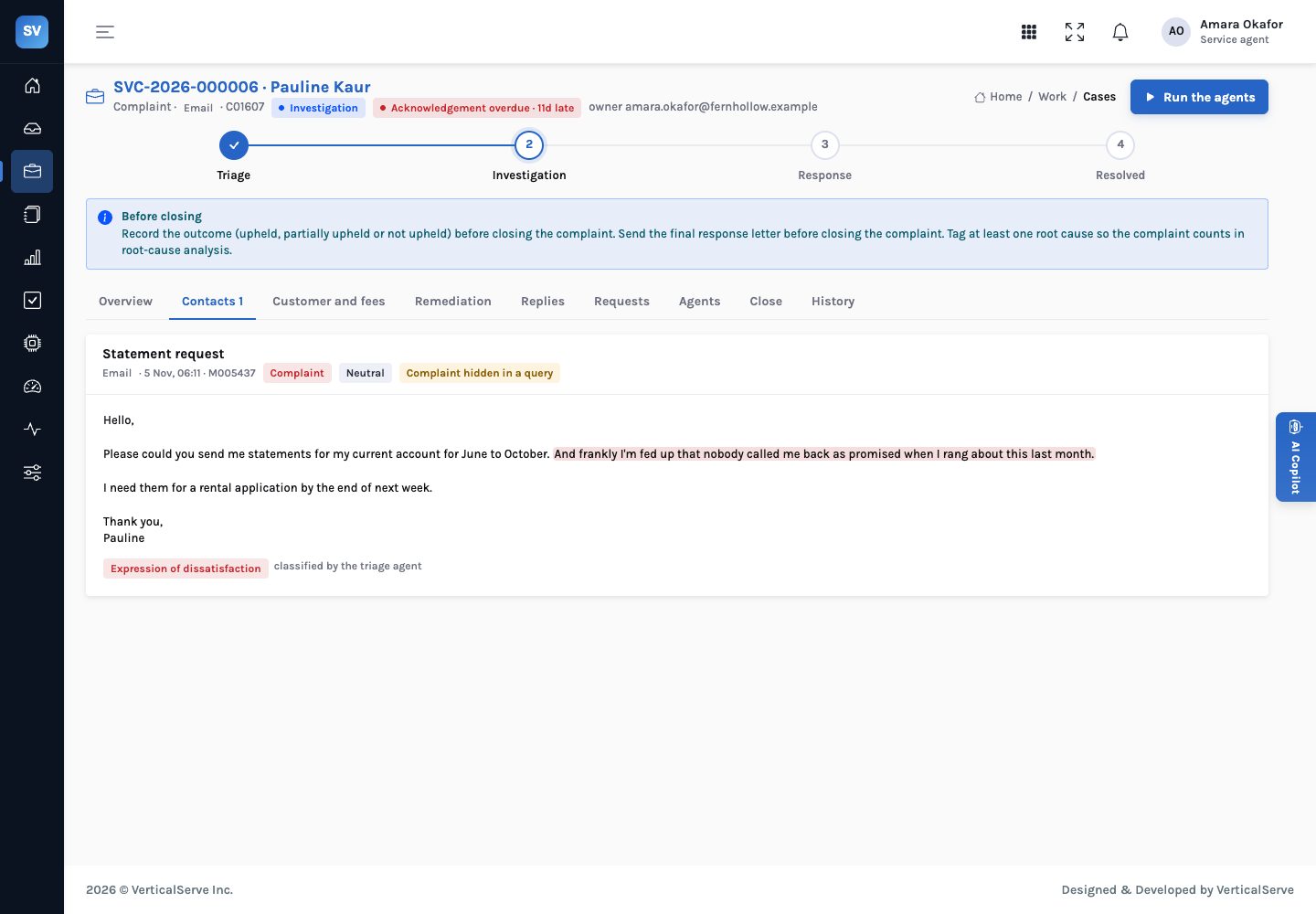
When the case was opened, InsightService made it a complaint and set its deadlines from the
email’s receipt on 5 November: acknowledgement by 10 November and the final response by 31
December 2026, under the demo’s illustrative policy of five days and eight weeks
(SERVICE_ACK_DAYS, SERVICE_FINAL_WEEKS; your firm sets its own). The case
summary is the quoted sentence, not the subject line, because for a hidden complaint the quote is what
the case is about.
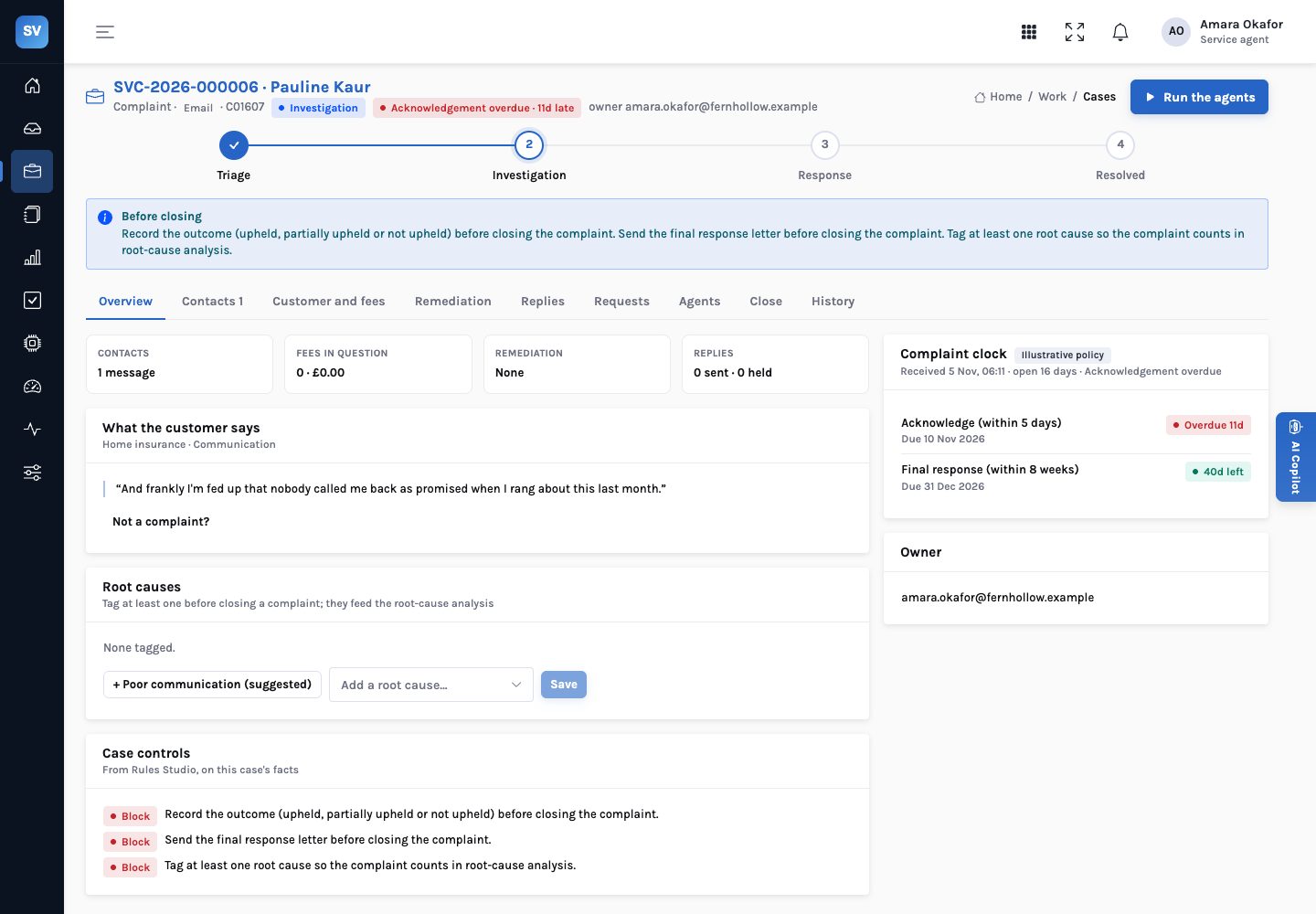
The agents then prepared three things, each waiting for the handler:
- Triage agent: “Treat SVC-2026-000006 as a complaint: it is hidden in a service request”, quoting the sentence and stating that “An expression of dissatisfaction makes it a complaint: the clock runs from receipt (final response due 2026-12-31, illustrative policy).”
- Case researcher: no fees in question; a suggested root cause of poor communication.
- Reply drafter: an acknowledgement that quotes her concern back to her and gives the response date, flagged as following the firm’s illustrative timescales.
As of 21 November nothing has been sent. The acknowledgement is 11 days late against the illustrative policy, and the case says so in red at the top. The case controls still block the close: there is no outcome, no final response, and no root cause tagged yet. The statements themselves are a separate service task; the complaint is about the missed call-back.
Something to check in your own data
Pauline asks for statements for her current account, but the demo record behind this case shows only a home insurance policy, and the case’s product is home insurance (taken from the contact). In a real deployment, a mismatch like that is a prompt for the handler to check which account the customer means before replying.
Aisha’s change of address, and a vulnerability on record
Aisha’s case follows the same path, with one addition. Her own words contain no vulnerability indicator, but her customer record carries a health condition noted on 1 July 2026. When a case is opened, InsightService brings record-held vulnerability onto the case alongside anything quoted from the message, marked with its source: “On the customer’s record since 2026-07-01”. The case is marked vulnerable and its priority goes up to high.
That changes what it takes to close. In addition to the outcome, the final response and a root cause, the case control “The customer shows vulnerability indicators: record how the case is being adapted for them” blocks the close until a person writes down how. The vulnerability spotter has prepared a suggestion: “agree with the customer how and when to contact them; take extra care with deadlines.” Aisha’s form also gives her preferred contact as phone, which is the kind of fact the adaptation should reflect.
Her acknowledgement was due on 13 November and is 8 days late as of 21 November. The researcher found no fees in question and suggested a root cause of “other”; the handler would likely tag the app failure more precisely before closing.
What the agents prepared on SVC-2026-000005, and what remains for the handler.
When the classifier is wrong
A lexicon will sometimes see dissatisfaction that isn’t there, or miss it. InsightService treats the classification as a proposal a person confirms or corrects. On the case overview, under the quote, there is a “Not a complaint?” button; on a query it reads “Treat as a complaint” (the inbox has the same correction). A correction requires a reason. Turning a query into a complaint starts the clock from the first contact’s receipt. Turning a complaint back into a query removes the clock, but only while no reply has gone out: once an acknowledgement or final response has been sent, the case stays a complaint.
Agents cannot make that change. In the code, an attempt by an agent to set whether a case is a complaint is refused with “Whether a case is a complaint is a person’s call; the triage agent only proposes it.”
Who does what
Intent, product, sentiment, dissatisfaction and vulnerability, each quoted from the customer’s sentence.
“Hidden in a query” shows routine requests with one dissatisfied sentence.
The clock runs from when the message arrived; the summary is the quoted sentence.
Accept the triage agent’s proposal, or correct it with a reason. Agents can’t.
Required when the message or the record shows vulnerability. The spotter suggests text from the knowledge base.
Drafted and held; a person sends it.
The statements or the address change, and a final response about what went wrong.
Poor communication, process failure or another tag, so it counts in root-cause analysis.
What it means
For the head of complaints
Hidden complaints are the gap between the complaints a firm records and the complaints it receives. Quoting the sentence makes every one auditable: anyone can read why a statement request was treated as a complaint.
Because the clock starts at receipt, the case shows honestly when a hidden complaint was found late. That is information, not an embarrassment to hide.
For the service operations lead
A filter for hidden complaints gives a team lead a daily list to sweep, rather than relying on every handler reading every request closely.
Record-held vulnerability arrives on the case automatically, so it isn’t lost because the customer didn’t mention it this time.
For the board
Complaint volumes may rise when hidden ones are counted. That is the true number; the root causes behind them are the ones worth fixing.
No agent decides whether something is a complaint. People do, with a reason on the record.
Next: a bereaved customer, where the sentence that matters is about her husband, not about the bank.