“My husband Robert passed away in August.” It is the first sentence of Chidi Gill’s email, and it should change everything about how her complaint is handled: the tone of the reply, how she is contacted, what she is asked for, and how quickly the letters addressed to her husband stop. In a busy queue it is also easy to read past, because the complaint itself is about fee letters. This post follows her case through InsightService, from the sentence to the controls that stop the case closing until someone has written down how it was adapted for her.
In short
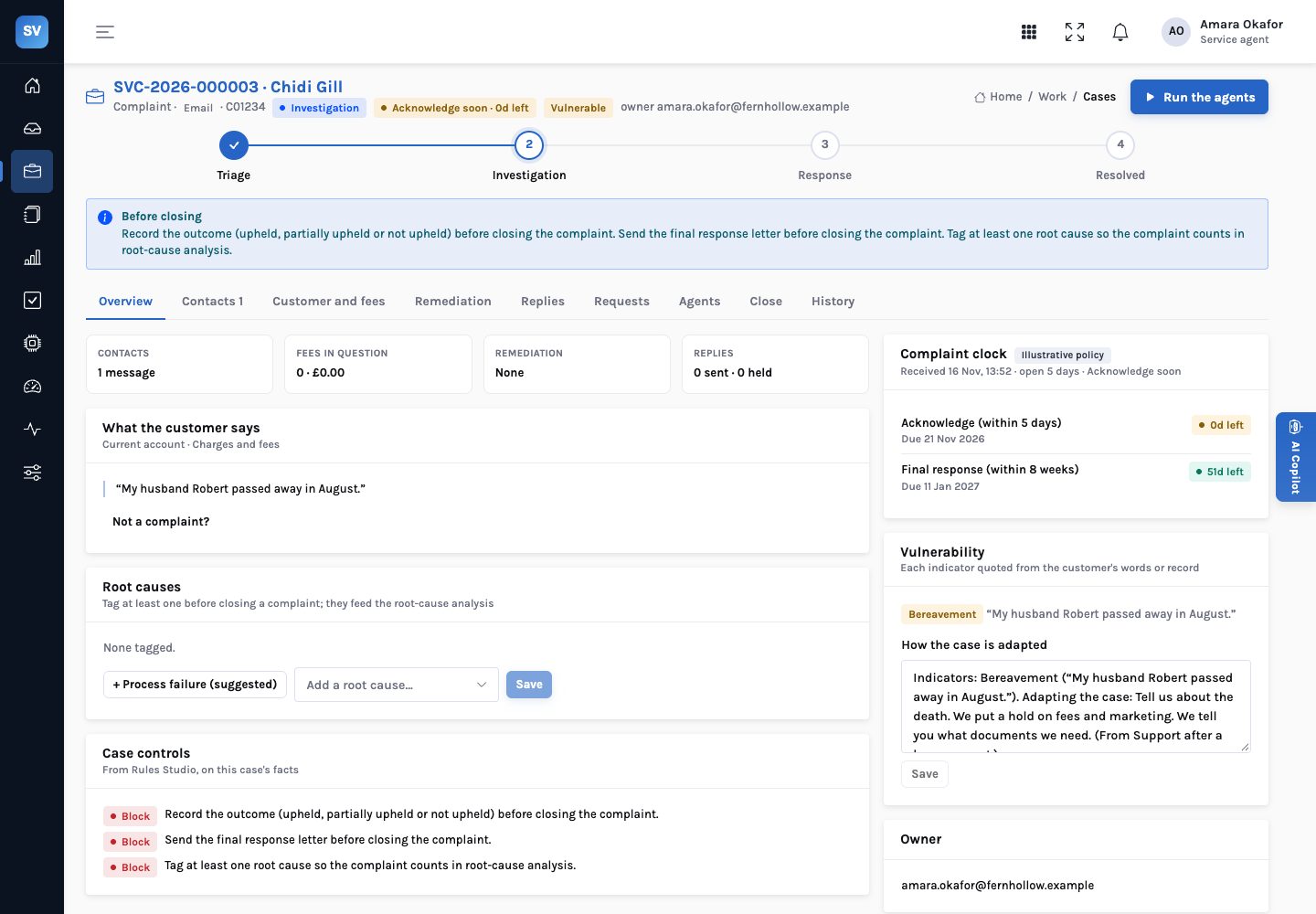
- The bereavement is quoted, not inferred. The vulnerability spotter quotes the sentence it rests on, so the handler sees why the case is flagged.
- It is a complaint, on the clock. “I’ve sent the death certificate twice now” and “it is very upsetting every time one arrives” are expressions of dissatisfaction; the clock runs from her email.
- The adaptation is a control, not a courtesy. A vulnerable customer’s case cannot close until a person records how it is being adapted. Here that has been done; the outcome, the final response and a root cause are still open.
- The reply is drafted with the firm’s bereavement support. The acknowledgement points to the knowledge-base article on support after a bereavement, and is held until a person sends it.
The situation
The case is SVC-2026-000003 in InsightService’s demo data for Fernhollow Bank & Insurance, a fictional firm. Chidi Gill emailed on 16 November 2026 under the subject “My late husband’s account”:
What she wrote
“My husband Robert passed away in August. We had a joint account with you and I’ve sent the death certificate twice now. I keep getting letters addressed to him about fees on the account and it is very upsetting every time one arrives. I don’t really know what I’m supposed to do and I’m finding all of this very hard. Could someone please just tell me what happens now and stop the letters?”
There are three things in that message. A life event (a death). A process failure (the certificate sent twice, letters still addressed to the deceased). And a plain request for help: tell me what happens now. Her customer record shows a joint Everyday Current Account and a two-year fixed-rate mortgage.
What the guidance expects
The FCA’s guidance on the fair treatment of vulnerable customers (FG21/1) describes vulnerability as arising from health, life events, resilience and capability, and names bereavement among the life events. It expects firms to understand their customers’ needs, to have staff who can recognise them, to adapt how they communicate and what they offer, and to check that the outcomes are good. The Consumer Duty’s consumer support outcome points the same way. None of that is possible if the sentence is missed, or if it is noticed by one handler and never written down for the next.
The handler reads the email, recognises the bereavement, and handles it kindly. Whether anything changes for the next handler, or the next letter run, depends on a free-text note somewhere.
The bereavement is quoted on the case and the case is marked vulnerable and high priority. It cannot close until a person records how it was adapted, and the adaptation is on the decision record.
Step 1: the classifier finds two things
InsightService’s classifier reads the email sentence by sentence. It found:
- Dissatisfaction in “We had a joint account with you and I’ve sent the death certificate twice now” and in “I keep getting letters addressed to him about fees on the account and it is very upsetting every time one arrives”. That makes the email a complaint, with a suggested root cause of process failure.
- A vulnerability indicator, bereavement, quoted from “My husband Robert passed away in August.”
The overall sentiment is neutral; she is courteous throughout. Again, it is the dissatisfaction finding, not the sentiment, that makes it a complaint, and the vulnerability finding is separate from both.
Opening the case set the clock from receipt on 16 November. Under the demo’s illustrative, configurable policy (five days to acknowledge, eight weeks for the final response) the acknowledgement is due on 21 November 2026, which is “today” in the demo, and the final response by 11 January 2027. The vulnerability made the case high priority.
Step 2: the agents prepare, the handler decides
Running the agents on the case produced these prepared decisions, each waiting for a person to accept, reject or ask about:
| Agent | What it prepared | Status in the demo |
|---|---|---|
| Vulnerability spotter | How the case is adapted, from the knowledge-base article “Support after a bereavement”: “Tell us about the death. We put a hold on fees and marketing. We tell you what documents we need.” | Accepted by the handler; the note is on the case |
| Case researcher | No fees in question; root cause process failure | Waiting for the handler |
| Reply drafter | An acknowledgement that quotes her concern, gives the response date and points to the bereavement support | Waiting for the handler |
| Supervisor | What still blocks the close, against the clock | Briefing only |
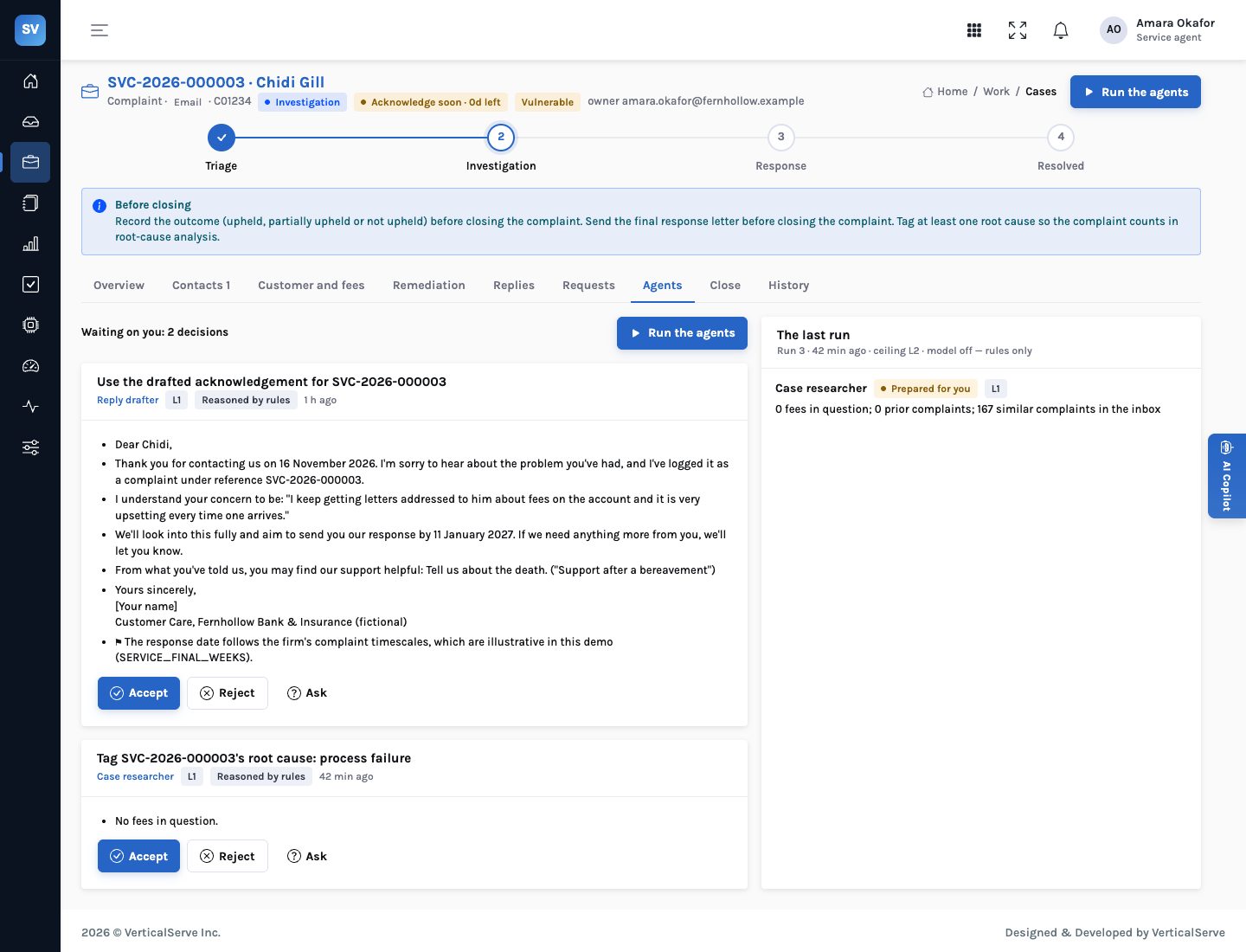
The drafted acknowledgement reads, in part: “Thank you for contacting us on 16 November 2026. I’m sorry to hear about the problem you’ve had, and I’ve logged it as a complaint under reference SVC-2026-000003. I understand your concern to be: ‘I keep getting letters addressed to him about fees on the account and it is very upsetting every time one arrives.’” It then gives the response date and adds “From what you’ve told us, you may find our support helpful: Tell us about the death.” with the article’s title.
A draft is a starting point
The drafter builds the acknowledgement deterministically from the case’s facts and the knowledge base, so it can quote the customer accurately and never invents a promise. It is not written for a widow by someone who has read her email. That is why it is held: the handler edits it before it goes, and on a case like this most handlers will want to, starting with an expression of condolence.
Step 3: asking her the right thing
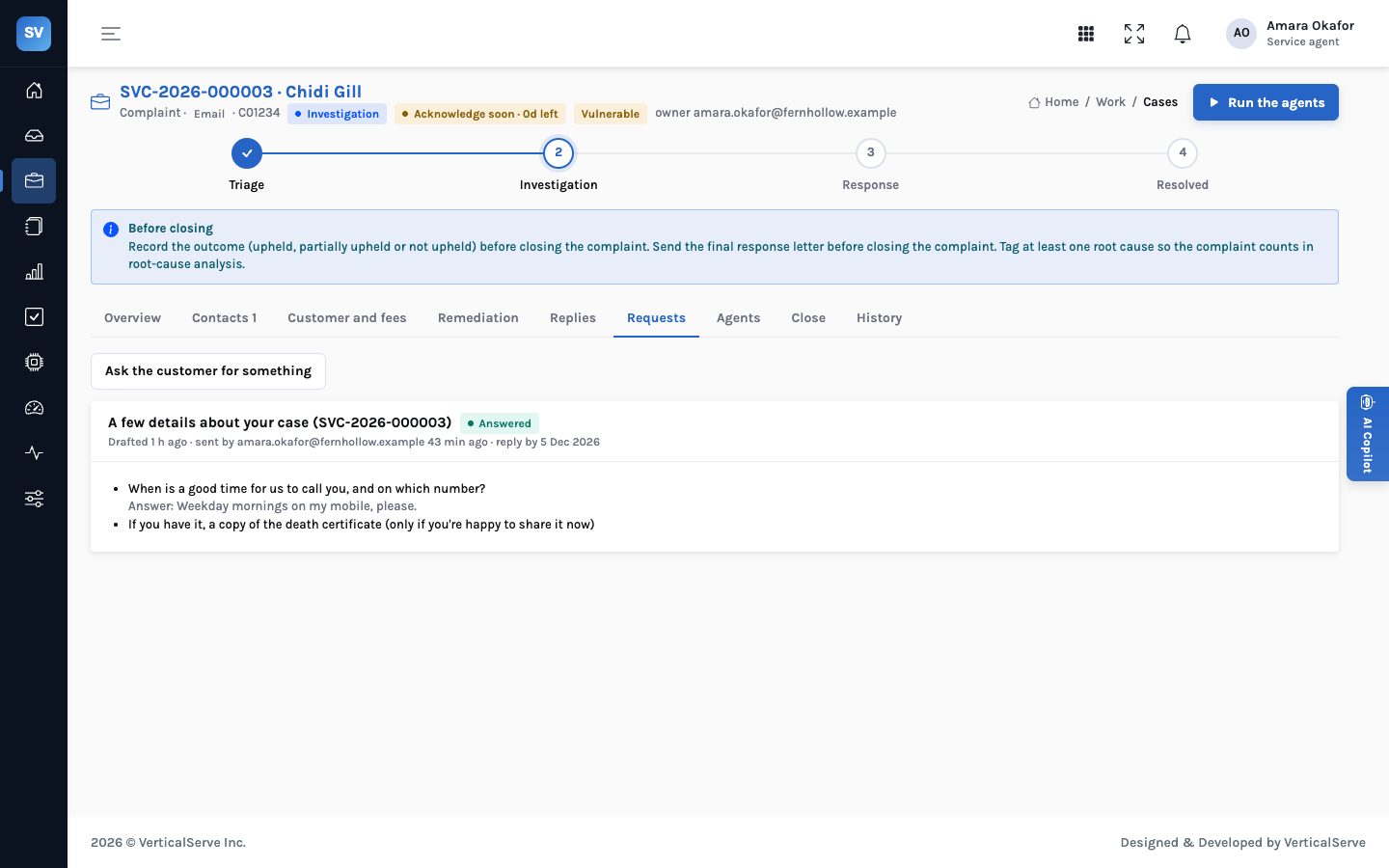
Her message asks the bank to tell her what happens now. Before calling, the handler sent a request through InsightService’s no-login link with two items: “When is a good time for us to call you, and on which number?” and “If you have it, a copy of the death certificate (only if you’re happy to share it now)”. Like every request, it was held until a person sent it. She answered the first: “Weekday mornings on my mobile, please.” She didn’t upload a certificate.
Worth asking yourself
She had already said she’d sent the death certificate twice. Asking for it a third time, even optionally, repeats the failure she is complaining about. The better move is to find the two copies she sent. InsightService makes the request easy to edit before it goes; it can’t make that judgement for the handler.
What still stands between the case and closing it
Because the adaptation has been recorded, the vulnerability control no longer blocks the close. The request has been answered, so it doesn’t either. Three controls from Rules Studio still do:
- Record the outcome (upheld, partially upheld or not upheld) before closing the complaint.
- Send the final response letter before closing the complaint.
- Tag at least one root cause so the complaint counts in root-cause analysis.
And the acknowledgement is due today under the illustrative policy.
The controls that apply to a vulnerable customer’s complaint. On SVC-2026-000003 the first two gates are passed; the third is still open.
Who does what, in order
The steps already taken, and those still to come. Every message to Chidi is sent by a person.
Each finding quotes the sentence it rests on.
Vulnerability raises the priority; the clock runs from her email.
From the spotter’s suggestion or in your own words. Required before close.
A no-login request, held until sent. Ask only for what you don’t already have.
Edit the draft; it is held until a person sends it.
Stop the letters to the deceased, find the certificates she sent.
Process failure is the suggestion; the outcome is a person’s call.
Replace the template referral-rights wording with the firm’s approved text. The decision record keeps the vulnerability note.
What it means
For the head of complaints
The vulnerability is evidenced by a quote and the adaptation by a recorded note, on the case and on the decision record. That is what a review of how vulnerable customers were treated will ask to see.
The QA checklist checks it again after the close: “Vulnerability recorded and addressed” fails if a vulnerable customer’s case closed without a note.
For the service operations lead
Vulnerable cases surface on the home page (“vulnerable customers without a recorded adaptation”) and in the inbox’s vulnerability filter, so they don’t depend on one handler’s reading.
The drafts save time; the handler’s time goes on the call and on the words.
For the board
A letter addressed to a dead customer is a process failure that will recur until someone fixes it. Tagging the root cause is how it reaches the root-cause analysis instead of staying a single apology.
No agent decides anything here: it quotes, suggests and drafts.
Next: a customer who has lost her job, where the case is a query, not a complaint, and the controls still apply.