Sooner or later someone will ask a firm that uses AI in complaint handling a simple question about a single case: why did this customer get this answer? It might be a supervisor, an internal auditor, the ombudsman or the customer. The firms that answer it easily will be the ones that designed for it from the start, so that every fact, every number and every decision on the case can be traced to its source and to a person.
In short
- Accountability doesn’t move to the software. Under the UK Senior Managers and Certification Regime, named people are accountable for how the firm is run. Using AI changes how the work is done, not who answers for it.
- The Consumer Duty asks for evidence of outcomes. A firm needs to show its complaint handling produces good outcomes, which means being able to explain individual decisions and spot patterns across them.
- Four questions come up every time. Where did this fact come from? Who decided? Could the arithmetic be checked? What does the AI do when it isn’t sure?
- The design answers them. In InsightService, classification, deadlines and redress are deterministic code; agents explain and draft over numbered facts; and sending, paying, classifying, approving and closing are always a person’s act.
The rules that already apply
There is, so far, no single rulebook for AI in UK complaint handling. The questions come from rules firms already live under, applied to a new way of doing the work.
| Framework | Why it matters for AI in complaints | The question it prompts |
|---|---|---|
| DISP (the FCA’s complaint rules) | Complaints must be investigated competently, diligently and impartially, and answered fairly and in time | Did a person with the right authority decide the outcome, on the evidence? |
| Consumer Duty (PRIN 2A, from 31 July 2023) | Firms must act to deliver good outcomes for retail customers and be able to evidence them | Can you show the outcome was fair, case by case and across the book? |
| Senior Managers and Certification Regime | Named senior managers are accountable for the areas they run | Who is accountable for how the AI is used, and how do they oversee it? |
| Model risk management | Banks are expected to manage the risk of the models they rely on; the PRA’s SS1/23 sets out principles for banks within its scope | Is the model inventoried, validated and monitored, and what happens when it is wrong? |
| Data protection (UK GDPR) | Restrictions and safeguards apply to some decisions based solely on automated processing | Is any decision with significant effect on the customer made without a person? |
A map, not legal advice
Each framework above has its own scope and conditions; SS1/23, for example, applies to some firms and not others, and the EU AI Act, where it applies, classifies systems by use case. Read the current texts that apply to your firm. The point of this post is the shape of the questions, which is similar everywhere.
The four questions
1. Where did this fact come from?
A complaint handler’s decision rests on facts: what the customer said, which fees were charged, when the complaint arrived. If an AI system can introduce a fact, a fee that was never charged, a date that was never in the email, the whole case becomes suspect. The answer a supervisor wants is that every fact on the case points back to a record.
2. Who decided?
The outcome of a complaint, the redress, the words sent to the customer and the decision to close all have consequences. A firm should be able to name the person who took each one, and show what they were looking at when they did.
3. Could the arithmetic be checked?
Deadlines and redress are calculations. If they come out of a language model, nobody can be sure the same inputs would give the same answer tomorrow. If they come out of code, anyone can recalculate them, which is what a QA reviewer or an ombudsman will do.
4. What happens when it isn’t sure, or is switched off?
Models are unavailable, change versions, or produce answers that don’t hold up. A design where the work stops when the model stops is fragile. A design where the model is an optional layer on top of rules degrades gracefully.
How InsightService answers them
The engines compute, the agents explain and prepare, and people decide. Each layer writes to the record.
| Question | What InsightService does |
|---|---|
| Where did this fact come from? | Every classification quotes the customer’s sentence. Every fee in question is a record from the firm’s systems, with its fee id and fee run. Every drafted reply carries citations to the facts and knowledge-base articles it used. Agents reason over facts numbered [F1], [F2] and so on, and an answer naming a person, date or amount that isn’t among them is thrown away. |
| Who decided? | Agents never send to a customer, approve or pay a remediation, decide whether a case is a complaint, record an outcome or close a case; the code refuses those actions when the actor is an agent. Each person’s act is on the case history with their name. |
| Could the arithmetic be checked? | Deadlines come from the received date and configured policy. Redress is each fee refunded plus simple interest, amount × rate × days ÷ 365, rounded to the penny per item. QA recalculates both after the case closes. |
| What if the model is off? | It is a supported mode. With SERVICE_AGENTS_LLM off, every agent runs on its rules and each step says “Reasoned by rules”; the copilot answers from the case’s headline facts and says the model is off. The public demo runs this way. |
Prepared decisions, not automated ones
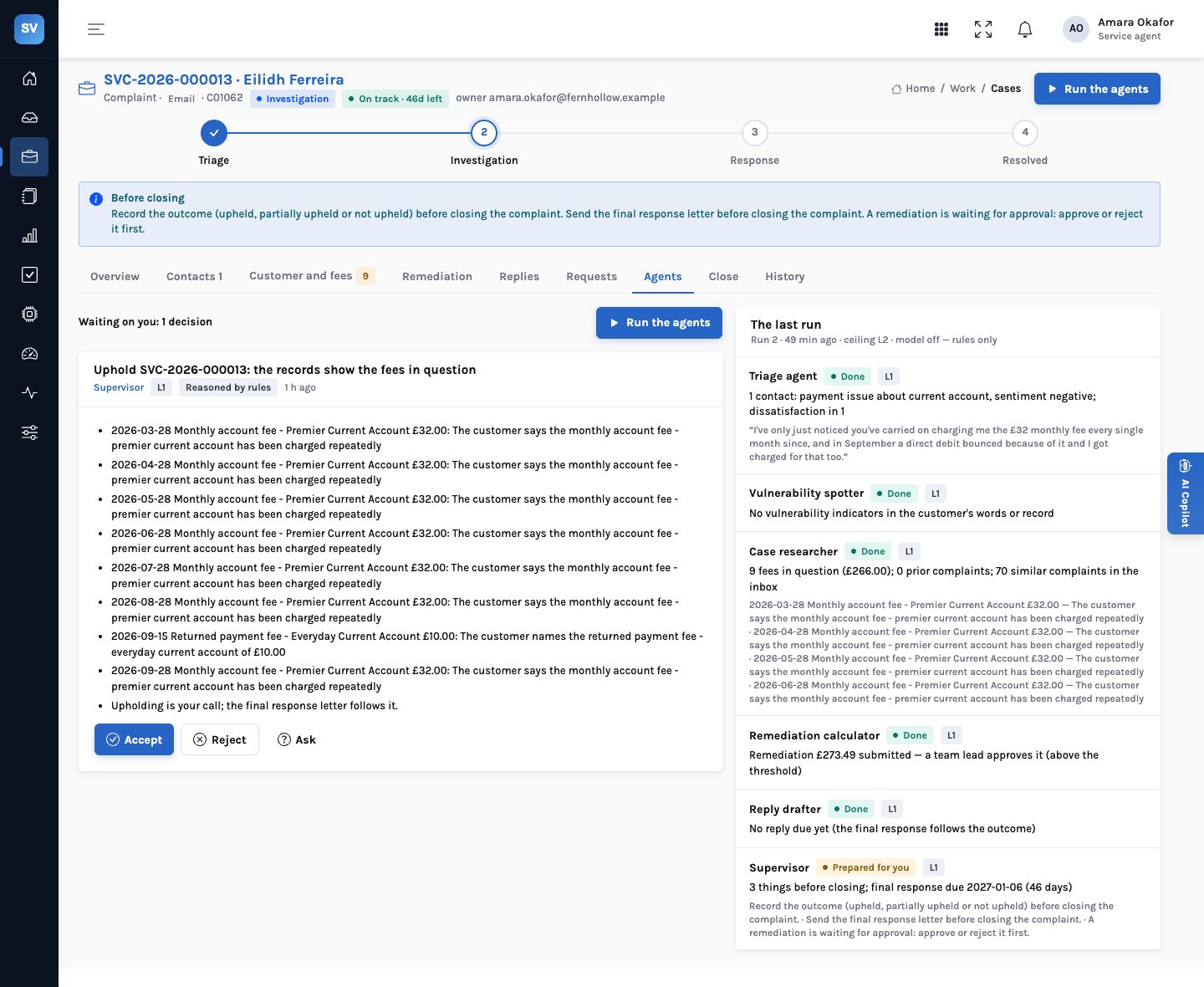
The unit of AI work in InsightService is the prepared decision. An agent does its step (the case researcher reads the fees, the remediation calculator works out a refund, the reply drafter writes the acknowledgement) and, where a person’s act is needed, it prepares that act and stops. The person answers in one of three ways.
Every answer is recorded, and how often people agree with an agent is what decides how much it may do.
Accepting a prepared remediation puts it on the case; it still needs approving, by a team lead who didn’t propose or submit it if it is above the threshold. Accepting a drafted reply puts it on the case, held; a person still presses send. Accepting a proposed outcome records it in the person’s name. The agent’s preparation saves the time; the person’s act is the decision.
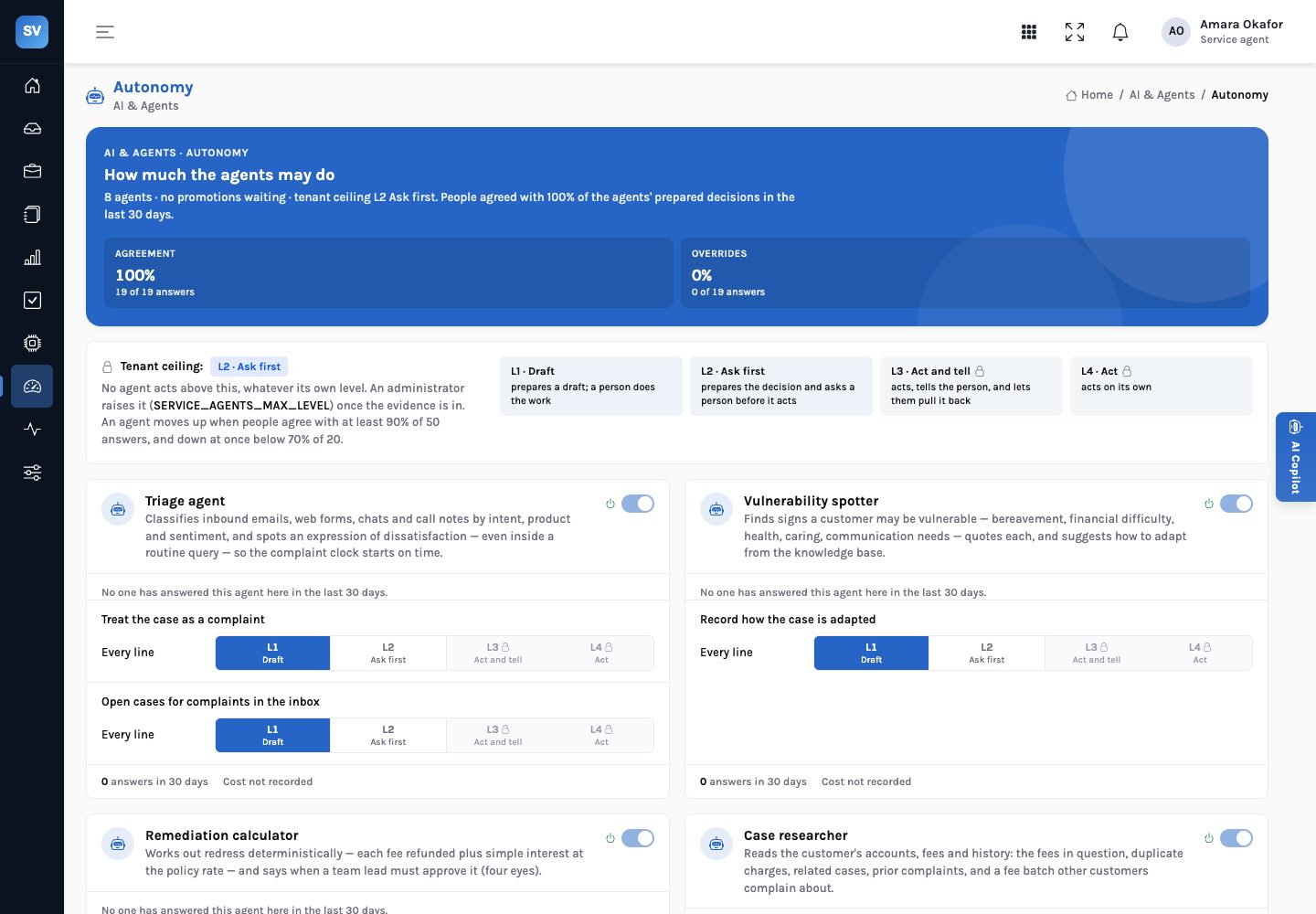
Autonomy that is earned and capped
Each agent action has an autonomy level. L1 means the agent drafts; L2 (“Ask first”) means it prepares the decision and asks before acting. Higher levels exist in the shared platform but every InsightService agent action is hard-capped at L2, whatever an administrator sets, and the demo agents run at L1. The platform recommends a change of level from the record: promotion only after sustained agreement (by default, 90% of at least 50 answers in 30 days), and a step back down if agreement falls.
The copilot reads; it doesn’t act
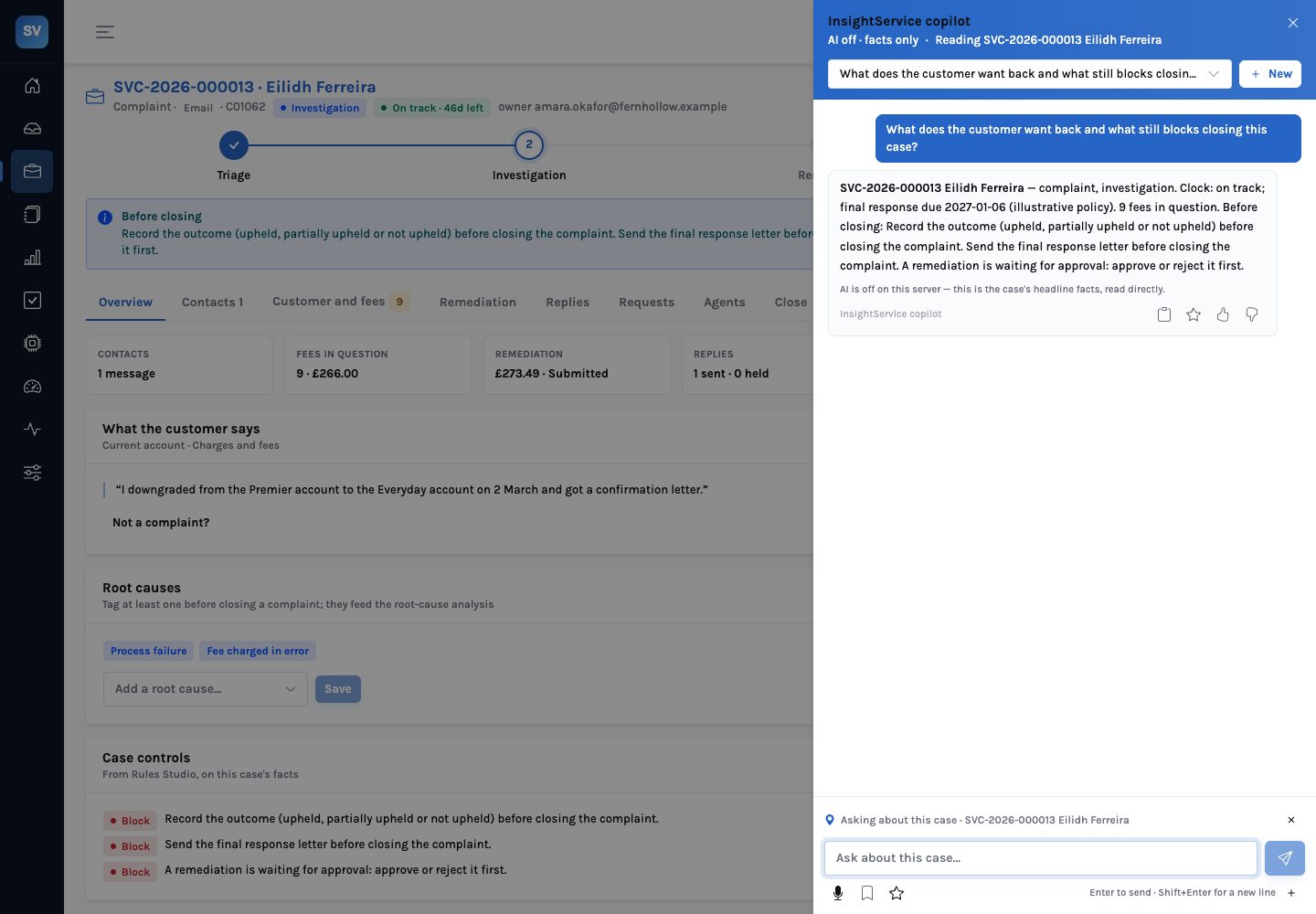
Beside every case is a copilot that answers questions about it: what the customer wants back, what blocks closing, when the final response is due. It reads the case through read-only tools (the summary and clock, the contacts, the customer’s accounts and fees, the research, the knowledge base, the remediation, the replies, what the agents prepared, the root causes) and cites them. It has no tool that sends, pays, classifies or closes, and every figure and name in its answer is checked against what the tools returned.
What a reviewer can reconstruct
The quoted sentence, the classifier version, and any person’s correction with its reason.
The received timestamp, the deadlines, and when each reply was sent.
The fees in question with ids and fee runs, related cases and prior complaints, as found on the day.
Each item, its days and interest, the rate, the as-of date, who proposed, submitted and approved it.
The final letter as sent, with its citations, and whether template wording was flagged.
The outcome, the person who closed it, the case controls and, where a close was referred, the lead who signed it off.
Every agent step, what it prepared, and who accepted, rejected or asked.
For the head of complaints
Treat AI in complaints as a change to how the work is prepared, not to who decides. Write down which acts are always a person’s and check the system enforces them, rather than relying on procedure.
Ask to see one closed case reconstructed end to end before go-live. If it takes more than a few minutes, the evidence trail isn’t good enough.
For the service operations lead
Handlers stay accountable for what they send and close, so they need to see why each prepared decision was made. Prepared decisions that show their facts are faster to check than ones that don’t.
Agreement and override rates are a useful operational signal: an agent people keep rejecting is telling you something about its rules or your process.
For the board
Accountability under SM&CR and evidence of outcomes under the Consumer Duty both point the same way: the board should be able to see who decided and on what basis, for any case.
Deterministic arithmetic and a model that can be switched off reduce the model risk to explain, not just the effort to explain it.
Let the AI prepare. Make sure a person decided, and that you can show it.
The questions a regulator will ask about AI in complaint handling are the same questions it asks about complaint handling: was it fair, was it on time, who decided, and can you prove it. AI makes the answers harder only if it is allowed to supply facts or take decisions.
InsightService keeps it to explaining and drafting, over facts it can cite, with every consequential act left to a named person.