A customer writes in because a £6.00 unarranged overdraft fee was taken from an account that has always been in credit. Handled on its own, it is a small refund and an apology. Handled as data, it is a question: who else was charged by the same run? At Fernhollow, the fictional bank and insurer InsightService runs on in our demo, the answer was 104 customers, from a single fee run on 3 October. Four of them had complained. Most of the rest had not noticed yet.
In short
- A complaint is evidence about a process, not only about a customer. UK firms are expected to identify and remedy recurring or systemic problems that their complaints reveal (DISP 1.3.3R), and the same idea runs through most complaint-handling regimes.
- Root cause only works if every complaint is tagged. InsightService will not let a complaint close without at least one root cause, so the analysis is never built on a convenient subset.
- Count customers, not complaints, and look beyond your own cases. Clusters combine confirmed cases, complaints still in the inbox and the firm’s prior complaints, by cause and product.
- “Possibly systemic” is a flag for a person, not a verdict. A fee run several complainants share, or a cause that has doubled and crossed a threshold in a month, is raised for an owner to acknowledge.
Why one complaint is never only one complaint
Complaint handling is usually organised around the case: one customer, one handler, one letter. That is the right unit for fairness to the person who complained. It is the wrong unit for spotting what went wrong. A faulty fee run, a broken screen in the app, a letter template that confuses everyone who receives it: each of these produces a trickle of complaints, spread across handlers, channels and weeks. No single handler sees enough of them to recognise the pattern.
Regulators know this. In the UK, the FCA’s complaints sourcebook asks firms to put in place appropriate management controls and take reasonable steps to ensure that, in handling complaints, they identify and remedy any recurring or systemic problems (DISP 1.3.3R). The Consumer Duty raises the stakes: a firm is expected to monitor whether its customers are getting good outcomes, and complaints are one of the clearest signals it has. Elsewhere the wording differs, but the expectation that complaint data feeds back into the business is close to universal.
The difficulty is practical. To answer “is this happening to other people?” a handler needs the complaint tagged with a cause, the fees or transactions behind it, and a view across every other complaint with the same cause. In most firms the first is optional, the second sits in another system and the third is a quarterly spreadsheet.
Tag every complaint, or the numbers lie
InsightService treats the root cause as part of handling the complaint, not as reporting done afterwards. The classifier suggests causes from the customer’s words as soon as a contact arrives: a fee charged in error, a duplicate charge, a claim handling delay, poor communication, a system outage, staff conduct and so on. Case research adds to the suggestion from the records: if the same fee appears twice on the same day, “duplicate charge” is put first; if fees are in question, “fee charged in error” is added.
A person confirms the tags on the case. And one of the nine case controls in Rules Studio,
ROOT_CAUSE_MISSING, blocks a complaint from closing until at least one root cause is tagged,
“so the complaint counts in root-cause analysis”. That control is the difference between
analysis built on every complaint and analysis built on the ones somebody remembered to tag.
Root causes are suggested from the words and the records, confirmed by a person, and required before a complaint can close.
Three sources, one picture
A root-cause view that only counts closed cases is always late. InsightService’s root-cause analyst groups every complaint the firm knows of, one row each, from three places:
| Source | What counts | Tag used |
|---|---|---|
| Cases | Every complaint opened as a case in InsightService | The confirmed tags, or the research’s suggestion until a person confirms |
| Inbox | Complaints the classifier found in incoming contacts that are not on a case yet | The classifier’s suggested cause, marked as suggested |
| Prior complaints | Complaints the firm handled before InsightService, read from its own records | The cause recorded at the time |
Each complaint is grouped by root cause and product, so “fee charged in error on the Everyday Current Account” is a different cluster from “fee charged in error on the Plus Current Account”. For each cluster the analyst counts complaints and distinct customers, how many customers appeared in the last 90 days, the last 30 and the 30 before that, how many cases are still open, and the upheld rate where an outcome was decided.
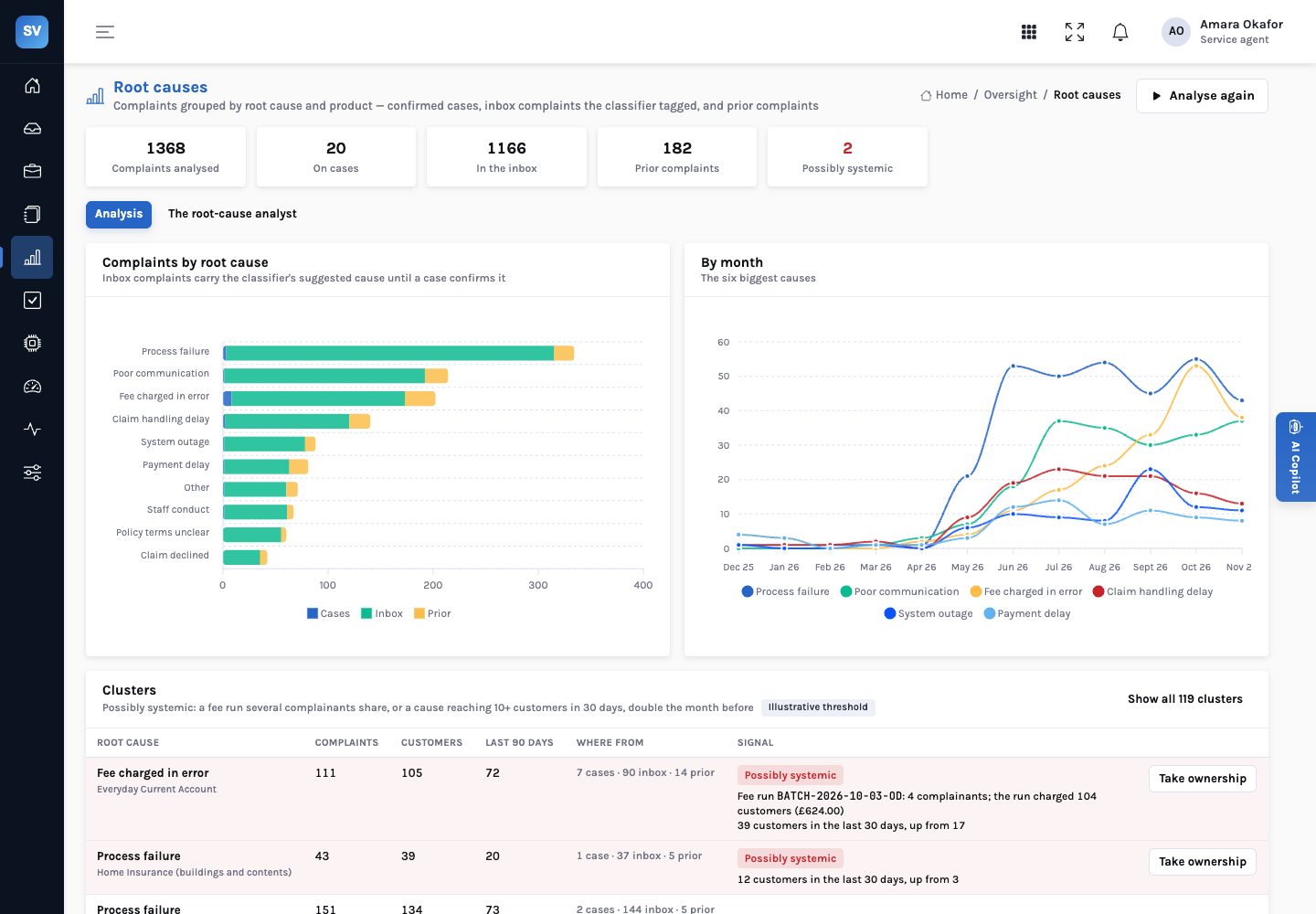
On the demo data that is 1,368 complaints: 20 on cases, 1,166 in the inbox and 182 prior complaints, across 119 clusters. The two largest causes are process failure (334) and poor communication (214), followed by fees charged in error (202).
When a cluster looks systemic
Counting is not the same as noticing. InsightService flags a cluster as possibly systemic on two signals, both deterministic so anyone can check them:
- A shared fee run. When case research finds the fees in question, it records the fee run (batch) each was charged in. If two or more complaining customers share a fee run, the cluster is flagged, and the run’s full reach is read from the firm’s fee records: how many fees, how many customers, what total.
- A cause that is rising fast. When the number of customers complaining about a cause
in the last 30 days is at least twice the systemic threshold and at least double the 30 days before,
the cluster is flagged as rising. The threshold is
SERVICE_SYSTEMIC_CUSTOMERS, 5 by default, which is an illustrative placeholder for the firm’s own policy.
The two signals behind a possibly systemic flag. The threshold is configurable policy; the default is illustrative.
On the demo data two clusters are flagged. The first is fee charged in error on the Everyday
Current Account: 111 complaints from 105 customers, 72 of them in the last 90 days, 39 in the
last 30, up from 17. Four complainants share fee run BATCH-2026-10-03-OD, which charged 104
customers £624.00 in unarranged overdraft fees. The second is process failure on home
insurance: 43 complaints from 39 customers, with 12 customers in the last 30 days, up from 3,
flagged on the rising signal alone.
Possibly systemic, not proven systemic
The flag says the numbers deserve a person’s attention. It doesn’t say the fee run was wrong, how many customers were harmed, or what the firm should do. Those are judgements for the owner who acknowledges the cluster, with the evidence the cluster carries.
From the case to the run, and back
The same link works in the other direction, from a single case. When a handler opens Muhammad Ellery’s complaint, received through the web form on 9 October (“I have never had an overdraft and my account has always been in credit”), the case researcher has already found the £6.00 unarranged overdraft fee charged on 3 October and the run it belongs to. The case shows that the run charged 104 customers and lists the other cases on the same run, so the handler knows before writing a word that this is not an isolated mistake.
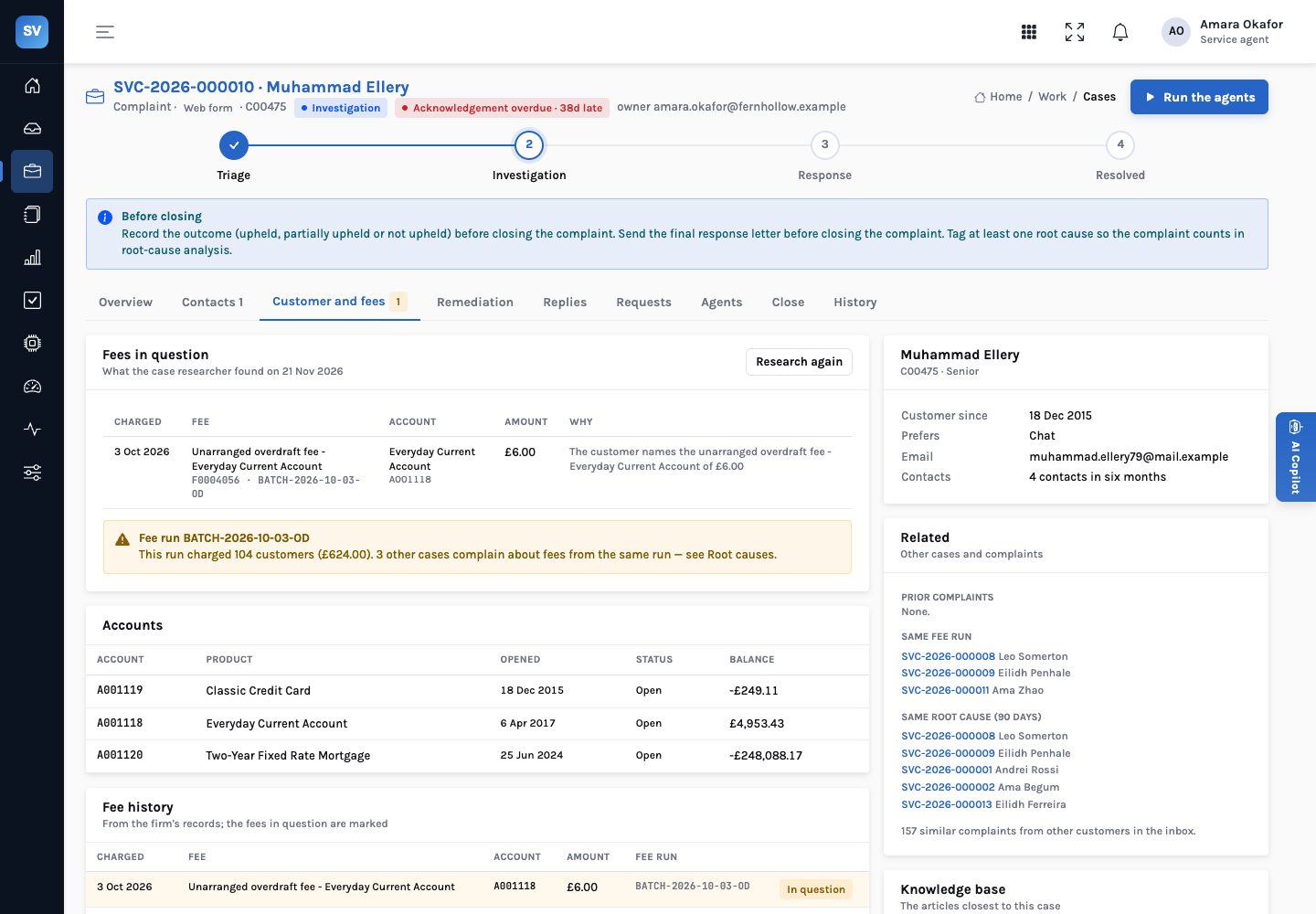
That matters for fairness as well as for analysis. If the fee run was wrong for everyone, the customers who complained should not be the only ones refunded, and the ones who complained first should not get a different answer from the ones who complained last. Seeing the run on the case is how the handler knows to ask.
The root-cause analyst and its owner
Running the analysis is the job of the root-cause analyst, one of InsightService’s eight agents. It groups the complaints, updates each cluster, and prepares one decision for a person: take ownership of the systemic clusters. Like every agent it is capped at L2, Ask first; it prepares, and a person accepts, rejects or asks.
Cases, inbox complaints and prior complaints, by root cause and product.
Complaints, customers, last 90 / 30 / previous 30 days, open cases, upheld rate.
A shared fee run, or a rising cause above the illustrative threshold.
A prepared decision to take ownership of the clusters flagged possibly systemic.
Takes ownership with a note. Agents can’t own a root cause; the platform refuses.
Fix the run, refund those affected, change the letter: outside InsightService, owned by a person.
The owner’s acknowledgement is recorded with their name and note on the cluster and in the audit trail. What happens next, whether that is a proactive refund to every customer on the run or a change to how overdraft fees are calculated, is the business’s decision. InsightService doesn’t pay or change anything in the firm’s systems; it reads them.
Upheld rates tell you where you are wrong
The last table on the Root causes page is the simplest and often the most useful: for each cause, the share of decided complaints that were upheld or partially upheld. A cause with a high upheld rate is one where the firm keeps agreeing it got something wrong. On the demo data, policy terms unclear is upheld 80% of the time, system outage 70% and fees charged in error 63%; “other” is upheld 18% of the time. Those are the fictional firm’s numbers, generated for the demo, but the shape of the question is real: where are we repeatedly saying sorry, and have we fixed it?
For the head of complaints
Root-cause evidence comes from every complaint because the control won’t let one close untagged. When a supervisor asks how you identify recurring problems, the answer is a page, not a project.
Each flagged cluster has a named owner and a note. That is the trail that shows the firm noticed and acted.
For the service operations lead
Handlers see the run behind a fee on the case itself, with the other complaints on it, so answers stay consistent across the team.
Suggested tags save typing; confirming them is one click, and the case can’t close without one.
For the board
Complaints become an early warning: a faulty fee run shows up as a flagged cluster while it is still four complaints, not four hundred.
The upheld rate by cause shows where the firm keeps getting it wrong.
What this doesn’t do
It is worth being precise about the limits. The classifier’s suggested causes come from word patterns a firm tunes; they are a starting point, and inbox complaints carry them as suggestions until a case confirms them. The rising signal is arithmetic on counts, not a statistical test. The fee-run link depends on the firm’s fee records carrying a run identifier. And “possibly systemic” is exactly that. The value is that every number on the page can be recomputed from the complaints behind it, and every flag has a person who owns it.
A complaint about six pounds can be the first sign of a problem for a hundred customers.
Root-cause analysis works when every complaint is tagged, every source is counted, and every flag has an owner.
InsightService makes the tag a condition of closing, counts the inbox and the past as well as the case, and leaves the judgement about what is systemic to a person.