Two customers are charged the same wrong fee on the same day. One complains in October and gets the fee back. The other complains in November and gets the fee back with interest and a goodwill payment, because a different handler worked it out a different way. Neither customer is likely to find out. An auditor, an ombudsman or a regulator reviewing a sample of files will, and inconsistent redress is one of the easiest findings there is to make.
In short
- Redress should be calculated, not composed. InsightService refunds each fee in question in full and adds simple interest from the day it was charged, worked out by code to the penny, item by item.
- The method is on the page. Every remediation shows each fee, its charge date, the days, the interest and the sentence describing the method, so anyone can recalculate it with a calculator.
- The rate and the threshold are your policy. The demo uses 8% a year and £250 as illustrative placeholders (
SERVICE_REMEDIATION_RATE,SERVICE_APPROVAL_THRESHOLD). - Above the threshold, four eyes is enforced. A team lead who neither proposed nor submitted the remediation approves it, and the decision record keeps who did what. Nothing is paid from InsightService.
What fair redress has to be
The FCA’s complaints rules ask firms to investigate a complaint competently, diligently and impartially, assess it fairly, consistently and promptly, and, where the complaint is upheld, offer redress or remedial action that is fair (DISP 1.4.1R). Consistency is the word that does the work. Two customers in the same position should end up in the same place, and the firm should be able to show how it got there.
For the most common money complaint, a fee or charge that shouldn’t have been taken, the usual starting point is to put the customer back where they would have been: return the money and compensate them for being without it. The UK Financial Ombudsman Service commonly awards simple interest at 8% a year for money a customer was deprived of, which is why many firms use that rate in their own redress. It is a common reference, not a rule that covers every case, and InsightService treats it as a configurable placeholder rather than a statement of what any firm must pay.
The calculation
InsightService’s remediation calculator is deliberately small. For each fee a person selects (normally the fees the case researcher found in question):
| Step | What it does |
|---|---|
| Refund | The fee amount, in full, rounded to the penny |
| Days | From the date the fee was charged to the as-of date (today, when the remediation is proposed) |
| Interest | amount × rate × days ÷ 365, rounded to the penny for that fee |
| Goodwill | An optional amount a person adds for distress or inconvenience; never negative |
| Total | Refunds + interest + goodwill |
| Approval | Needed when the total is above the threshold |
Nothing in that table is a language model. The remediation agent runs the calculator and explains the result; the arithmetic is code, and the same fees on the same day always give the same answer. A fee that was already reversed can’t be refunded again, and fees that aren’t this customer’s are refused.
A worked example: eight months of a fee she shouldn’t have paid
In the demo, Eilidh Ferreira downgraded from the Premier current account to the Everyday account on 2 March. The £32 monthly Premier fee carried on being charged every month, and in September a direct debit bounced because of it, adding a £10 returned payment fee. The case researcher found nine fees in question, £266.00 in total. The calculator, run on 21 November, worked out each line:
| Charged | Fee | Refund | Days | Interest at 8% |
|---|---|---|---|---|
| 28 Mar 2026 | Monthly account fee – Premier | £32.00 | 238 | £1.67 |
| 28 Apr 2026 | Monthly account fee – Premier | £32.00 | 207 | £1.45 |
| 28 May 2026 | Monthly account fee – Premier | £32.00 | 177 | £1.24 |
| 28 Jun 2026 | Monthly account fee – Premier | £32.00 | 146 | £1.02 |
| 28 Jul 2026 | Monthly account fee – Premier | £32.00 | 116 | £0.81 |
| 28 Aug 2026 | Monthly account fee – Premier | £32.00 | 85 | £0.60 |
| 15 Sep 2026 | Returned payment fee | £10.00 | 67 | £0.15 |
| 28 Sep 2026 | Monthly account fee – Premier | £32.00 | 54 | £0.38 |
| 28 Oct 2026 | Monthly account fee – Premier | £32.00 | 24 | £0.17 |
| Total | £266.00 | £7.49 |
The first line checks easily: £32.00 × 0.08 × 238 ÷ 365 = £1.669, which rounds to £1.67. The total is £273.49. Because that is above the illustrative £250 threshold, the remediation can’t simply be approved by the handler who proposed it.
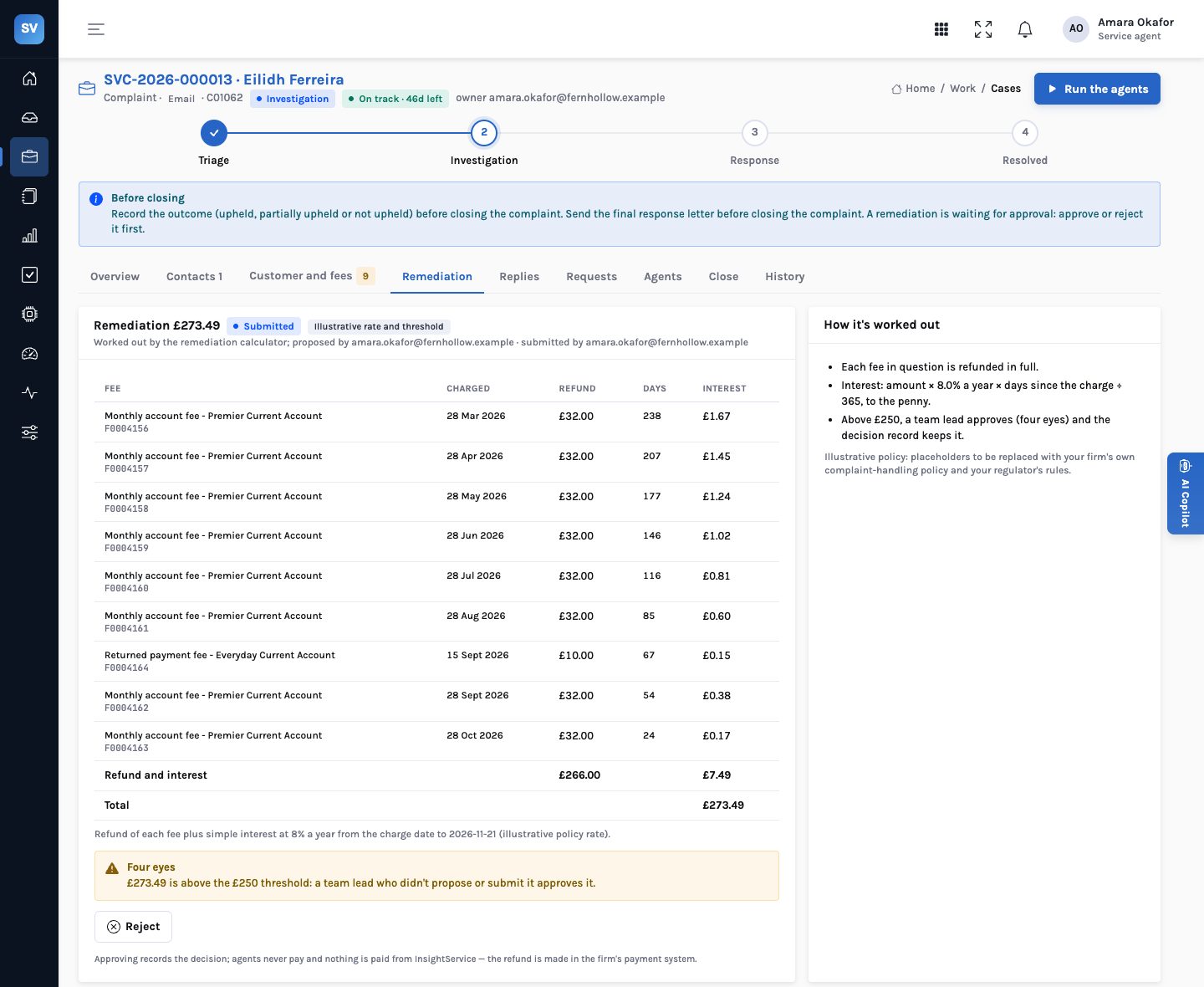
Four eyes above the threshold
A remediation moves through a short life: proposed, submitted (when it needs approval), then approved or rejected. Proposing a new one for the same case marks the old one superseded, so there is only ever one live remediation on a case. The rules for deciding it are enforced by the API, not by a reminder on the screen:
Above the threshold: the agent prepares, the handler proposes and submits, a different team lead approves.
| Rule | What happens if someone tries |
|---|---|
| An agent approves or pays | Refused: “An agent can’t approve or pay a remediation; a person does.” |
| A handler approves above the threshold | Refused: the total is above the threshold, so a team lead approves it |
| The lead proposed or submitted it | Refused: four eyes, the approver can’t be the person who proposed or submitted it |
| A rejection without a reason | Refused: say why it’s rejected |
| A final response while it waits | Refused: approve or reject the remediation before the final response |
| Closing the case while it waits | Blocked by the REMEDIATION_PENDING case control |
Below the threshold the remediation still needs a person to approve it, but that person can be the handler. In the demo, Ama Begum’s duplicate £6.00 overdraft fees became a £12.02 remediation (£12.00 plus £0.02 interest for ten days) that the handler approved herself, which the policy allows. Where you set the threshold is a risk decision for the firm; the product enforces whatever you choose.
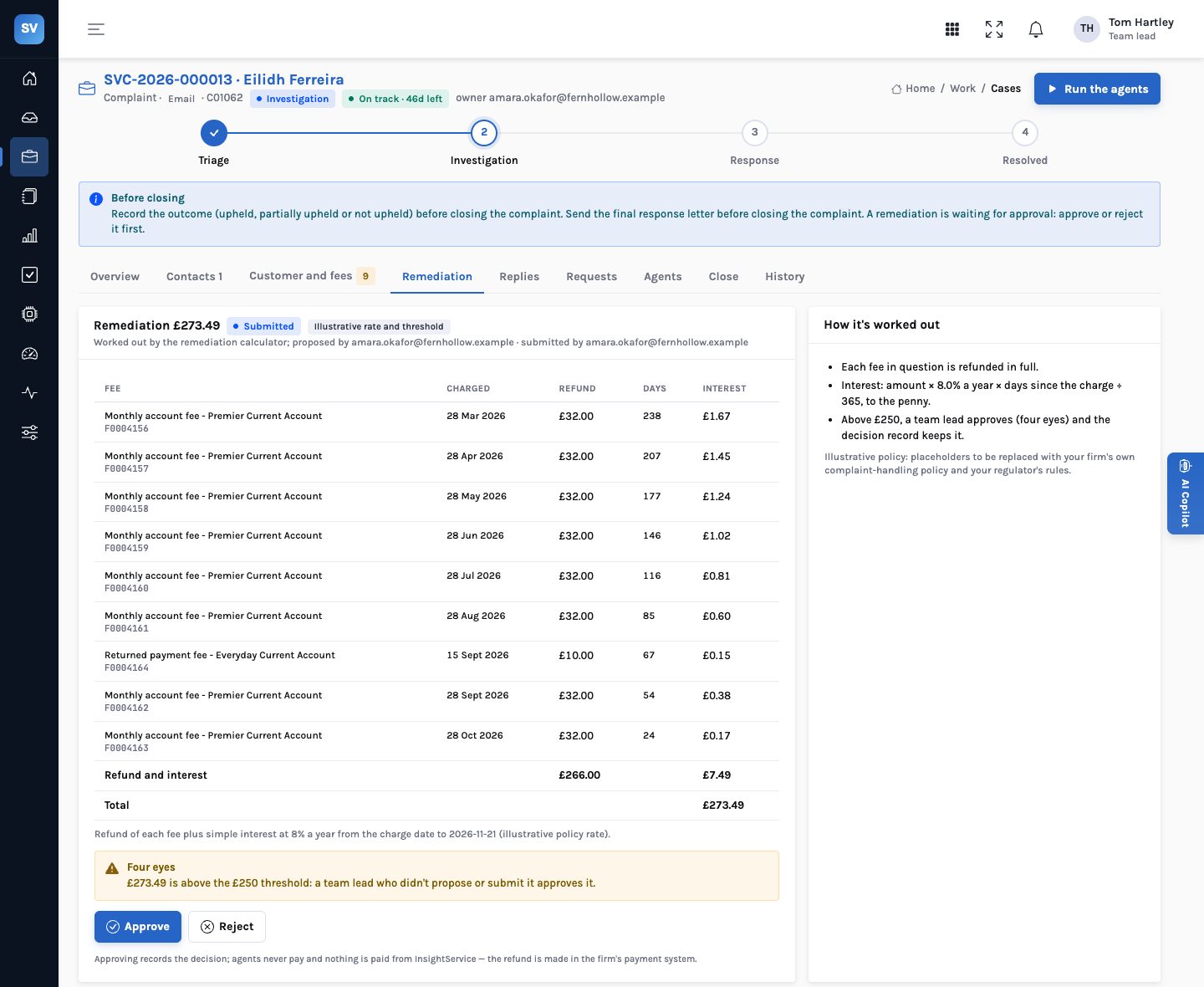
The decision record
When a remediation is approved or rejected, InsightService writes a decision record: the case, the total, the refund, the interest, the rate, the threshold, whether approval was needed, who proposed it, who submitted it, every item, and a line for the approval-threshold rule saying whether the total was within the threshold or referred for four eyes. The approver’s note is signed off as a human decision.
Approving records the decision; it doesn’t move money. The refund is made in the firm’s payment or core banking system, by the people and controls that already govern payments there. InsightService’s job is to make the amount right, consistent and approved by the right person.
Why not let the model suggest an amount?
Because there is nothing for a model to add. The fees come from the firm’s records and the method is policy. A generated figure would be one more thing to check; a calculated one can be checked by anyone. The agent’s job is to explain which fees are included and why.
Recalculating after the fact
Consistency is only provable if someone checks. InsightService’s QA sampling does it mechanically: for each sampled closed case with a remediation, the QA reviewer recalculates the redress from the stored items, rate, as-of date, goodwill and threshold, and compares it with the amount that was approved. A difference of more than half a penny fails the check. A second check confirms that, where approval was needed, the approver was neither the proposer nor the submitter.
QA recalculates every sampled remediation and checks the approver was independent where the threshold required it.
A spreadsheet here, a mental estimate there; interest sometimes, goodwill sometimes. Each file defensible on its own and the book inconsistent as a whole.
Each fee, its days and its interest on the page; the rate and threshold set once as policy; four eyes enforced above the threshold; QA recalculating a sample.
Choosing the fees is the judgement
The arithmetic is mechanical; deciding what to refund is not. The case researcher proposes the fees in question from two kinds of evidence: the same fee charged twice on the same day on the same account, and fees the customer’s message names, over the last ten months or so. Each comes with the reason it was picked, such as “Charged twice on 2026-11-08: F0004046 repeats F0004045” or “The customer says the monthly account fee has been charged repeatedly”. The handler can include or leave out any fee, and add a goodwill amount for distress or inconvenience, before proposing.
Andrei Rossi’s complaint is the simple case. He was charged a £10.00 returned payment fee twice on 8 November. The researcher found both, the remediation calculator prepared a refund of both (he wasn’t sure the first was right either), and the handler proposed it: £20.00 plus £0.06 interest for thirteen days, £20.06, well under the threshold, so the handler can approve it herself.
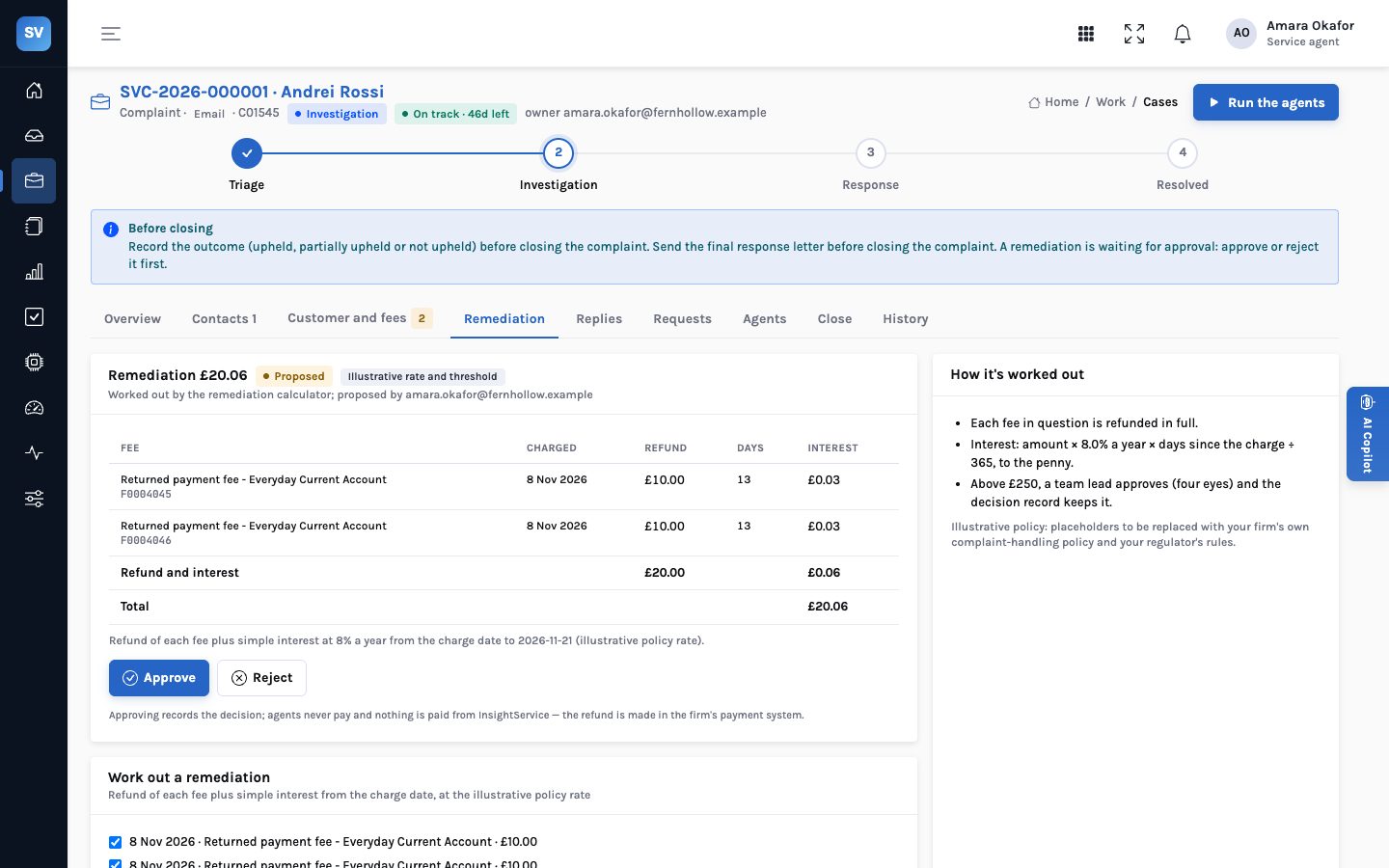
Setting the policy
Three settings govern remediation, all read from the environment of the API and shown on screen as
“illustrative policy”: the interest rate (SERVICE_REMEDIATION_RATE, 0.08 by
default), the approval threshold (SERVICE_APPROVAL_THRESHOLD, 250 by default) and the
currency, pounds in the demo. A firm replaces them with its own redress policy before relying on them.
Some firms use different rates for different products or periods; others add consequential losses
that need a person’s judgement. InsightService’s calculator covers the common case, refunds
plus simple interest plus an optional goodwill amount, and leaves anything else to the handler and the
approver, on the record.
For the head of complaints
Every remediation shows its method and can be recalculated, so the question “how did you arrive at this?” has a one-line answer.
Four eyes above the threshold is enforced by the system and visible on the decision record.
For the service operations lead
Handlers don’t compute interest by hand; they choose which fees to refund and whether goodwill is warranted.
The lead’s approval queue shows what is waiting, with the lines already worked out.
For the board
The approval threshold is a policy lever: lower it for more oversight, raise it for speed.
Nothing leaves the firm without its existing payment controls; InsightService only decides the amount.
Fair redress is redress you can explain, repeat and recalculate.
Refund the fee, add interest by a stated method, show every line, and make a second person approve the large ones.
Then check a sample by doing the arithmetic again.