When a complaint reaches an ombudsman, the first document anyone reads is the firm’s final response. It is where the firm said what it decided, why, what it would do about it and what the customer could do next. A good one closes the matter. A vague one, or one that promises something nobody approved, or one that leaves out the customer’s right to go further, becomes part of the problem.
In short
- The letter has a job list. In the UK, a final response tells the customer the outcome and the reasons, any redress offered, and their right to refer the complaint to the Financial Ombudsman Service, generally within six months (DISP 1.6.2R).
- Draft it from the case, not from memory. InsightService’s reply drafter writes the letter from the recorded outcome, the fees in question, the approved remediation and the knowledge base, and lists a citation for every fact.
- Your approved wording, not a model’s. The referral-rights paragraph is a marked template to replace with the firm’s approved text; the draft flags it every time.
- Held until a person sends it. The letter can’t be drafted before an outcome is recorded or sent while a remediation waits for approval, and no agent can send it.
What a final response has to do
The FCA’s complaints rules set out what a final response is. Broadly, it is a written response from the firm that accepts the complaint and, where appropriate, offers redress or remedial action; or offers redress without accepting the complaint; or rejects the complaint and gives reasons. It must tell the customer that, if they remain dissatisfied, they may refer the complaint to the Financial Ombudsman Service, generally within six months of the date of the letter, and the firm must include the standard explanatory wording the rules prescribe (DISP 1.6.2R and DISP 1 Annex 3R). Other regimes set different contents, but the shape is similar everywhere: a decision, the reasons, the remedy and the route to escalate.
Under the Consumer Duty, the letter is also communication the customer has to be able to understand. A final response that is technically complete but opaque doesn’t support good outcomes. That argues for plain sentences built from the specific facts of the case, which is exactly what a template filled in by hand tends not to produce.
| The letter says | Where InsightService takes it from |
|---|---|
| The complaint and its reference | The case: received date, case reference, the customer’s own words |
| The outcome | Recorded by a person on the Close tab: upheld, partially upheld or not upheld, with an explanation |
| What we found | The fees in question from case research, each with its amount and date |
| What we will do | The approved remediation: refund, interest, any goodwill, the total |
| Helpful context | The knowledge-base articles closest to the case, quoted and named |
| Support, where it applies | Vulnerability articles matched to the indicators on the case |
| Referral rights | A marked template for the firm’s approved wording |
How the draft is built
The reply drafter is one of InsightService’s eight agents. It drafts three kinds of reply: the acknowledgement, a response (for a query) and the final response letter. The text is assembled deterministically from the case’s facts; if a language model is switched on, it explains and phrases over numbered facts, and an answer that carries a name or number not in those facts is thrown away.
Every paragraph of the draft comes from something on the case or in the knowledge base, and the draft waits for a person.
Two preconditions are enforced before the letter exists at all. If no outcome has been recorded, the drafter refuses: “Record the outcome (upheld, partially upheld or not upheld) before drafting the final response.” And if a remediation has been proposed or submitted but not yet decided, it refuses again, because the letter would otherwise describe money nobody has approved. The outcome itself is a person’s call; the supervisor agent can propose one where the records support it, but it cannot record it.
A real draft, from the demo
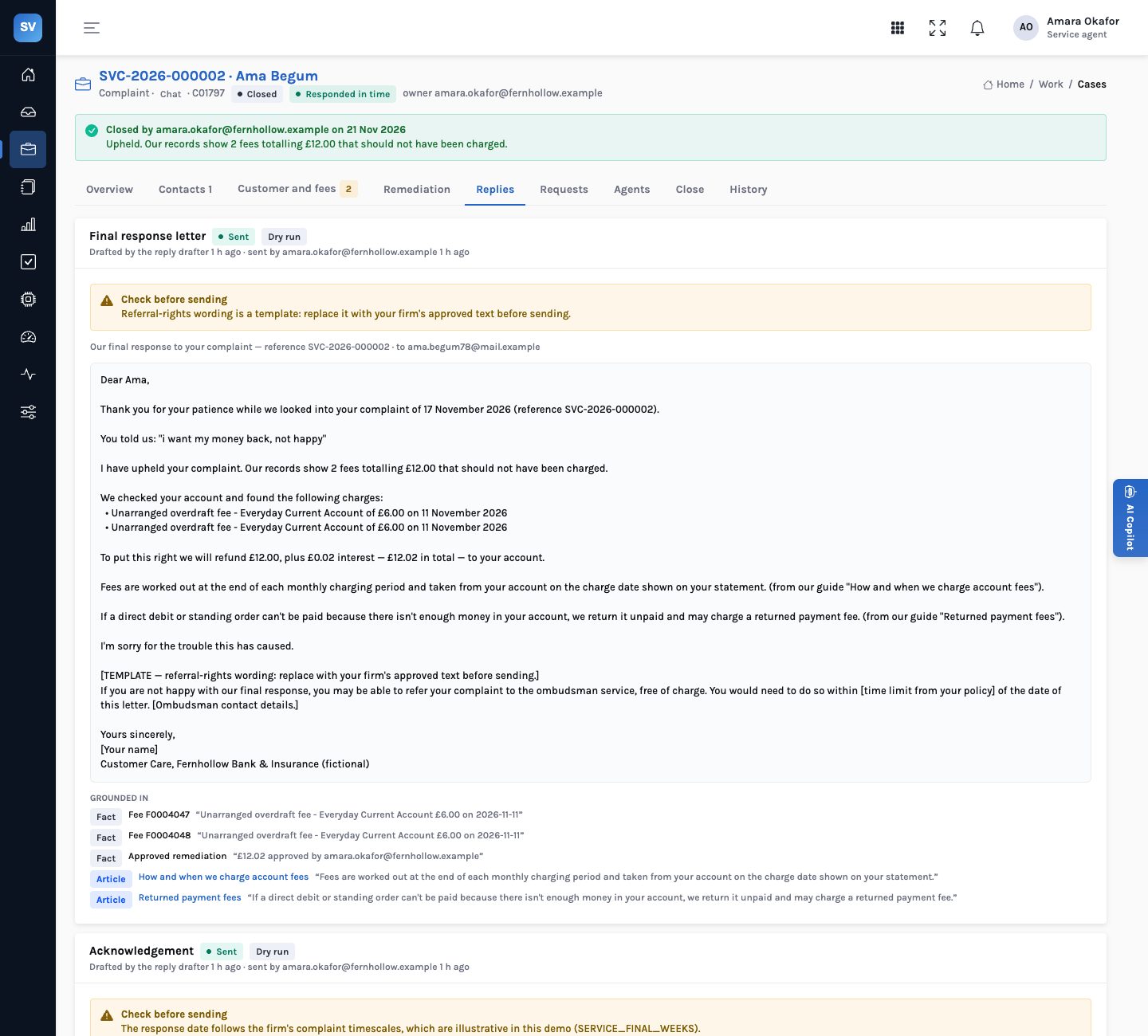
Ama Begum contacted Fernhollow by chat on 17 November: two unarranged overdraft fees of £6.00 on the same day, “i want my money back, not happy”. The case researcher found both fees, the calculator worked out £12.02, the handler upheld the complaint and approved the remediation, and the reply drafter prepared this letter, which the handler reviewed and sent:
Dear Ama,

Thank you for your patience while we looked into your complaint of 17 November 2026
(reference SVC-2026-000002).

You told us: "i want my money back, not happy"

I have upheld your complaint. Our records show 2 fees totalling £12.00 that should
not have been charged.

We checked your account and found the following charges:
  • Unarranged overdraft fee - Everyday Current Account of £6.00 on 11 November 2026
  • Unarranged overdraft fee - Everyday Current Account of £6.00 on 11 November 2026

To put this right we will refund £12.00, plus £0.02 interest — £12.02 in total —
to your account.

Fees are worked out at the end of each monthly charging period and taken from your
account on the charge date shown on your statement. (from our guide "How and when
we charge account fees").

… a second knowledge-base paragraph …

I'm sorry for the trouble this has caused.

[TEMPLATE — referral-rights wording: replace with your firm's approved text before sending.]
If you are not happy with our final response, you may be able to refer your complaint
to the ombudsman service, free of charge. You would need to do so within [time limit
from your policy] of the date of this letter. [Ombudsman contact details.]

Yours sincerely,
[Your name]
Customer Care, Fernhollow Bank & Insurance (fictional)
The final response on SVC-2026-000002, as stored on the case. Fernhollow and its customers are fictional.
Under the letter the case lists what it rests on: fee F0004047, fee F0004048,
the approved remediation and who approved it, and the two knowledge-base articles quoted. A reviewer can
check every sentence against its source without leaving the page.
Why the referral wording is a template
It would be easy to have the drafter write the ombudsman paragraph itself. InsightService deliberately doesn’t. The referral-rights text is regulated wording that firms take from their regulator’s prescribed text and approve through their own legal and compliance process; the time limit, the ombudsman’s contact details and any statement about time-limit waivers are things a firm has to get exactly right. So the draft carries a clearly marked placeholder, and every draft lists a template flag: “Referral-rights wording is a template: replace it with your firm’s approved text before sending.”
A setting worth changing before go-live
In the demo, a letter that still contains the template marker can be sent, so the flow can be shown end to end. The setting SERVICE_ALLOW_TEMPLATE_SEND controls this: set it to anything other than 1 and InsightService refuses to send a final response until the template wording has been replaced. A firm should do that, or replace the template text at source, before any real letter goes out.
Sending, and what sending changes
Every reply is created with the status held. A person can edit the subject, the body and the recipient while it is held, withdraw it, or send it. The checks at sending repeat the ones at drafting: an outcome is recorded, no remediation is waiting, and there is an email address. Agents are refused outright: “An agent can’t send to a customer; a person sends it.”
A reply's life. Only a person moves it out of Held.
Sending a final response stamps the time on the case, which stops the complaint clock for the final
response leg (and counts as the acknowledgement if none was sent), and moves the case to Resolved. The
clock then shows whether the letter went out in time against the illustrative policy timescale
(SERVICE_FINAL_WEEKS, 8 weeks by default). Whether the email actually leaves depends on the
environment: outside production, and unless SERVICE_COMMS_LIVE opts in, the send is recorded
as a dry run and nothing is delivered. The audit trail says which.
Upheld, partially upheld or not upheld; the explanation goes into the letter.
Approved or rejected; nothing can be pending.
From the case’s facts and the knowledge base, with citations and template flags.
With the firm’s approved referral-rights text.
The letter leaves; the clock records when.
Case controls check the final response was sent; QA later checks the letter carried the referral wording.
The acknowledgement comes first
The final response is the last letter, not the only one. The same drafter prepares the acknowledgement as soon as a complaint is opened: it thanks the customer, gives the case reference, repeats what they told us in their own words, and says when to expect the response, dated from the illustrative policy timescale and flagged as such. Ama Begum’s acknowledgement told her to expect a response by 12 January 2027, eight weeks from her chat. It is held for a person to send like every other reply, and sending it stops the acknowledgement leg of the clock.
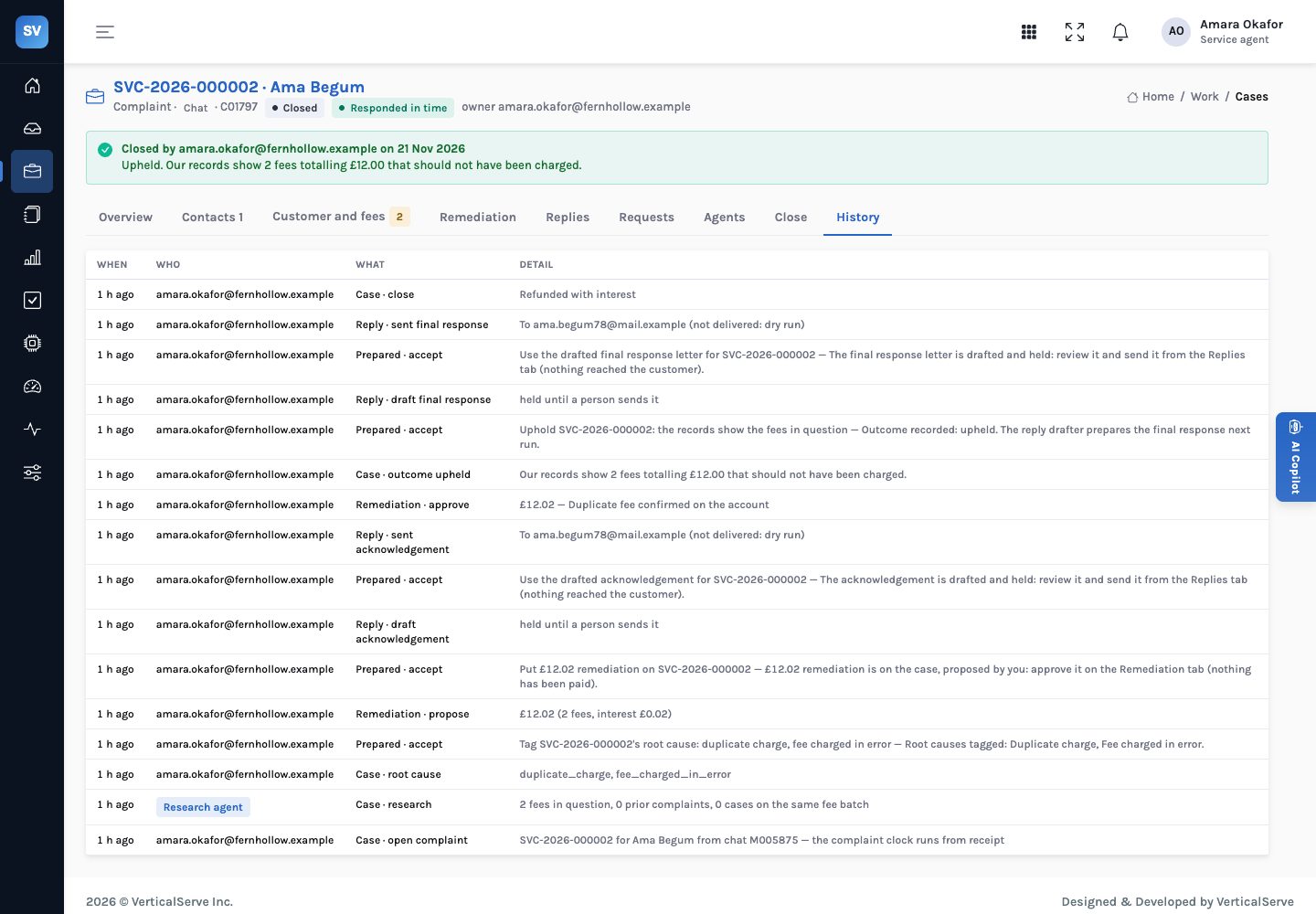
Every send is a line in the case history: who sent which reply, to which address, and whether it was delivered or recorded as a dry run. The history is what a reviewer reads to reconstruct the order of events, and it is the same record whether the customer’s letter was drafted by an agent or written from scratch.
How QA checks the letter
One of the eight checks QA sampling runs on a closed complaint is “Final letter carries the referral-rights wording”. It looks for a sent final response on the case that mentions the ombudsman. It is a simple check, and that is the point: it catches the case closed without a letter, or with a letter that lost its most important paragraph during editing. The deeper question, whether the wording is the firm’s approved text, is for the person recording the QA result.
The handler copies figures from three screens, pastes the ombudsman paragraph from a shared drive, and the reviewer has to re-find every number to check it.
Figures come from the records and the approved remediation, each with a citation; the regulated paragraph is a flagged template; the letter can’t be sent until the outcome and redress are decided.
For the head of complaints
The letter can’t describe redress nobody approved, and the referral wording is under your control, not the drafter’s.
Every fact in the letter has a citation, which is what an ombudsman or auditor will ask for.
For the service operations lead
Handlers start from a complete draft and spend their time on the explanation, which is the part only they can write well.
The checks at drafting and sending stop the common mistakes before the customer sees them.
For the board
Final responses are consistent across the team and the product lines.
The firm can prove what each customer was told, when, and on what basis.
The final response is the firm’s decision, in writing, with its reasons and the customer’s rights.
Draft it from the facts, cite every one, keep the regulated wording in the firm’s hands, and let only a person send it.