Every complaints operation runs on clocks, and most of them are kept in people’s heads: eight weeks for this, three days for that, fifteen business days if it’s a payment. The rules behind those numbers are real, but they differ by regime, by product and by how the complaint was resolved. A complaint handled against the wrong clock is late even when everyone worked hard on it.
In short
- The clock starts at receipt. In the UK rules the timescales run from when the firm received the complaint, which is why a hidden complaint found late is already behind.
- There is more than one clock. A prompt acknowledgement, a final response within eight weeks, a summary resolution route for complaints closed by the end of the third business day, and shorter limits for payment services complaints.
- The US works differently. Error-resolution rules under Regulation E and Regulation Z set their own investigation periods, and the CFPB sets response expectations for complaints sent through its portal.
- Deadlines belong in configuration. InsightService computes the acknowledgement and final-response dates from settings a firm replaces with its own policy, and labels them “illustrative policy” on every screen.
The UK clocks
For firms subject to the FCA’s Dispute Resolution sourcebook (DISP), the main timescales are set out in DISP 1.5 and DISP 1.6. In outline:
| Clock | What the rules expect | Where to look |
|---|---|---|
| Acknowledgement | A prompt written acknowledgement that the complaint has been received and is being handled. The rule doesn’t set a fixed number of days; firms set their own standard. | DISP 1.6.1R |
| Summary resolution | A complaint resolved by the close of the third business day after it was received can be closed with a summary resolution communication instead of a final response. | DISP 1.5 |
| Final response | A final response (or a response explaining why the firm isn’t yet in a position to give one) by the end of eight weeks after receipt. | DISP 1.6.2R |
| Payment services complaints | For most complaints about payment services and e-money, a final response within 15 business days, extendable to 35 business days in exceptional circumstances with a holding reply explaining why. | DISP 1.6.2A |
| Referral to the ombudsman | The final response tells the customer they can refer the complaint to the Financial Ombudsman Service, normally within six months of the final response. | DISP 1.6.2R, DISP 2.8.2R |
Check the current text
These are summaries of rules with conditions and exceptions attached: which firms and activities are in scope, how business days are counted, what a holding reply must say. Read the current DISP text for your firm before relying on any summary, including this one.
Two details cause most of the trouble. The first is which clock applies. A complaint about a card payment that didn’t arrive may fall under the payment services timescale; a complaint about the same customer’s home insurance claim doesn’t. The second is when the clock started. The timescale runs from receipt of the complaint, so the date the email arrived matters more than the date somebody opened a case for it.
A simplified map of the UK timescales. Real rules have conditions this diagram leaves out.
The US clocks
US consumer financial regulation has no single complaint clock like DISP’s. Instead, specific rules give the consumer the right to assert an error and set the time the institution has to investigate it.
| Rule | What it covers | The timescale, in outline |
|---|---|---|
| Regulation E, 12 CFR 1005.11 | Errors on electronic fund transfers: an unauthorised transfer, a wrong amount, a missing deposit | The consumer notifies within 60 days of the statement; the institution investigates within 10 business days, or up to 45 days if it provisionally credits the account, and reports the result |
| Regulation Z, 12 CFR 1026.13 | Billing errors on credit card and other open-end credit accounts | Acknowledge in writing within 30 days of the notice; resolve within two complete billing cycles and in any case within 90 days |
| CFPB complaint portal | Complaints consumers submit to the CFPB about a company | Companies are expected to respond within 15 days, and to give a final response within 60 days where the first wasn’t final |
A US bank therefore often runs two processes on the same contact: the error-resolution clock the regulation sets, and its own complaint-handling standard for everything else the customer said. The same lesson applies as in the UK: know which clock you are on, and start it from the right moment.
Extended timescales and exceptions
Regulation E and Regulation Z both carry extended periods and conditions (new accounts, point-of-sale and foreign transactions under Regulation E, for example) that this summary leaves out. Treat the table as a list of rules to read, not as the rules.
Why a deadline belongs in configuration
A firm’s complaint policy usually sets tighter internal standards than the rules require: acknowledge within a few days, aim to respond well before the final deadline, escalate when a case is close. Those numbers change, and they differ between firms and between products. If they live in code, every change is a release. If they live in a spreadsheet beside the case system, every case is a calculation someone can get wrong.
InsightService takes the middle route. The deadlines are computed by the product, consistently, for every complaint, but from settings the firm owns. The values it ships with are placeholders, and the product says so wherever they appear.
| Setting | Value in the demo | What it does |
|---|---|---|
SERVICE_ACK_DAYS | 5 calendar days | Acknowledgement due this many days after receipt |
SERVICE_FINAL_WEEKS | 8 weeks | Final response due this many weeks after receipt |
SERVICE_DUE_SOON_DAYS | 7 days | A deadline counts as “due soon” this many days before it falls |
All three are illustrative, configurable policy: placeholders for a firm’s own complaint-handling policy and its regulator’s rules, not a statement of any rule. The complaint clock on every case carries an “Illustrative policy” label, and the acknowledgement the reply drafter prepares flags that its response date follows those illustrative timescales. A firm that handles payment services complaints on a 15-business-day timescale would need its own policy for them; the demo uses one calendar-based clock for every complaint.
How the clock works on a case
When a contact is classified as a complaint and a case is opened, InsightService sets two deadlines from the date the contact was received: the acknowledgement and the final response. A query has no clock. If a person later decides a query is a complaint, the deadlines are set from the first contact’s receipt, not from the moment of the correction.
The states the clock moves through on a complaint. The final-response deadline decides “breached”; a late acknowledgement shows on its own.
Each leg of the clock shows its due date, whether it was met or missed, and the days left or the days late. Sending the acknowledgement or the final response from the Replies tab stops that leg. The states feed three things:
- The queue and the home page, which sort and count cases by what is due next: acknowledgements due soon, acknowledgements overdue, final responses due soon, and breaches.
- The case controls in Rules Studio. A breached clock doesn’t stop a case being closed, but it refers the close to a team lead, who must be someone other than the person who submitted it.
- QA sampling, where “acknowledged within the policy timescale” and “final response within the policy timescale” are two of the checks on every closed complaint, recalculated from the dates.
A worked example from the demo
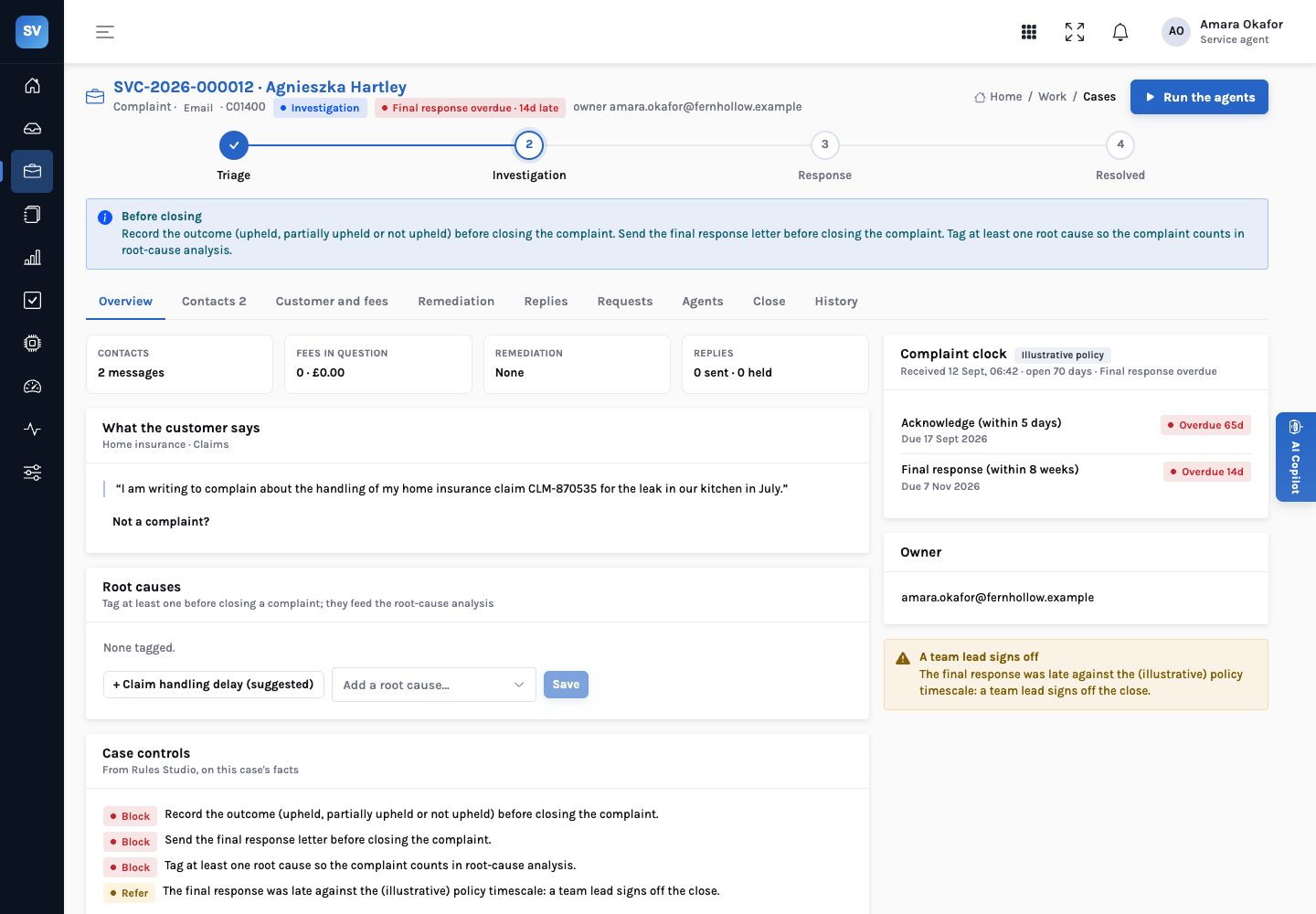
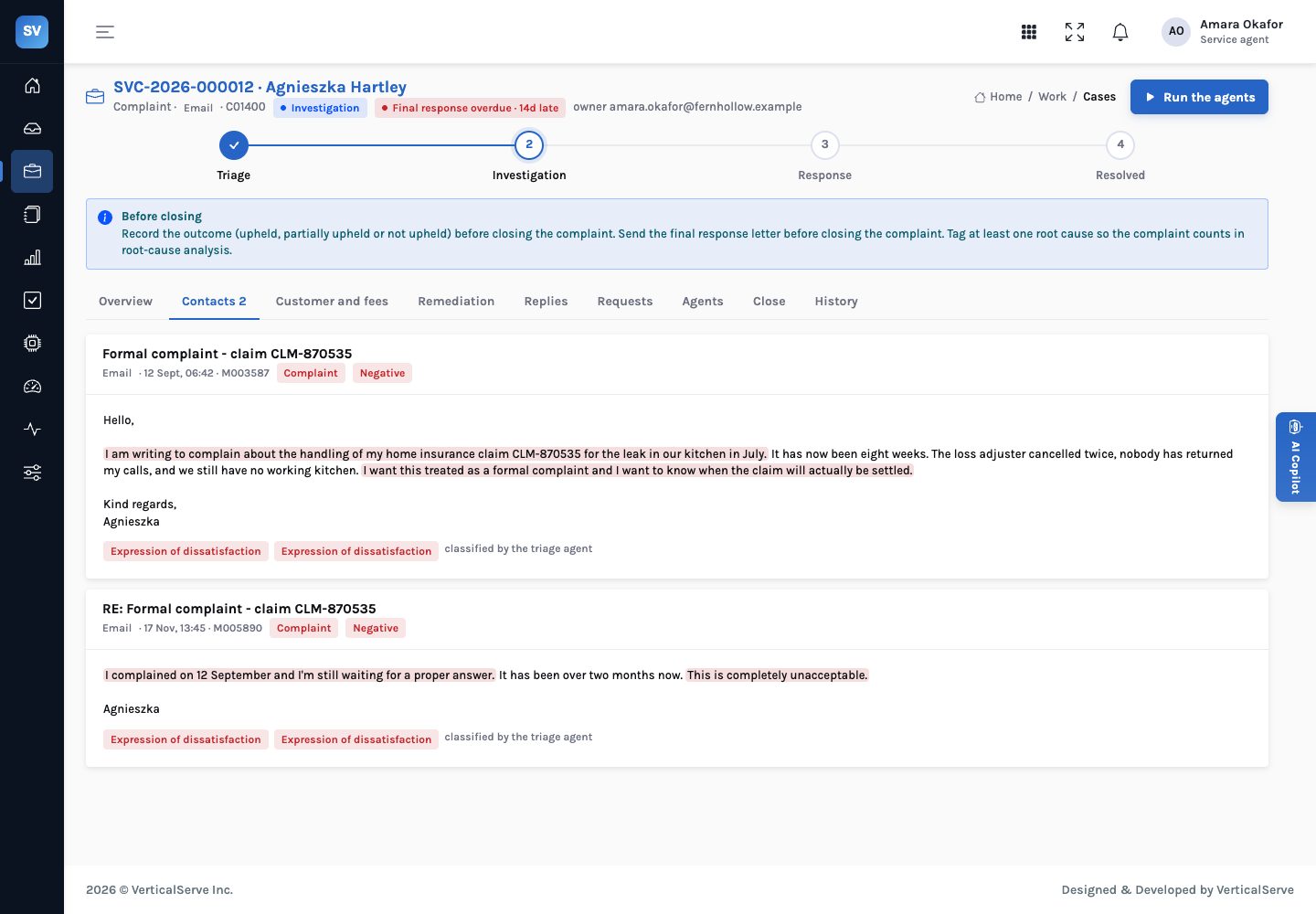
Agnieszka Hartley (a fictional customer of the demo firm) emailed on 12 September about her home insurance claim for a kitchen leak: the loss adjuster had cancelled twice, nobody had returned her calls, and she asked for it to be treated as a formal complaint. On 17 November she wrote again: “I complained on 12 September and I’m still waiting for a proper answer.”
Both deadlines run from the first email. By the time the chaser arrives, the final response is ten days late against the illustrative policy.
Both contacts are on one case, because the second is part of the same thread. The deadlines come from the first: acknowledgement due 17 September, final response due 7 November under the illustrative five-day and eight-week settings. The case shows the final response breached, and the case controls say that a team lead signs off the close. None of that depends on a handler working out the dates.
Questions to ask about your own clocks
The timestamp the contact arrived, or the date a case was opened? If it is the second, every hidden or misrouted complaint starts late.
Payment services, credit card billing errors and other complaints may run on different timescales. Is that decided by a rule or by the handler?
In a policy document, in the case system’s configuration, or in code? Can compliance change them without a release, and is the change recorded?
Does a late case close like any other, or does someone senior look at it before it closes?
QA that recalculates the acknowledgement and final-response dates finds late cases that a re-read of the file misses.
For the head of complaints
A deadline missed because the clock started late is still a missed deadline. Ask how the start date is set before asking how fast the team works.
Keep the timescales your firm commits to in one place that compliance owns, separate from the code that applies them.
For the service operations lead
The queue should sort by what falls due next, acknowledgement or final response, not by when a case was opened.
A breach that needs a lead’s sign-off is a prompt to look at why, not just a second signature.
For the board
Deadline performance is one of the simplest complaint metrics to report and one of the easiest to get wrong. It is only as reliable as the start date and the rule applied.
Ask whether the reported figures are recalculated from the dates or self-reported by the team.
Know which clock you are on, and start it when the customer spoke.
The rules set the outer limits; a firm’s policy sets its own standard inside them. Both change, which is why InsightService computes every deadline from configuration and labels the values it ships with as illustrative.
The clock is also why classification matters so much: it can only run from receipt if the complaint was recognised at receipt.