“My husband Robert passed away in August.” “I lost my job in September and I’m behind on everything.” Sentences like these are rarely the subject of a message. They arrive in the middle of a complaint about fees or letters, and they change how the whole case should be handled. The risk is not that a handler doesn’t care. It is that, on a busy day, the sentence isn’t noticed.
In short
- The FCA expects firms to notice. Its guidance on the fair treatment of vulnerable customers (FG21/1, February 2021) asks firms to understand their customers’ needs, equip staff to recognise vulnerability, and adapt how they respond.
- Vulnerability is about circumstances, not categories of people. The guidance describes four drivers: health, life events, resilience and capability. Any customer can move into, and out of, a vulnerable situation.
- The Consumer Duty raised the stakes. Since 31 July 2023 firms must deliver good outcomes for retail customers, including those with characteristics of vulnerability, and support is one of the outcomes the Duty names.
- Noticing has to be systematic. InsightService quotes each indicator from the customer’s words or record, suggests support from the knowledge base, and won’t let a case close until a person records how it was adapted.
What the guidance asks for
The FCA defines a vulnerable customer as someone who, due to their personal circumstances, is especially susceptible to harm, particularly when a firm is not acting with appropriate levels of care. FG21/1 sets out what firms should do about it, in three broad areas: understanding the needs of their customers, equipping staff with the skills and capability to recognise and respond to those needs, and putting that into practice in product design, customer service and communications. It also asks firms to monitor whether they are achieving good outcomes for these customers.
| Driver in FG21/1 | What it covers | How it can show up in a complaint |
|---|---|---|
| Health | Conditions or illnesses that affect the ability to carry out day-to-day tasks | “I’ve been in and out of hospital, so I’m sorry if I’ve missed letters” |
| Life events | Bereavement, job loss, relationship breakdown and other major changes | “My husband passed away in August” |
| Resilience | Low ability to withstand financial or emotional shocks | “I can’t make my loan payment this month” |
| Capability | Low knowledge of financial matters, low confidence, or difficulty with digital channels | “I’m not good with apps” |
The four drivers are a way of thinking about circumstances, not a form to fill in. The indicators InsightService looks for in a customer’s words line up with them roughly like this:
FG21/1’s drivers on the left; the indicator labels the InsightService classifier quotes on the right. The mapping is ours, for illustration; a customer’s circumstances often touch more than one driver.
The Consumer Duty, in force for open products since 31 July 2023, reinforces this. Firms must act to deliver good outcomes for retail customers, and the Duty’s consumer support outcome expects support that meets customers’ needs, including those with characteristics of vulnerability. In a complaint, that means the handling itself (the tone of the reply, the channel, whether to pause collections or letters, who else may speak for the customer) should reflect what the customer has told the firm.
Guidance, not a checklist
FG21/1 is guidance on how firms should meet their existing obligations, and the Consumer Duty is set out in PRIN 2A and the FCA’s accompanying guidance. This post summarises the shape of both; read the current texts for the detail that applies to your firm.
Why vulnerability is missed in complaints
Complaint handling is organised around the thing being complained about: a fee, a claim, a payment. The vulnerability is usually incidental to it, which is exactly why it gets lost.
- It isn’t the subject. The email is headed “My late husband’s account” or “Struggling with payments” if the firm is lucky, and “Fees” if it isn’t.
- It is on the record but not on the case. A customer told the firm about a health condition months ago; the note sits on the customer record, and nobody handling this complaint sees it.
- The case closes on the money. The fee is refunded, the letter goes, the case closes, and nothing records whether the handling was adapted, so nobody can show it was.
In InsightService, an indicator from either the message or the record follows the case through to the close and to QA.
How InsightService handles it
The same classifier that spots dissatisfaction also looks, sentence by sentence, for indicators of vulnerability. It recognises eight kinds, each with its own label: bereavement, financial difficulty, physical health, mental health, caring responsibilities, communication needs, digital or age-related difficulty, and abuse or coercion. Each indicator is recorded with the sentence it came from, so the handler sees the customer’s words, not a score.
When a case opens, InsightService also reads the customer’s record in the firm’s systems. An indicator already on file joins the case, quoted as “On the customer’s record since” the date it was noted. A case with any indicator is marked vulnerable and given high priority in the queue.
The sentence is stored with the indicator’s label: “Bereavement: My husband Robert passed away in August.”
An indicator on the customer’s record joins the case, with the date it was noted.
The agent quotes the indicators and suggests how to adapt the case from the firm’s knowledge-base articles on support, such as “Support after a bereavement” or “If you’re struggling financially”. It prepares the note; it doesn’t record it.
A person writes how the case is being adapted. Without it, the case control “Vulnerability not addressed” blocks the close.
Drafted replies include a line pointing to the relevant support article, cited, and are held until a person sends them.
“Vulnerability recorded and addressed” is one of the QA checks on every sampled case, and a vulnerable case is always sampled.
Two cases from the demo
A bereavement and a process failure
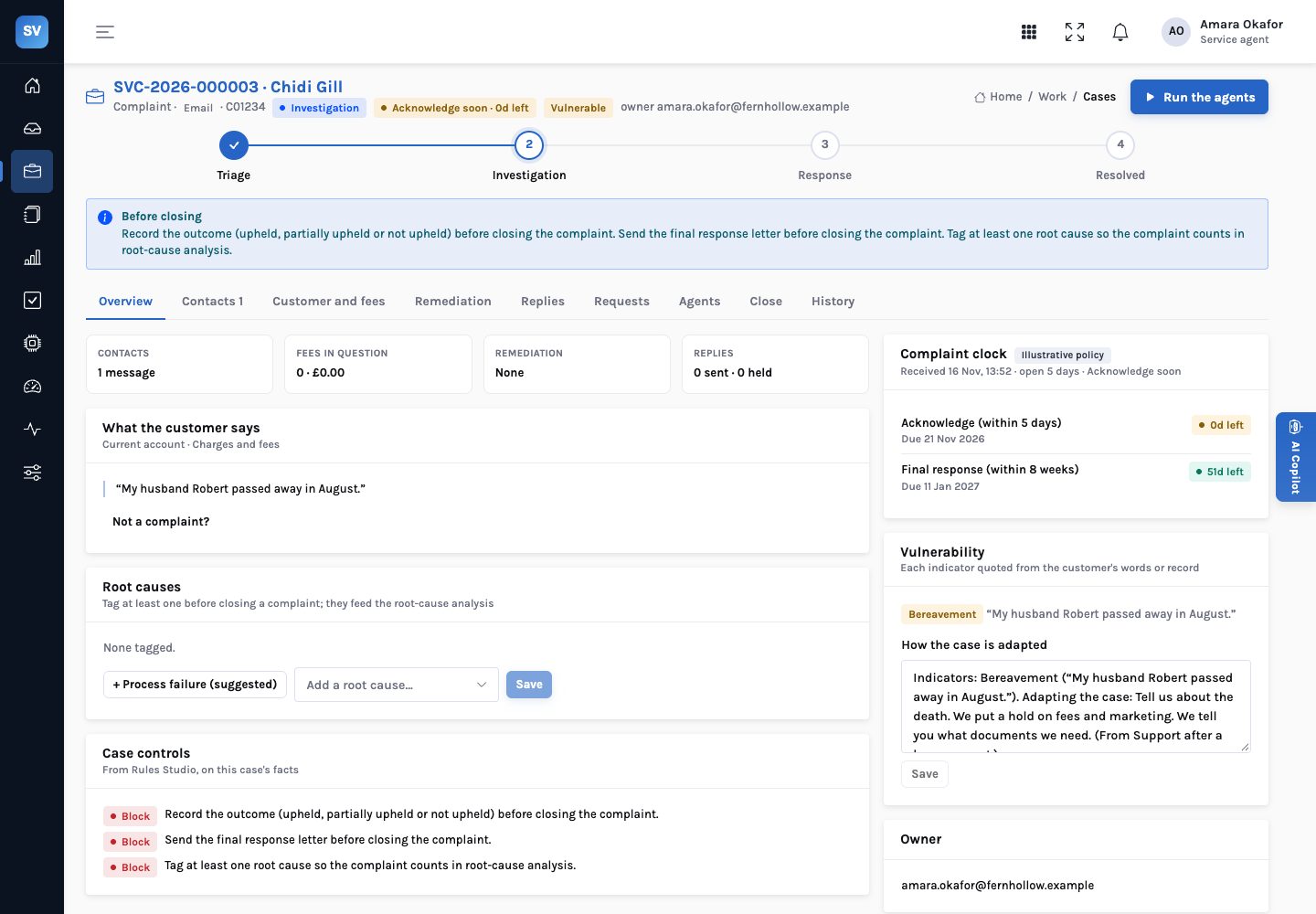
Chidi Gill (a fictional customer of the demo firm, Fernhollow Bank & Insurance) wrote that her husband had died in August, that she had sent the death certificate twice, and that she kept receiving letters addressed to him about fees on their joint account: “it is very upsetting every time one arrives.” The classifier made it a complaint and quoted the bereavement. The case researcher suggested a root cause of process failure. The case opens with the indicator in the Vulnerability panel and an empty box for how the case is adapted, and the controls list it as one of the things that block closing.
A customer in financial difficulty
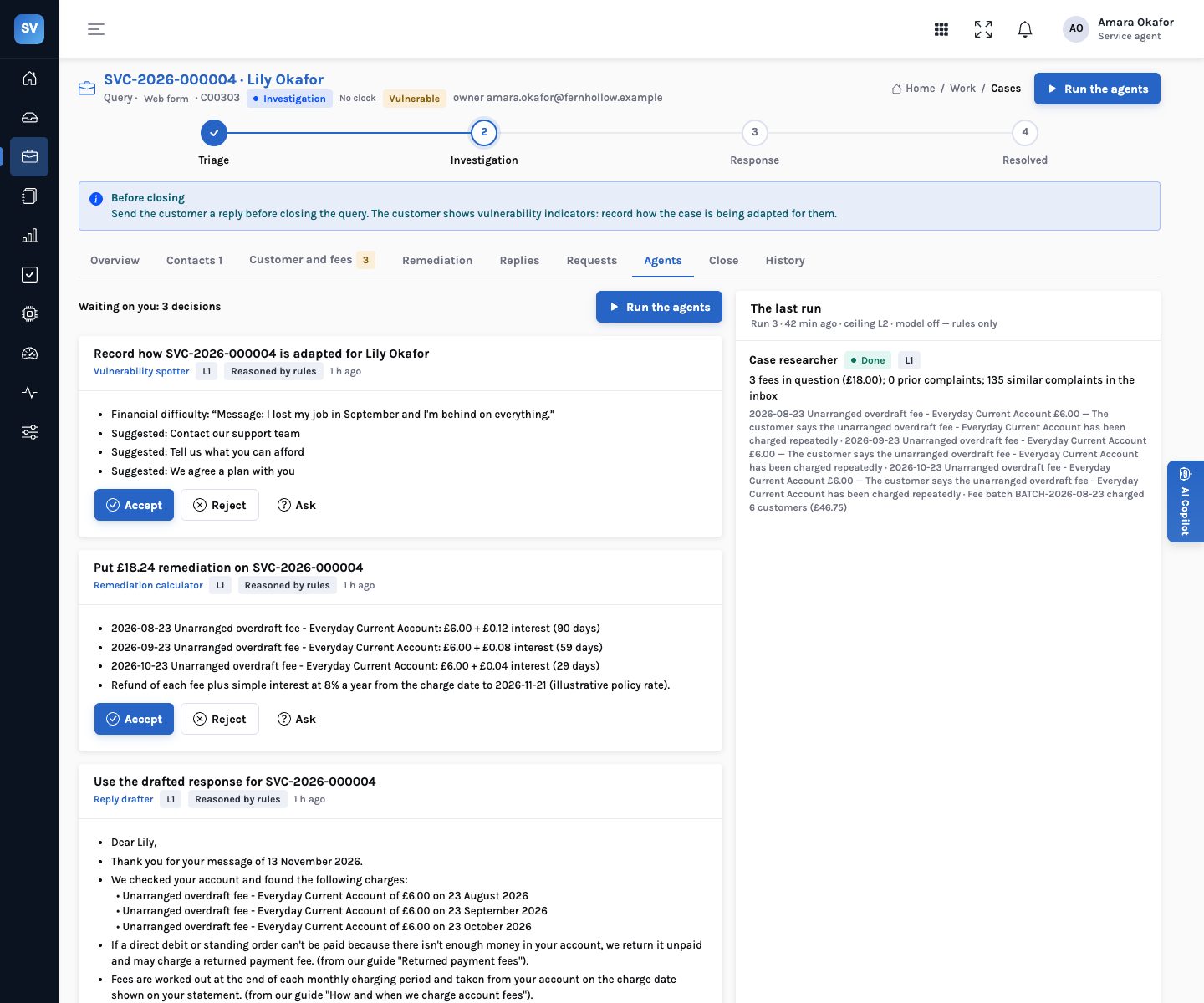
Lily Okafor (fictional) used a web form: “I lost my job in September and I’m behind on everything. I’ve had overdraft fees every month since and I can’t make my loan payment this month either.” The classifier recorded it as a query, not a complaint (nothing in it expresses dissatisfaction with the firm), but quoted the financial difficulty. A query has no complaint clock, but it still can’t close until someone replies and records how the case is adapted.
On the case, the agents prepared three things for the service agent to accept, reject or ask about: the adaptation, with the indicator quoted and three suggested steps from the knowledge base; a refund of the three £6.00 overdraft fees with interest at the illustrative 8% rate, £18.24 in all; and a drafted response listing the fees.
Whether to refund is still a person’s decision
The remediation calculator works out what a refund of the fees in question would be; it doesn’t decide that a refund is right. For a customer in financial difficulty the right answer may be more, or different: a payment plan, a pause, a referral to debt advice. The interest rate and the approval threshold in the demo are illustrative, configurable policy.
What a good adaptation note looks like
The control only checks that a note exists; QA and the customer find out whether it was any good. A useful note says what changes, not just that the customer is vulnerable.
Restates the indicator. Says nothing about what the firm did differently, so neither a reviewer nor the ombudsman can tell whether the handling was appropriate.
Specific, checkable actions. A reviewer can confirm each one happened, and the next handler knows how to continue.
Who can see what
Vulnerability information is sensitive personal data in many cases, and it should be visible to people who need it to handle the case well, not spread across reports. In InsightService the indicators sit on the case and the customer record that the firm already holds; the root-cause analysis counts complaints by cause and product, not by vulnerability. How long the notes are kept and who can read them is a matter for the firm’s own data protection policy.
What this means for each reader
For the head of complaints
Ask how a vulnerability disclosed in the middle of a complaint reaches the handler, and how you would show that the handling was adapted. If the answer is a free-text field nobody has to fill in, the evidence is thin.
Sampling every vulnerable case for QA, rather than a random share of them, is a cheap way to see whether adaptations are real.
For the service operations lead
Make the adaptation a step the case can’t skip, not an optional note. Give handlers the firm’s own support wording so the reply says the same thing the policy does.
Check that indicators on the customer record reach the case: the customer shouldn’t have to tell you twice.
For the board
Under the Consumer Duty, outcomes for customers with characteristics of vulnerability are something the board should be able to see. That needs the indicators and adaptations recorded consistently enough to count.
A complaint is often the moment a firm first learns about a customer’s circumstances. How it responds is a test of the policy.
Notice the sentence. Write down what you changed. Check it afterwards.
Vulnerability rarely announces itself. It is one sentence in a longer message, or a note on a record from months ago. A system that quotes the sentence, brings the record onto the case and won’t close without an adaptation makes noticing routine rather than heroic.
The decisions stay with people: what support to offer, whether to refund, how to reply. The system makes sure they are asked.