Ask a contact centre how many complaints it received last month and you will get a number. Ask how many of its customers expressed dissatisfaction last month and nobody knows, because most of that dissatisfaction arrived inside a request for a statement, a change of address or a question about a fee. The regulator’s definition of a complaint is built around the second number, not the first.
In short
- The definition is deliberately broad. In the UK, a complaint is any oral or written expression of dissatisfaction, whether justified or not, about a financial service, which alleges the complainant has suffered, or may suffer, financial loss, material distress or material inconvenience.
- The customer doesn’t have to use the word. “Fed up that nobody called me back” in the middle of a statement request is a complaint. So is “that’s not right is it? i want my money back” in a chat.
- Classification starts a clock. Once a contact is a complaint, deadlines run from when it was received, not from when someone noticed it. A hidden complaint found a week late has already lost a week.
- The fix is evidence, not volume. Every classification should quote the sentence it rests on, so a person can confirm or correct it in seconds, and the correction is recorded.
What the definitions say
The UK Financial Conduct Authority’s Handbook defines a complaint, for the purposes of its Dispute Resolution sourcebook (DISP), as any oral or written expression of dissatisfaction, whether justified or not, from or on behalf of a person about the provision of, or failure to provide, a financial service or a redress determination, which alleges that the complainant has suffered (or may suffer) financial loss, material distress or material inconvenience.
Three parts of that sentence do most of the work. Any expression means there is no required form: no “formal complaint” wording, no complaint form, no particular channel. Oral or written means a phone call and a chat message count as much as a letter. Whether justified or not means the firm cannot decide something isn’t a complaint because the customer is wrong; that is what the investigation and the outcome are for.
Other regimes draw the line in different places. In the United States, the Consumer Financial Protection Bureau runs a complaint portal and sets expectations for how companies respond to complaints submitted through it, while specific rules such as Regulation E (electronic fund transfers) and Regulation Z (billing errors on credit cards) define “errors” the consumer can assert and the timescales for resolving them. A firm operating in several jurisdictions needs to know which definition and which clock applies to which contact, which is a good reason to keep both in configuration rather than in a handler’s memory.
Read the rules that apply to you
This post summarises the shape of the definitions. The exact wording, exclusions and the firms and activities in scope differ by regime and change over time. Check the current text of the rules that apply to your firm before relying on any summary, including this one.
Where complaints hide
If complaints always arrived with “I want to make a formal complaint” at the top, nobody would miss them. In practice a large share arrive as something else. The customer has a task they need done, and the dissatisfaction is one sentence on the way.
The demo firm in InsightService, Fernhollow Bank & Insurance (fictional, with invented customers), has examples of each pattern among its inbound contacts:
| How it arrived | What the customer wanted | The sentence that makes it a complaint |
|---|---|---|
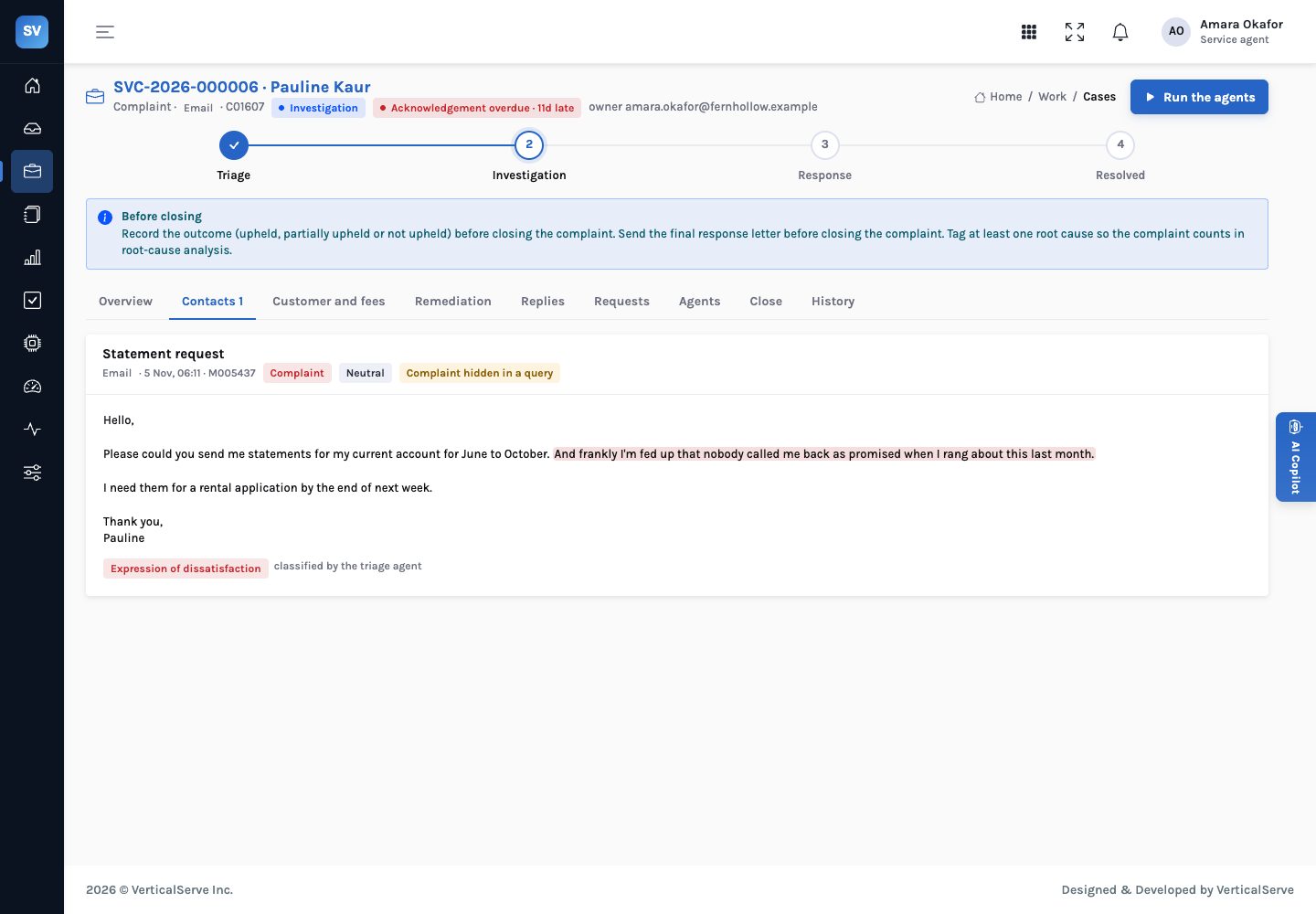
| Email headed “Statement request” | Statements for June to October for a rental application | “And frankly I’m fed up that nobody called me back as promised when I rang about this last month.” |
| Web form, reason “Change of address” | A new address on her savings account and home insurance | “I’m also not happy that I tried to do this in the app three times and it failed every time, which is ridiculous in 2026.” |
| Chat transcript | Two overdraft fees on the same day looked at | “thats not right is it? i want my money back, not happy” |
| Call note written by an adviser | A claim decision reviewed | “Disputes decline of CLM-354836 … Cust dissatisfied.” |
The first two are the hard ones. The subject line is routine, the first sentence is routine, and the last sentence is routine. Someone triaging by subject line, or reading the first two lines of each message in a busy queue, routes them to a service team. The service team changes the address, sends the statements and closes the request. The dissatisfaction is never recorded, the deadline is never started, and the root cause (a promised call-back that didn’t happen, an app journey that fails) never reaches the people who could fix it.
The same email, triaged two ways. Only one of them produces a complaint record, a deadline and a root cause.
Why under-recording is expensive
Missing a hidden complaint is not a clerical error with no consequence. Each one is several failures at once.
- A deadline that started without you. Timescales run from when the complaint was received. If it is recognised a week later, a week of the time allowed has already gone.
- A customer who never got an answer to what they were unhappy about. The statement arrives; the apology for the missed call-back doesn’t. The second contact is usually angrier, and sometimes goes straight to the ombudsman.
- Root-cause data with holes in it. DISP 1.3.3R expects firms to identify and remedy recurring or systemic problems. A complaint that was never recorded can’t be counted, so the app journey that fails three times in a row looks rarer than it is.
- Management information that flatters. Complaint volumes reported upwards (and, in the UK, to the regulator in complaints returns) are only as good as the classification underneath them.
Routes “complaint” and “unhappy” in the subject to the complaints team. Misses anything phrased as a request, and anything where the dissatisfaction is in the fourth sentence.
Each sentence is scored against a lexicon of dissatisfaction. The sentence that carries the most weight is quoted on the case as the reason, and a hidden complaint is marked as hidden so a person looks twice.
How InsightService classifies a contact
InsightService copies the firm’s inbound emails, web forms, chat transcripts and call notes into one inbox and classifies each one. The classifier is deterministic and explainable: the same message gives the same answer, and every finding is tied to the sentence it rests on.
In a chat transcript, only the customer’s lines count. An adviser saying “sorry you’re unhappy” is not the customer expressing dissatisfaction.
Emails, form fields, chat lines and call-note sentences each become a unit that can be quoted on its own.
Phrases such as “fed up”, “not happy”, “charged twice”, “nobody called me back” or “I want this complaint looked into” carry weights. Enough weight, and no “this is not a complaint”, makes the contact a complaint.
The sentence that carries the most weight becomes the complaint quote, shown on the inbox, the case and the agent’s summary.
A single dissatisfied sentence inside a routine request, under a routine subject, that isn’t the opening line, is marked “hidden in a query”.
The same pass records what the customer wants, which product it concerns, the sentiment, and any vulnerability indicators, each quoted.
Whether a case is a complaint is a person’s call. A correction needs a reason and goes on the record; making a case a complaint starts the clock from the first contact’s receipt.
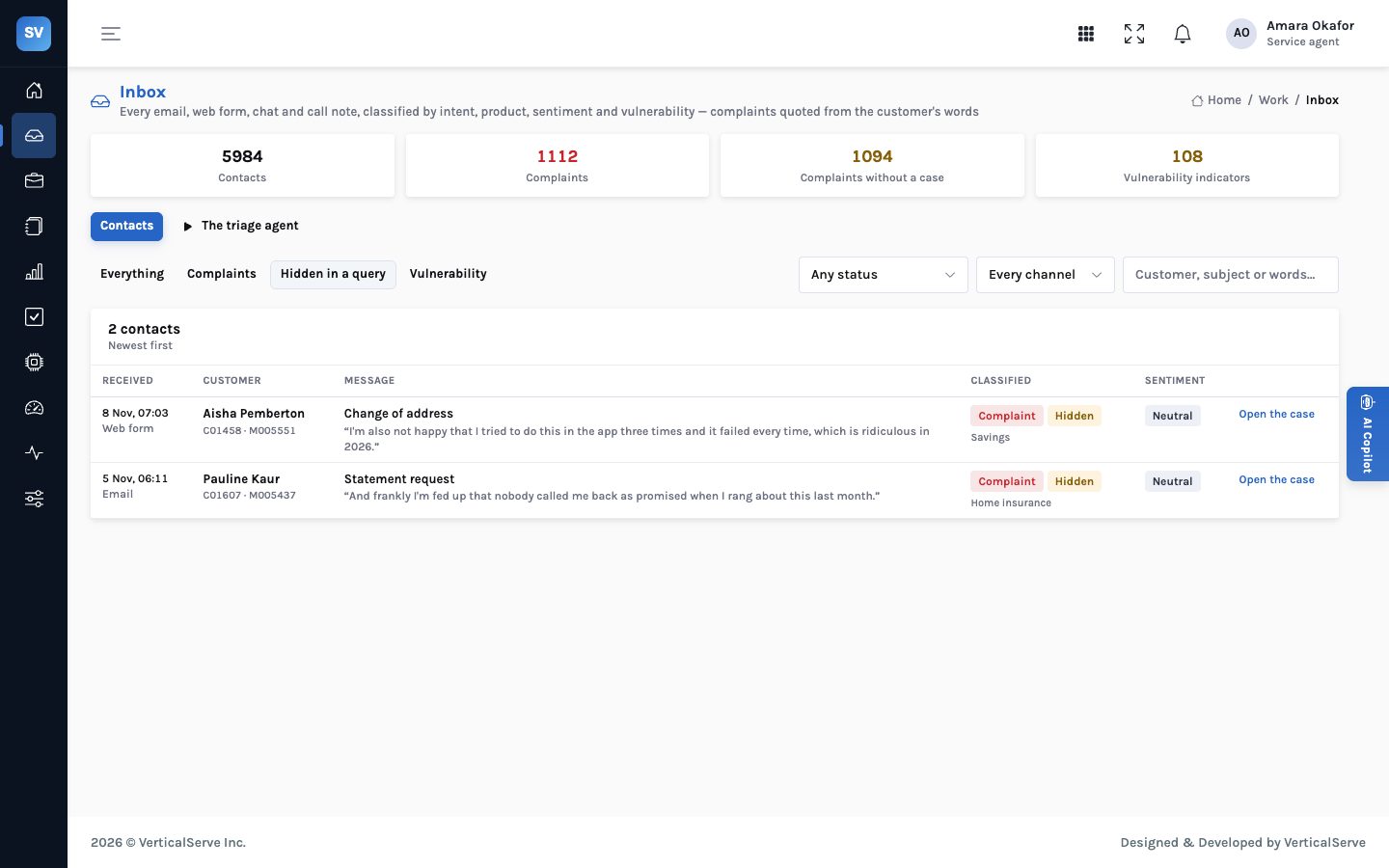
Opened, the statement request shows exactly why it was classified as it was: the dissatisfied sentence is highlighted in the customer’s own email, tagged as an expression of dissatisfaction, and the contact is labelled as a complaint hidden in a query.
A person decides, and can say “not a complaint”
A broad definition creates the opposite risk too: treating every grumble about the weather as a complaint clogs the queue and dilutes the data. InsightService doesn’t settle that by making the classifier cleverer. It settles it by making the classifier’s reasoning visible and leaving the decision with a person.
- On the inbox, a contact can be corrected to “not a complaint” or “actually a complaint”, with a reason. The original classification and who changed it are kept.
- On the case, the “Not a complaint?” control under the quote does the same. Turning a query into a complaint sets the acknowledgement and final-response deadlines from when the first contact was received.
- Once replies have gone out on a complaint, it stays a complaint. A case can’t be quietly reclassified to make a missed deadline disappear.
- Agents can’t decide it. The triage agent can prepare “treat this case as a complaint: it is hidden in a service request”, but the code refuses the classification change when the actor is an agent.
The classifier and the triage agent propose; the service agent decides, and either answer is recorded.
A lexicon is a starting point, not a finished product
The phrases and weights InsightService ships with are a starting point a firm tunes to its own customers and channels. Every decision the classifier makes is quoted, so tuning is a matter of reading the corrections people made, not guessing what a model was thinking.
What this means for each reader
For the head of complaints
The question to put to your operation is not “how many complaints did we get?” but “how would we know about one that arrived as a statement request?” If the answer is a person reading every message closely, ask how that holds on a Monday morning.
Corrections are your best tuning data. A sample of contacts people reclassified, with their reasons, shows where the lexicon is too eager and where it misses.
For the service operations lead
Hidden complaints change the shape of the queue: a request routed to a service team may need to come back to complaints with a deadline already running. Routing on the classification, not the channel, avoids the hand-back.
Each classification carries its quote, so a handler confirms or corrects in seconds rather than rereading the whole thread.
For the board
Under-recorded complaints make complaint metrics look better than the customer experience they describe. Board reporting is only as reliable as the classification beneath it.
The fix is visible evidence for every classification, not a larger complaints team.
A complaint is whatever the customer was unhappy about, wherever they said it.
The definition puts the burden on the firm to notice. That is a reading problem, sentence by sentence, across every channel, and it is the kind of reading software does well, provided every finding is quoted and a person makes the call.
The next post looks at what happens once a contact is a complaint: the clocks, which rules set them, and why InsightService treats every deadline as configurable policy.